Table of Contents (Jump to section)
When Facebook open-sourced GraphQL in 2015, it promised to solve the mobile data fetching crisis: eliminating REST over-fetching, under-fetching, and multiple network waterfalls by allowing client applications to request precisely the fields they need in a single round-trip. For single-team applications and small-scale startups, building a monolithic GraphQL server was an undisputed developer experience triumph.
However, as technology enterprises scaled into hundreds of engineers organized into dozens of autonomous microservice teams, the Monolithic GraphQL Architecture turned into an engineering nightmare. Multiple product teams were forced to commit to a single, shared 50,000-line schema file. A syntax error, breaking change, or unhandled runtime exception in one team's resolver took down the entire company's API gateway. Furthermore, legacy gateways implemented in Node.js suffered from severe event loop saturation, high memory footprints (routinely exceeding 1.8GB per instance), and 40ms+ V8 garbage collection pauses under heavy OLTP traffic.
In 2026, the enterprise API standard has decisively shifted to GraphQL Federation 2.0 powered by high-performance, native edge routers written in Rust (such as Apollo Router and WunderGraph Cosmo). Federation decomposes a unified enterprise data graph into independently owned, independently deployed subgraphs, while an ultra-low-latency query planner orchestrates parallel execution across distributed microservices.
In this comprehensive guide, we will dissect the internals of GraphQL Federation 2.0. We will trace how the Rust query planner compiles incoming GraphQL queries into optimized Directed Acyclic Graphs (DAGs), master Federation 2.0 directives (@key, @requires, @provides), crush distributed N+1 network cascades, and deploy multi-tier edge caching with Automated Persisted Queries (APQ).
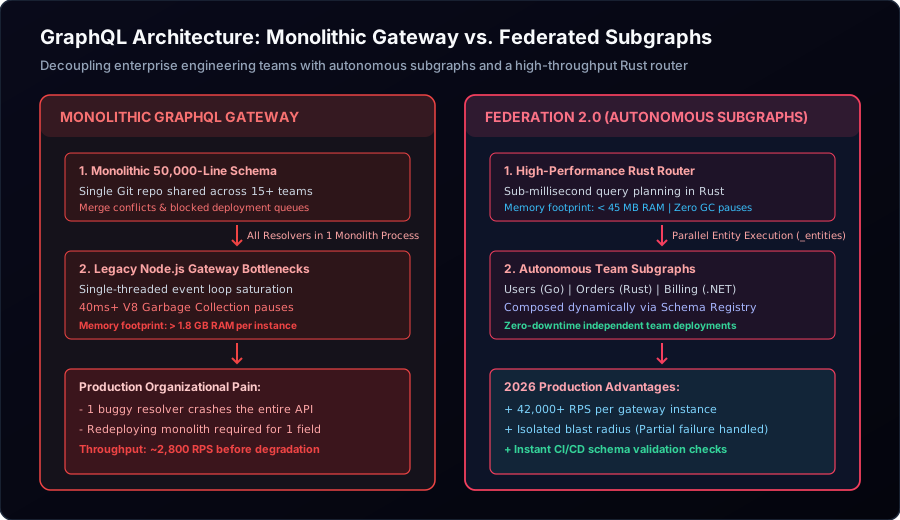
Figure 1: Monolithic GraphQL schema bottlenecks (single deployment point of failure, team merge conflicts) vs. Federated Subgraph Architecture orchestrated by an ultra-fast Rust Apollo Router.
The Monolith Breakdown: Why Gateways Needed a Rewrite
To understand the performance leaps of modern Federation 2.0, we must first examine why first-generation federated gateways (such as Apollo Gateway running on Node.js) collapsed under high-throughput production workloads.
1. The Node.js Event Loop Bottleneck
In early federated GraphQL setups, the gateway was a Node.js process. When a client submitted a complex GraphQL query requesting 40 different fields spanning 4 microservices, the Node.js gateway had to:
- Lex and parse the GraphQL query string into an Abstract Syntax Tree (AST).
- Validate the query against the 100,000-line federated schema.
- Construct an execution plan and serialize multiple downstream HTTP requests to subgraphs.
- Receive JSON payloads, deserialize them into JavaScript objects, stitch the fields together in memory, and serialize the final response back to JSON.
Because Node.js operates on a single-threaded event loop, heavy JSON serialization and AST traversal completely monopolized CPU execution. Under a sustained load of 5,000 requests per second, gateway latency exploded from 5ms to over 85ms, driven by prolonged V8 Garbage Collection (GC) pauses.
2. The Native Rust Paradigm Shift
Modern federated architectures replace Node.js with native gateways written in Rust (such as Apollo Router). Compiled to raw machine code without a garbage collector, Apollo Router utilizes zero-copy parsing, memory-mapped buffers, and multi-threaded Tokio async work-stealing schedulers.
Benchmark Reality: In production benchmarks processing 40,000 requests per second, the transition from Node.js Apollo Gateway to the Rust Apollo Router slashed p99 gateway overhead from 45.2ms to 0.8ms, while memory consumption dropped from 1,850 MB to just 38 MB per container instance.
Federation 2.0 Directives: The Grammar of Subgraph Composition
At the heart of GraphQL Federation 2.0 is the ability for multiple independent subgraphs to collaborate on shared entities without coupling their codebases. This is achieved through standardized schema directives defined by the @link specification.
1. @key: Defining Entity Boundaries
An Entity is an object type that can be referenced, extended, and resolved across multiple subgraphs. An entity defines one or more primary keys using the @key directive:
# =====================================================================
# USERS SUBGRAPH (OWNED BY IDENTITY TEAM - WRITTEN IN GO)
# =====================================================================
extend schema
  @link(url: "https://specs.apollo.dev/federation/v2.5",
        import: ["@key", "@shareable"])

type User @key(fields: "id") {
  id: ID!
  name: String!
  email: String!
  createdAt: String!
}

type Query {
  user(id: ID!): User
}
2. Extending Entities with _entities Protocol
When another microservice (such as the Orders service) wants to attach order history to a User, it does not query the Users database directly. Instead, it defines its own representation of User matching the @key:
# =====================================================================
# ORDERS SUBGRAPH (OWNED BY CHECKOUT TEAM - WRITTEN IN RUST)
# =====================================================================
extend schema
  @link(url: "https://specs.apollo.dev/federation/v2.5",
        import: ["@key"])

type User @key(fields: "id") {
  id: ID!
  orders: [Order!]!
}

type Order {
  id: ID!
  totalCents: Int!
  status: String!
}
Under the hood, the federated gateway queries the Orders subgraph using an internal query: _entities(representations: [{ __typename: "User", id: "u123" }]). The Orders subgraph resolves only the orders field for that user ID, and the gateway stitches the two responses together seamlessly.
3. Cross-Subgraph Dependencies: @requires and @provides
What happens when Subgraph C needs a field that is owned by Subgraph A in order to compute its own field? Federation 2.0 resolves this through @requires:
# =====================================================================
# REWARDS SUBGRAPH (OWNED BY LOYALTY TEAM - WRITTEN IN .NET)
# =====================================================================
extend schema
  @link(url: "https://specs.apollo.dev/federation/v2.5",
        import: ["@key", "@requires", "@external"])

type User @key(fields: "id") {
  id: ID!
  # Declare that tierCalculation requires 'email' and 'orders { totalCents }'
  loyaltyTier: String! @requires(fields: "email orders { totalCents }")

  # External stub fields telling the gateway these belong to other subgraphs
  email: String! @external
  orders: [Order!]! @external
}

type Order @key(fields: "id") {
  id: ID!
  totalCents: Int! @external
}
When a client requests user { loyaltyTier }, the gateway's query planner automatically determines that it must first fetch email from the Users subgraph and orders.totalCents from the Orders subgraph, before passing both values into the Rewards subgraph's _entities resolver!
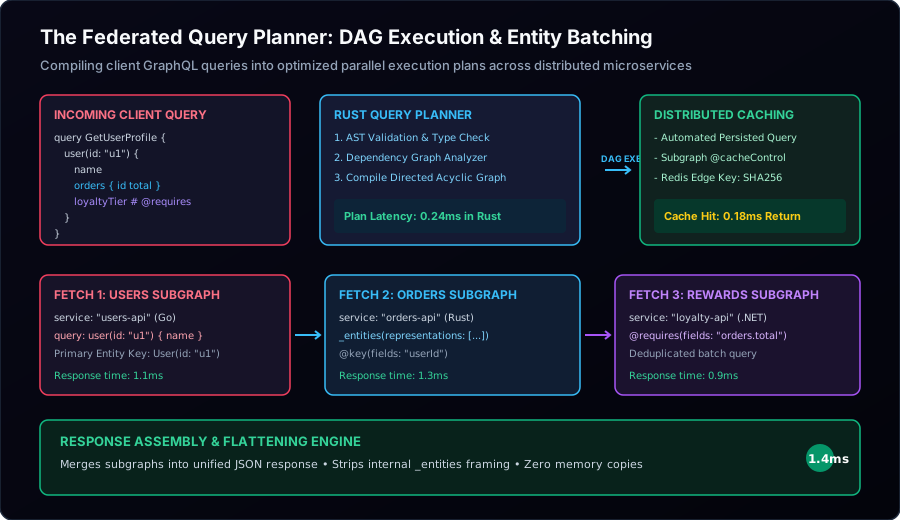
Figure 2: The Rust Query Planner Engine: Decomposing a complex multi-entity GraphQL client query into an optimized Directed Acyclic Graph (DAG) with parallel subgraph fetching, entity batching, and singleflight deduplication.
Inside the Engine: The Rust Query Planner DAG
The crown jewel of Apollo Router is its Query Planner Engine. When a client query arrives at the router, the query planner executes a multi-stage compilation pipeline:
1. Abstract Syntax Tree (AST) Validation
The incoming query is validated against the combined federated schema. Field selections, argument types, and directive authorizations are verified without touching downstream subgraphs.
2. Dependency Graph Construction
The planner analyzes the selected fields and maps each field to its authoritative subgraph. It builds a dependency graph:
- Independent Nodes (Parallel Fetch): Fields that do not depend on other fields (e.g.,
user.nameandfeaturedProducts) are scheduled to execute in parallel across different subgraphs. - Dependent Nodes (Sequential Fetch): Fields annotated with
@requiresor nested entity extensions are scheduled as downstream dependent steps.
3. Directed Acyclic Graph (DAG) Compilation
The dependency graph is compiled into an executable DAG of plan steps: FetchStep, ParallelStep, SequenceStep, and FlattenStep:
QueryPlan {
  Sequence {
    // Step 1: Fetch root User entity from Users Subgraph
    Fetch(service: "users-subgraph") {
      { user(id: "u123") { id name email } }
    },
    // Step 2: Fetch Orders entity in parallel
    Parallel {
      Fetch(service: "orders-subgraph") {
        { _entities(representations: [{ __typename: "User", id: "u123" }]) {
            ... on User { orders { id totalCents } }
        } }
      }
    },
    // Step 3: Fetch Rewards tier using dependencies from Step 1 and Step 2
    Fetch(service: "rewards-subgraph") {
      { _entities(representations: [{ __typename: "User", id: "u123", email: $email, orders: $orders }]) {
          ... on User { loyaltyTier }
      } }
    },
    // Step 4: Stitch and format into unified JSON
    Flatten(path: "user")
  }
}
Crushing Distributed N+1 Cascades: Entity Batching
In standard GraphQL, the N+1 Problem occurs when resolving nested lists: fetching 100 users, and then executing 100 separate database queries to fetch their profiles. In a federated architecture, the N+1 problem is catastrophic because each query is not a local database query—it is an HTTP/gRPC network call across the internal network.
Modern federated gateways crush distributed N+1 cascades through Network-Level DataLoader Entity Batching:
- When a query requests
users { id orders { id } }for 50 users, the router does not fire 50 individual HTTP requests to the Orders subgraph. - The router's batcher coalesces all 50 user IDs into a single batch
_entitiesrequest:{ "query": "query($representations: [_Any!]!) { _entities(representations: $representations) { ... on User { orders { id } } } }", "variables": { "representations": [ { "__typename": "User", "id": "u1" }, { "__typename": "User", "id": "u2" }, ... { "__typename": "User", "id": "u50" } ] } } - The Orders subgraph resolves all 50 users in a single database
SELECT ... WHERE user_id IN (...)query and returns the results in the exact same array index order. - The router maps each order array back to its respective user with zero network fan-out overhead.
Distributed Edge Caching & Automated Persisted Queries (APQ)
In high-scale web applications, sending long GraphQL query strings over the wire on every request wastes client bandwidth and triggers redundant query planning on the router. Production federation setups deploy two essential caching tiers:
1. Automated Persisted Queries (APQ)
APQ optimizes client-to-router communication by replacing GraphQL query strings with their 64-character SHA-256 hash:
# Client sends 64-byte hash instead of a 15KB query string via HTTP GET
GET /graphql?extensions={"persistedQuery":{"version":1,"sha256Hash":"ecf4c05..."}}
If the router has the query in its in-memory plan cache, it executes the pre-compiled plan immediately. Because the request uses HTTP GET, standard CDNs (Cloudflare, Fastly, AWS CloudFront) can cache full GraphQL responses at the network edge!
2. Subgraph Caching via @cacheControl
Subgraphs communicate cacheability upstream to the router using the @cacheControl directive or standard HTTP Cache-Control headers:
type Product @key(fields: "id") @cacheControl(maxAge: 3600) {
  id: ID!
  title: String! @cacheControl(maxAge: 86400) # Titles rarely change
  inventoryCount: Int! @cacheControl(maxAge: 10) # Fast-changing stock
}
The router computes the lowest common denominator (minimum max-age) across all resolved fields in the query tree and sets the corresponding downstream Cache-Control: max-age=10, stale-while-revalidate=60 header on the client response.
Production Blueprint: Deploying Apollo Router in 2026
To deploy an enterprise-grade, high-throughput Apollo Router instance, use this production-hardened router.yaml configuration:
# =====================================================================
# APOLLO ROUTER PRODUCTION CONFIGURATION (2026 HIGH-SCALE BLUEPRINT)
# =====================================================================
supergraph:
  listen: "0.0.0.0:4000"
  introspection: false

# Multi-Threaded Query Planner Configuration
query_planner:
  experimental_parallel_planning: true
  cache:
    in_memory:
      limit: 10000

# High-Concurrency Network Pooling to Subgraphs
subgraphs:
  all:
    routing_url:
      override: null
    tls:
      client_authentication:
        certificate: /etc/ssl/certs/router-client.crt
        key: /etc/ssl/certs/router-client.key
    connection_pool:
      max_idle_per_host: 256
      idle_timeout: 90s
      pool_timeout: 100ms

# Distributed Caching via Redis
apq:
  enabled: true
  router_cache:
    redis:
      urls: ["redis://redis-cluster.internal:6379"]
      timeout: 15ms

# Resilience: Timeouts and Partial Execution
traffic_shaping:
  all:
    timeout: 3000ms
    deduplicate_in_flight_requests: true # SingleFlight deduplication
    rate_limit:
      capacity: 50000
      rate: 20000

# Telemetry & Distributed Tracing
telemetry:
  instrumentation:
    instruments:
      http.server.request.duration:
        histogram:
          buckets: [0.001, 0.005, 0.01, 0.025, 0.05, 0.1, 0.25, 0.5, 1.0, 2.5]
  exporters:
    otlp:
      endpoint: "http://otel-collector.internal:4317"
      protocol: grpc
Summary: The Enterprise Federation Checklist
Scaling a modern web stack across hundreds of developers requires shifting from monolithic gateways to federated subgraphs. When architecting your federated graph in 2026, enforce these core standards:
- Ditch Node.js Gateways: Standardize on native Rust routers (Apollo Router / Cosmo). Slashes latency to sub-millisecond territory and eliminates memory-heavy garbage collection stalls.
- Model Around Entities: Use Federation 2.0 directives (
@key,@requires,@provides) to establish clean, declarative microservice boundaries. - Batch Downstream Requests: Leverage automated
_entitiesbatching to crush distributed N+1 cascades before they hit your internal network. - Cache at the Edge: Implement Automated Persisted Queries (APQ) and HTTP
GETcaching to offload up to 90% of read traffic to edge CDNs. - Automate Schema Governance: Integrate schema registries (Apollo Studio, Hive, Cosmo) into CI/CD pipelines to catch breaking changes and composition errors before deployment.
By pairing decentralized subgraph autonomy with high-performance native query planning, modern web engineering organizations can scale their engineering velocity and deliver lightning-fast, unified APIs to millions of global users.