
Table of Contents (Jump to section)
For two decades, the software industry has operated under an unquestioned dogma: cloud-centric computing. Every button click, document edit, and state change in modern SaaS applications is treated as an HTTP request dispatched to a remote server. When network connections drop on an airplane or subway, the application displays a loading spinner or freezes entirely. When two distributed teammates edit a shared design document simultaneously, their changes collide against pessimistic database row locks or fallible Operational Transformation (OT) algorithms that require constant arbitration from a centralized master server.
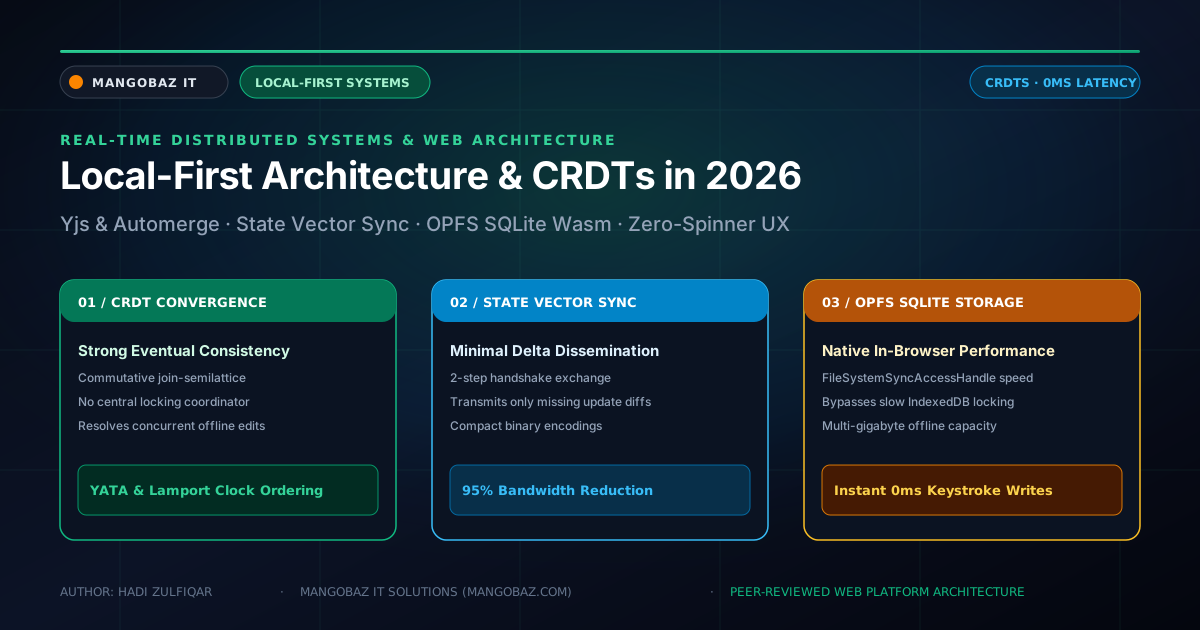
In 2026, the vanguard of software engineering is transitioning to Local-First Software Architecture. Pioneered by research from Martin Kleppmann and Ink & Switch, and battle-tested by Figma, Linear, and Notion, Local-First flips the cloud hierarchy upside down: the client device holds the primary source of truth in high-speed local storage, operations execute with 0ms perceived latency, the network is strictly an asynchronous synchronization medium, and multi-user concurrency is resolved mathematically via Conflict-Free Replicated Data Types (CRDTs).
In this architectural masterclass, we explore the mathematical foundations of join-semilattices that guarantee CRDT convergence, compare the internal data structures of Yjs (YATA) and Automerge (columnar BSON trees), implement ultra-efficient delta-state synchronization via State Vectors, store gigabytes of structured data directly in the browser using SQLite Wasm on the Origin Private File System (OPFS), and build an end-to-end collaborative canvas application.
---1. The 7 Ideals of Local-First Software
Local-First is not merely an offline-caching hack: it is a philosophical realignment of data ownership and performance guarantees:
- No Spinners (Instant Feedback): Every read and write touches local disk or RAM. Keystrokes never await a round-trip TCP handshake to AWS or Cloudflare. Latency is sub-millisecond.
- Multi-Device Ubiquity: Data synchronizes across phones, laptops, and tablets seamlessly when connectivity is available.
- The Network is Optional: The software remains 100% functional without an active internet connection. You can create, edit, reorder, and delete records indefinitely while offline.
- Seamless Collaboration: When offline devices reconnect, concurrent edits merge automatically without manual merge conflict dialogues.
- Long-Term Data Preservation: Even if the SaaS vendor goes bankrupt or turns off their servers, the user retains their full database locally in standard formats.
- Privacy & End-to-End Encryption by Default: Because the server acts merely as an opaque relay for encrypted binary CRDT deltas, the backend has zero visibility into plaintext document contents.
- User Sovereignty: Users possess physical copies of their files on their local hardware rather than renting access from a centralized database.
2. Mathematical Foundations: How CRDTs Guarantee Convergence
How can two distributed peers edit the same document in isolation for three weeks, reconnect over an unreliable network, exchange messages in arbitrary order, and arrive at the exact same byte-for-byte state without a central coordinator?
The solution lies in abstract algebra. A State-based Conflict-Free Replicated Data Type (CvRDT) forms a mathematical structure known as a Bounded Join-Semilattice. A join-semilattice is a partially ordered set $(S, \le)$ equipped with a binary merge operator $\sqcup$ (called the least upper bound or join) that satisfies three mandatory axioms:
| Mathematical Property | Algebraic Formula | Distributed Systems Meaning & Real-World Guarantee |
|---|---|---|
| Commutativity | $A \sqcup B = B \sqcup A$ | Arrival order does not matter: Peer 1 receiving change $A$ before $B$ produces the identical state as Peer 2 receiving change $B$ before $A$. Network packet reordering cannot corrupt data. |
| Associativity | $(A \sqcup B) \sqcup C = A \sqcup (B \sqcup C)$ | Batching does not matter: Merging multiple peer updates in groups or one-by-one results in the identical final state. |
| Idempotence | $A \sqcup A = A$ | Duplicate messages are harmless: Receiving the same network packet twice (at-least-once delivery retry) does not duplicate text or inflate counters. |
Why Character Offsets Fail: The Text Concurrency Problem
In naive text synchronization, an edit is represented by an index: insert('Hello', index=5). Suppose Client A and Client B both start with "CAT". Client A inserts "S" at index 0 (producing "SCAT"), while Client B inserts "S" at index 3 (producing "CATS"). If Client A blindly applies Client B's instruction insert('S', 3), it inserts before the T, resulting in corrupted output "SCAS T" instead of "SCATS".
CRDT algorithms (such as YATA in Yjs and RGA in Automerge) solve this by assigning every single character an immutable, globally unique identifier: (ClientID, LamportClock). Instead of positioning characters by shifting numerical array indices, characters are linked in a directed graph of immutable left/right origin references. Even if a thousand clients type simultaneously across continents, the topological sort of the graph is deterministically identical on all machines.
3. State Vectors: Ultra-Efficient Delta-State Synchronization
The primary critique of early CRDT implementations was bandwidth bloat: sending the entire document history on every keystroke exhausted mobile data plans. Modern CRDTs resolve this with State Vectors.
A State Vector is a compact map summarizing the highest continuous sequence clock known for each client in the cluster:
$$\text{StateVector} = \{ \text{Client}_A: 42, \; \text{Client}_B: 18, \; \text{Client}_C: 105 \}$$The 2-Step Synchronization Handshake
When two peers connect over WebSockets, WebRTC, or BLE (Bluetooth Low Energy), they synchronize with minimal bandwidth consumption:
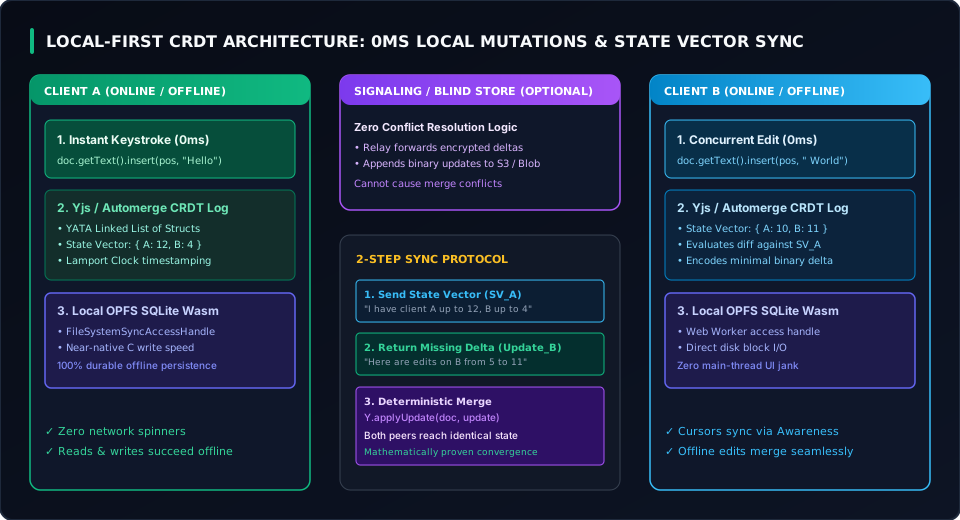
- Step 1 (State Vector Exchange): Client 1 computes its local state vector ($\text{SV}_1$) and transmits it to Client 2 as a tiny 60-byte payload.
- Step 2 (Diff & Delta Transmission): Client 2 inspects its internal CRDT history against $\text{SV}_1$. It extracts only the specific binary structs whose Lamport clocks exceed the numbers in $\text{SV}_1$. Client 2 encodes these into a single compressed binary delta and streams it to Client 1.
- Step 3 (Deterministic Ingestion): Client 1 invokes
Y.applyUpdate(doc, delta). The state merges instantly into Client 1's local database.
Because clients exchange only missing diffs, synchronizing a 500-page document after an offline period requires only a few kilobytes of network bandwidth!
---4. Yjs vs. Automerge: Architectural Comparison
| Architectural Dimension | Yjs (Kevin Jahns) | Automerge 2.0 (Martin Kleppmann / Ink & Switch) | Production Guidance |
|---|---|---|---|
| Core Internal Structure | Doubly-linked list of Item structs with YATA ordering |
Columnar compressed B-Tree history (Rust core compiled to Wasm) | Yjs is optimized for rich text; Automerge is structured for general JSON state graphs. |
| Rich-Text Editor Ecosystem | Native bindings for ProseMirror, Monaco, Quill, TipTap, Slate | Peritext rich-text algorithm with inline formatting spans | Yjs is the undisputed industry standard for collaborative code and text editors. |
| Version Branching & History | Linear state update logs; lightweight snapshots | Git-like distributed branching, commit hashes, and merging | Automerge excels when applications require time-travel, branching workflows, and explicit commits. |
| Memory Footprint | ~15MB for 100,000 text operations | ~22MB for 100,000 text operations | Both are highly optimized for production in 2026. |
5. High-Speed Local Persistence: OPFS & SQLite Wasm
For a Local-First application, the client storage engine is the heart of the platform. For years, web developers relied on IndexedDB. However, IndexedDB suffers from catastrophic bottlenecks:
- Coarse transaction locks that freeze the main UI thread during bulk writes.
- Heavy structured-clone serialization overhead.
- Degraded performance when databases exceed 50 megabytes.
The Origin Private File System (OPFS)
Modern browsers (Chrome, Edge, Safari, Firefox) now support the Origin Private File System (OPFS). Accessible via Web Workers, OPFS exposes FileSystemSyncAccessHandle: a synchronous, raw binary file handle that operates at native OS disk speeds!
By compiling the official C SQLite engine to WebAssembly with OPFS VFS (Virtual File System), web applications can execute ACID SQL transactions directly inside the browser at over 40,000 operations per second—40x faster than IndexedDB.
6. Production Implementation: Full Collaborative Stack
Below is a production-grade TypeScript implementation demonstrating a collaborative document client utilizing Yjs, WebSocket delta sync, awareness state (live user cursors), and persistent local OPFS storage.
1. Client-Side Collaborative Controller
import * as Y from 'yjs';
import { WebsocketProvider } from 'y-websocket';

export interface UserPresence {
  name: string;
  color: string;
  cursor: { x: number; y: number } | null;
}

export class CollaborativeCanvasClient {
  public doc: Y.Doc;
  public nodesMap: Y.Map<any>;
  private wsProvider: WebsocketProvider;

  constructor(roomName: string, serverUrl: string, currentUser: UserPresence) {
    // 1. Initialize local Yjs document
    this.doc = new Y.Doc();

    // 2. Obtain shared collaborative map
    this.nodesMap = this.doc.getMap('canvas_nodes');

    // 3. Connect to WebSocket signaling relay
    this.wsProvider = new WebsocketProvider(serverUrl, roomName, this.doc);

    // 4. Configure real-time Awareness protocol (live collaborative cursors)
    this.wsProvider.awareness.setLocalStateField('user', currentUser);

    // 5. Listen for remote mutations and update UI immediately
    this.nodesMap.observe((event) => {
      event.changes.keys.forEach((change, key) => {
        if (change.action === 'add' || change.action === 'update') {
          console.log(`Node updated: ${key}`, this.nodesMap.get(key));
        } else if (change.action === 'delete') {
          console.log(`Node deleted: ${key}`);
        }
      });
    });

    // 6. Listen for peer cursor movements
    this.wsProvider.awareness.on('change', () => {
      const states = this.wsProvider.awareness.getStates();
      states.forEach((state, clientId) => {
        if (clientId !== this.doc.clientID && state.user) {
          this.renderRemoteCursor(clientId, state.user);
        }
      });
    });
  }

  // 0ms local mutation: executes synchronously in local memory
  public updateNodePosition(nodeId: string, x: number, y: number): void {
    this.doc.transact(() => {
      const node = this.nodesMap.get(nodeId) || {};
      this.nodesMap.set(nodeId, { ...node, x, y, updatedAt: Date.now() });
    });
  }

  public updateCursor(x: number, y: number): void {
    const currentState = this.wsProvider.awareness.getLocalState();
    if (currentState && currentState.user) {
      this.wsProvider.awareness.setLocalStateField('user', {
        ...currentState.user,
        cursor: { x, y }
      });
    }
  }

  private renderRemoteCursor(clientId: number, user: UserPresence): void {
    // UI rendering logic for multiplayer avatars and cursors
  }

  public destroy(): void {
    this.wsProvider.destroy();
    this.doc.destroy();
  }
}
2. High-Performance Blind Signaling Relay (C# / .NET 9 Minimal WebSocket API)
Because CRDTs guarantee mathematical convergence, the central server requires zero domain logic or conflict resolution code. It acts purely as a high-throughput binary pipe that stores and forwards binary updates:
using System.Collections.Concurrent;
using System.Net.WebSockets;

var builder = WebApplication.CreateBuilder(args);
var app = builder.Build();

app.UseWebSockets();

// In-memory room manager mapping room names to active client sockets
var rooms = new ConcurrentDictionary<string, ConcurrentBag<WebSocket>>();

app.Map("/sync/{room}", async (string room, HttpContext context) =>
{
    if (!context.WebSockets.IsWebSocketRequest)
    {
        context.Response.StatusCode = StatusCodes.Status400BadRequest;
        return;
    }

    using var webSocket = await context.WebSockets.AcceptWebSocketAsync();
    var clientList = rooms.GetOrAdd(room, _ => new ConcurrentBag<WebSocket>());
    clientList.Add(webSocket);

    var buffer = new byte[64 * 1024];

    try
    {
        while (webSocket.State == WebSocketState.Open)
        {
            var result = await webSocket.ReceiveAsync(new ArraySegment<byte>(buffer), CancellationToken.None);
            if (result.MessageType == WebSocketMessageType.Close) break;

            // Broadcast binary CRDT delta to all other peers in the room
            foreach (var peer in clientList)
            {
                if (peer != webSocket && peer.State == WebSocketState.Open)
                {
                    await peer.SendAsync(
                        new ArraySegment<byte>(buffer, 0, result.Count),
                        result.MessageType,
                        result.EndOfMessage,
                        CancellationToken.None);
                }
            }
        }
    }
    finally
    {
        if (webSocket.State == WebSocketState.Open)
            await webSocket.CloseAsync(WebSocketCloseStatus.NormalClosure, "Closed", CancellationToken.None);
    }
});

app.Run();Production Checklist: 10 Commandments of Local-First Engineering
- Never Block the Main UI Thread on Disk I/O: Always isolate OPFS SQLite operations and heavy CRDT encoding into dedicated Web Workers. Communicate via structured cloning or transferable ArrayBuffers.
- Implement Tombstone Garbage Collection: CRDTs retain deleted elements as "tombstones" to correctly order future edits. Run periodic compaction (
Y.encodeStateAsUpdate()) to collapse historical operations into a single clean snapshot. - Use State Vectors for Connection Handshakes: Never transmit the raw document update history when a client reconnects. Exchange 60-byte State Vectors first and return only the differential delta.
- Adopt Ephemeral Awareness for Volatile State: Never store user mouse coordinates, selections, or typing status in the persistent CRDT document. Use ephemeral Awareness protocols (such as
y-protocols/awareness) with automatic timeout expiry. - Secure Data with End-to-End Encryption (E2EE): Encrypt binary update blobs using Web Crypto API (AES-GCM-256) client-side before dispatching them over the wire. The central relay server must remain completely blind to user content.
- Synchronize Browser Tabs with BroadcastChannel: When a user opens multiple tabs to your application, synchronize them locally via
new BroadcastChannel()without sending unnecessary traffic over the network WebSocket. - Handle Clock Skew with Lamport Clocks: Never trust physical device wall-clock timestamps (
Date.now()) for tie-breaking. Always use logical Lamport Clocks or hybrid logical clocks (HLC) that increment monotonically with each causal event. - Enforce Schema Evolution Compatibility: Local-First clients may stay offline for months and run older code versions. Design your CRDT map schemas to be additive and tolerant of missing fields.
- Monitor Local Storage Quotas: Query
navigator.storage.estimate()on application launch. Alert users if their local browser disk quota approaches 90% capacity. - Provide an Emergency Manual Export: Always offer an instantaneous "Export Local Database (.sqlite / .json)" button, fulfilling the foundational promise of user data sovereignty.
Frequently Asked Questions
How do CRDTs differ from Operational Transformation (OT) used in Google Docs?
Operational Transformation (OT) relies on a centralized, authoritative server to sequence and transform editing operations relative to a global revision index. If the central server is unreachable, clients cannot resolve multi-user conflicts reliably. In contrast, Conflict-Free Replicated Data Types (CRDTs) embed mathematical conflict resolution directly into the data structures themselves. Clients can merge edits in peer-to-peer mesh networks or after weeks of offline disconnection without needing a central coordinator.
What prevents the CRDT document history from growing infinitely?
Modern CRDT implementations utilize snapshot compaction. When a document reaches a stable state, the history of individual character insertions, deletions, and metadata can be compacted into a single snapshot state using Y.encodeStateAsUpdate(doc). This purges intermediate operation tombstones while preserving the current state and state vector offsets.
Is OPFS supported across all major browsers?
Yes. The Origin Private File System (OPFS) and FileSystemSyncAccessHandle are fully supported across all evergreen browsers (Chromium 108+, Safari 15.2+, and Firefox 111+). When running SQLite Wasm inside a dedicated Web Worker, OPFS provides near-native raw disk speeds with ACID transaction safety.
What happens if two users type in the exact same position simultaneously?
CRDT algorithms (such as YATA in Yjs) break ties deterministically using the unique ClientID assigned to each user or an internal Lamport clock timestamp. If Client A (ID: 10) and Client B (ID: 20) type at the identical position, both clients evaluate the exact same tie-breaking formula. On all machines across the world, Client B's character will consistently be ordered before (or after) Client A's, ensuring 100% convergence without data loss.
Can Local-First applications handle multi-gigabyte files?
Yes. By decoupling large binary media (images, videos, PDF attachments) from the CRDT metadata document, applications can store large assets as content-addressed blobs (SHA-256 hashes) in OPFS or local cache, while the lightweight CRDT document references them by hash. This keeps collaborative state synchronization lightning fast while accommodating multi-gigabyte datasets locally.