Table of Contents (Jump to section)
Every single HTTP request, database connection, mobile API sync, and video stream on the planet begins with a DNS query. Yet for most software engineers and systems architects, the Domain Name System (DNS) is treated as a magical black box: a simple key-value dictionary that translates human-readable names like mangobaz.com into IP addresses like 198.51.100.42.
When systems scale to global traffic, that mental model breaks down completely. How does Cloudflare's 1.1.1.1 or Google's 8.8.8.8 respond from over 300 cities worldwide using the exact same IP address without routing conflicts? Why does changing a DNS record with a 5-second Time-To-Live (TTL) take 20 minutes to propagate across residential ISPs? And how do modern edge networks achieve sub-second failover when a data center goes dark?
The answers lie at the intersection of Border Gateway Protocol (BGP) Anycast routing, EDNS Client Subnet (ECS) geo-steering, and DNSSEC cryptographic chains of trust. In this systems engineering masterclass, we will pull back the curtain on global internet traffic routing, trace raw UDP wire packets, dissect the DNSSEC validation hierarchy, and construct an asynchronous DNS wire protocol parser from scratch.
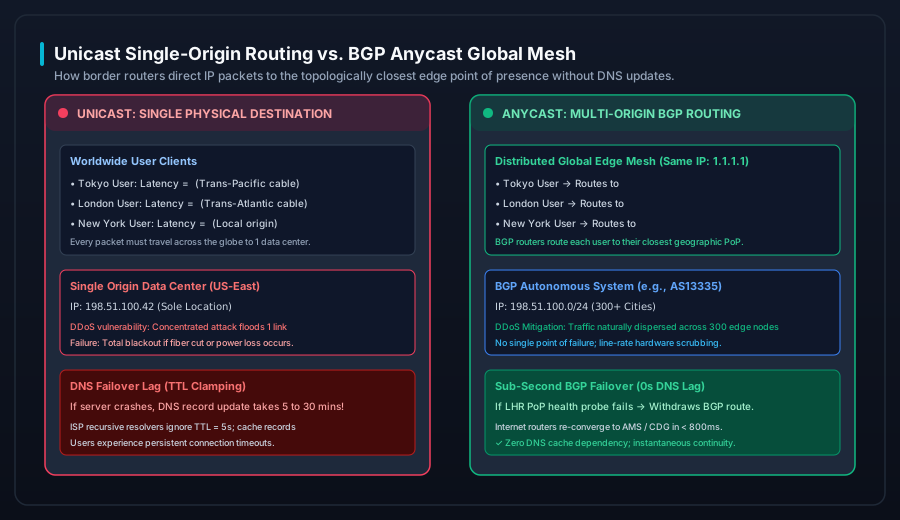 Figure 1: Unicast vs. Anycast BGP routing. Under Anycast, autonomous border routers direct packets to the topologically nearest Point of Presence (PoP), slashing latency and providing automated DDoS absorption.
1. The Hierarchical Resolution Journey: From Root Hints to Authoritative Answers
When a browser resolves api.mangobaz.com, it does not query your web server directly. Unless cached locally, it initiates an iterative resolution journey across the global DNS hierarchy:
- The Stub Resolver & Recursive Resolver: The operating system's stub resolver issues a query to a Recursive Resolver (such as your ISP's nameserver,
1.1.1.1, or8.8.8.8). The recursive resolver does the heavy lifting of walking the tree. - The Root Nameservers (
.): The recursive resolver starts with a hardcoded list of 13 logical root server IP addresses (a.root-servers.netthroughm.root-servers.net, operated by organizations like ICANN, NASA, and Verisign). The root server does not know the IP ofmangobaz.com; it responds with a referral (NS record) pointing to the Top-Level Domain (TLD) servers for.com. - The TLD Nameservers (
.com): The resolver queries the.comregistry nameservers (operated by Verisign). Verisign inspects its registry and returns the authoritative nameservers delegated for the domain (e.g.,ns1.mangobaz.com). - The Authoritative Nameservers: The resolver queries the authoritative nameservers for
mangobaz.com, which hold the final zone file and return the targetA(IPv4) orAAAA(IPv6) record.
2. BGP Anycast: How One IP Exists in 300 Cities Simultaneously
Traditional IP networking is Unicast: one IP address maps to one physical network interface on one specific server in one physical building. If your server is in Virginia, a user in Tokyo must wait 180 milliseconds for packets to traverse trans-Pacific submarine fiber cables.
Modern CDNs, DNS providers, and hyperscalers use BGP Anycast:
The Autonomous System (AS) and BGP Announcements
The internet is not a single network; it is a federation of thousands of independent networks called Autonomous Systems (AS), each identified by an Autonomous System Number (ASN). Networks exchange routing reachability information using the Border Gateway Protocol (BGP, RFC 4271).
Under Anycast, a network operator configures hundreds of edge data centers worldwide to announce the exact same IP prefix (e.g., 198.51.100.0/24) via BGP to their upstream transit providers:
// BGP Route Announcement sent from 300 PoPs globally:
BGP UPDATE:
  Prefix: 198.51.100.0/24
  AS_PATH: 13335 (Cloudflare)
  NEXT_HOP: Edge_Router_IP
When an internet user in London sends a packet to 198.51.100.42, intermediate Tier-1 internet transit routers evaluate their BGP routing tables. They select the path with the shortest AS Path length and best metric. Because the London edge router announced the prefix directly to local Internet Exchange Points (IXPs), the user's packet arrives at the London data center in 4 milliseconds.
Simultaneously, a user in Tokyo querying that exact same IP is routed to the Tokyo edge data center in 3 milliseconds!
3. The Failover Fallacy: Why Low DNS TTLs Fail
A widespread misconception in systems architecture is using DNS record updates for high-availability disaster recovery:
"We will set our DNS A-record TTL to 5 seconds. If our primary data center catches fire, our health check script will update the DNS record to point to our backup data center, and traffic will shift in 5 seconds."
In production, this strategy completely fails due to two architectural realities:
1. TTL Clamping by Residential Recursive Resolvers
The Time-To-Live (TTL) specifies how long intermediate resolvers may cache a record. However, the DNS specification is advisory. To reduce bandwidth and DNS query storms, hundreds of large ISPs worldwide enforce Minimum TTL Clamping:
- If your authoritative nameserver returns
TTL = 5s, many ISP resolvers (Comcast, Vodafone, Deutsche Telekom) automatically clamp the value to 300 seconds (5 minutes) or even 1800 seconds (30 minutes)! - During an outage, thousands of corporate and mobile users continue hitting the dead IP address for half an hour.
2. Application-Level DNS Caching
Modern web runtimes (such as Java's networkaddress.cache.ttl, Node.js HTTP agents, and mobile OS networking stacks) cache DNS lookup results in memory for the life of the process by default, completely ignoring TTL expiration headers.
4. Sub-Second Resiliency: BGP Anycast Route Withdrawal
How do elite cloud platforms achieve true zero-downtime failover without relying on DNS TTL propagation? They use Health-Checked BGP Route Withdrawal.
- Local health-monitoring daemons run inside every Anycast edge data center, testing ingress load balancers and upstream application clusters every 200 milliseconds.
- If an edge facility suffers a power disruption or upstream hardware failure, the local BGP daemon (e.g., BIRD or ExaBGP) immediately sends a BGP WITHDRAW message to upstream transit providers:
BGP UPDATE (Withdraw): Withdrawn Routes: 198.51.100.0/24 - Global internet border routers receive the withdrawal and re-converge their routing tables in under 800 milliseconds.
- Subsequent packets from nearby users are automatically routed to the next closest healthy PoP (e.g., from London to Paris or Amsterdam).
- Result: Traffic shifts globally in under 1 second with zero DNS modifications, zero cache-invalidation latency, and zero dropped customer sessions.
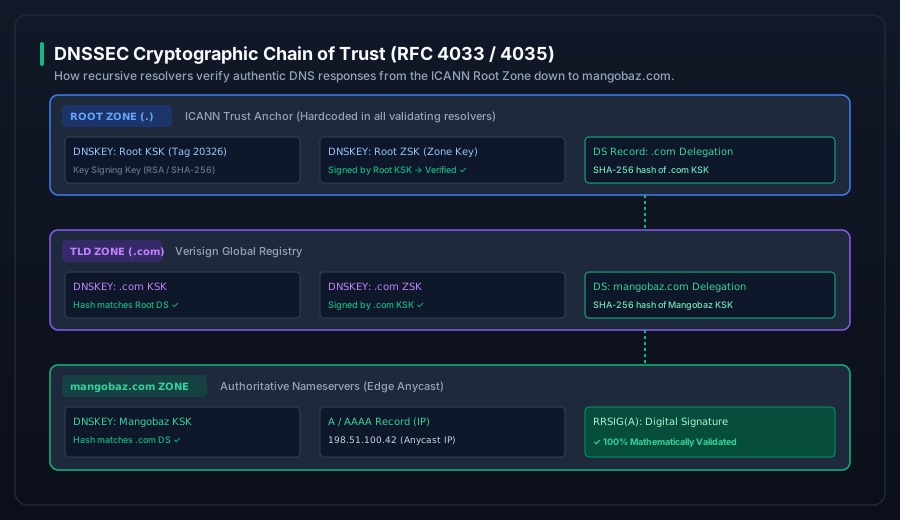 Figure 2: The DNSSEC cryptographic chain of trust. Recursive resolvers verify digital signatures (RRSIG) using Zone Signing Keys (ZSK) and Key Signing Keys (KSK), validated by Delegation Signer (DS) records up to the ICANN Root trust anchor.
5. Modern DNS Security: The DNSSEC Chain of Trust
Standard DNS has no built-in authentication or encryption: packets are transmitted over plaintext UDP port 53. In 2008, security researcher Dan Kaminsky demonstrated the devastating Kaminsky DNS Cache Poisoning Attack, showing that attackers could spoof UDP source ports and transaction IDs to inject malicious IP addresses into recursive resolver caches, hijacking bank and email traffic.
The industry's cryptographic defense is DNSSEC (DNS Security Extensions, RFC 4033).
The Cryptographic Delegation Architecture
DNSSEC does not encrypt queries (privacy is handled by DoH/DoT); instead, it provides cryptographic authenticity and data integrity through digital signatures:
| Record Type | Cryptographic Purpose | Verification Mechanism |
|---|---|---|
RRSIG |
Resource Record Signature | Digital signature covering a specific record set (e.g., the A record) generated by the ZSK. |
DNSKEY (ZSK) |
Zone Signing Key | Public key used to verify the RRSIG signatures within the zone. |
DNSKEY (KSK) |
Key Signing Key | Higher-security public key used exclusively to sign the ZSK. |
DS |
Delegation Signer | A cryptographic SHA-256 hash of your domain's KSK, published in the parent zone (e.g., in .com). |
The Chain of Trust: A validating resolver starts with the hardcoded public key of the Root Zone (.). The Root signs the DS record of .com; the .com zone signs the DS record of mangobaz.com; and mangobaz.com signs its own A records. If an attacker attempts to spoof a DNS reply on UDP, the digital signature check fails, and the resolver rejects the forged response with a SERVFAIL status.
6. Geo-Steering & Privacy: EDNS Client Subnet (ECS)
When using centralized public recursive resolvers (like Google 8.8.8.8 or Cloudflare 1.1.1.1), a subtle latency penalty emerges: the authoritative nameserver sees the IP address of the resolver, not the end user!
If a user in Sydney, Australia uses a resolver whose egress node happens to query from Singapore, a Geo-DNS system will mistakenly return Singapore server IPs, forcing Australian users to endure cross-ocean latency.
The ECS Mechanism (RFC 7871)
EDNS0 Client Subnet (ECS) solves this by appending an optional extension field to the DNS query containing a truncated prefix of the client's IP address (typically /24 for IPv4 or /56 for IPv6):
// EDNS0 Client Subnet Option (RFC 7871):
OPTION-CODE: 8 (Client Subnet)
FAMILY: 1 (IPv4)
SOURCE-PREFIX-LENGTH: 24
ADDRESS: 203.0.113.0
By truncating the client IP to a /24 subnet (which covers 256 addresses), the resolver preserves user privacy while providing the authoritative nameserver with enough geographical granularity to return the optimal local edge IP.
7. Building a Raw UDP DNS Packet Parser in C#
Below is a production-grade, asynchronous C# implementation demonstrating how to construct a raw RFC 1035 DNS wire-format query and decode the UDP binary response without external third-party dependencies:
using System;
using System.IO;
using System.Net;
using System.Net.Sockets;
using System.Text;
using System.Threading;
using System.Threading.Tasks;

public sealed class RawDnsClient
{
    private readonly IPEndPoint _dnsServer;

    public RawDnsClient(string dnsIp = "1.1.1.1", int port = 53)
    {
        _dnsServer = new IPEndPoint(IPAddress.Parse(dnsIp), port);
    }

    public async Task ResolveIPv4Async(string domain, CancellationToken ct = default)
    {
        using var udpClient = new UdpClient();
        udpClient.Connect(_dnsServer);

        byte[] queryPacket = BuildDnsQuery(domain, transactionId: 0x1A2B);
        await udpClient.SendAsync(queryPacket, queryPacket.Length);

        var receiveResult = await udpClient.ReceiveAsync(ct);
        return ParseDnsResponse(receiveResult.Buffer);
    }

    private static byte[] BuildDnsQuery(string domain, ushort transactionId)
    {
        using var ms = new MemoryStream();
        using var writer = new BinaryWriter(ms);

        // 1. Header (12 Bytes)
        writer.Write((byte)(transactionId >> 8));
        writer.Write((byte)(transactionId & 0xFF));
        writer.Write((byte)0x01); // Standard query with Recursion Desired (RD = 1)
        writer.Write((byte)0x00);
        writer.Write((byte)0x00); writer.Write((byte)0x01); // QDCOUNT = 1 question
        writer.Write((byte)0x00); writer.Write((byte)0x00); // ANCOUNT = 0
        writer.Write((byte)0x00); writer.Write((byte)0x00); // NSCOUNT = 0
        writer.Write((byte)0x00); writer.Write((byte)0x00); // ARCOUNT = 0

        // 2. Question: QNAME (e.g. \x08mangobaz\x03com\x00)
        string[] labels = domain.TrimEnd('.').Split('.');
        foreach (var label in labels)
        {
            byte[] labelBytes = Encoding.ASCII.GetBytes(label);
            writer.Write((byte)labelBytes.Length);
            writer.Write(labelBytes);
        }
        writer.Write((byte)0x00); // Zero length root label terminator

        // QTYPE = 1 (A Record), QCLASS = 1 (IN - Internet)
        writer.Write((byte)0x00); writer.Write((byte)0x01);
        writer.Write((byte)0x00); writer.Write((byte)0x01);

        return ms.ToArray();
    }

    private static string ParseDnsResponse(byte[] buffer)
    {
        if (buffer.Length