Table of Contents (Jump to section)
In distributed systems engineering, no challenge is more fundamental—or more treacherous—than distributed consensus. In a world of physical hardware failures, arbitrary network partitions, asymmetric packet drops, and variable CPU scheduling pauses, how can a cluster of independent computing nodes agree on a deterministic sequence of state machine operations without a single point of failure?
For decades, the theoretical answer was Paxos, formulated by Leslie Lamport. Yet, while Paxos was mathematically profound, it was notoriously opaque and notoriously difficult to implement in real-world software. Multi-Paxos lacked an explicit, structured concept of strong leadership, left log compaction as an unspecified exercise for the implementer, and forced teams to engineer complex, unverified ad-hoc heuristics to handle cluster membership changes.
In 2014, Diego Ongaro and John Ousterhout introduced Raft: a consensus algorithm designed from the ground up for understandability and operational safety. By decomposing consensus into three strictly independent subproblems—Leader Election, Log Replication, and Safety Invariants—Raft quickly conquered the modern infrastructure landscape. Today, Raft forms the consensus bedrock of etcd (Kubernetes control plane), CockroachDB, TiKV, Redpanda, and Kafka KRaft.
However, running vanilla Raft from the original 2014 paper in a modern, multi-datacenter 2026 production environment will quickly bring your cluster to its knees. Real-world networks experience asymmetric network partitions that induce term inflation storms; high-throughput applications demand millions of linearizable reads per second without paying a two-phase network round-trip; and enterprise topologies require dynamic node additions and removals without cluster downtime.
In this architectural deep dive, we will master the modern production implementation of Raft as practiced by hyperscale infrastructure engines in 2026. We will trace the state machine safety proofs, implement the Pre-Vote protocol, dissect Monotonic Quorum Leases for zero-RPC reads, and execute atomic cluster membership transitions using Joint Consensus ($C_{old,new}$).
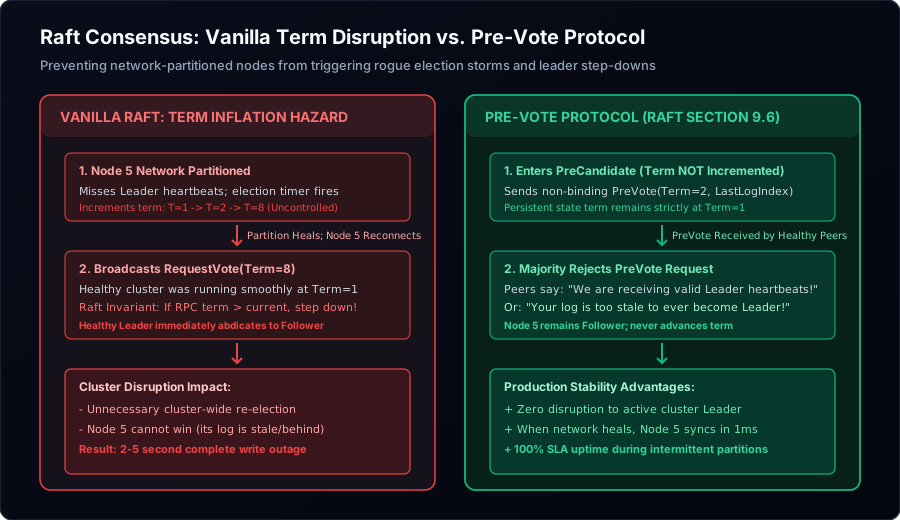
Figure 1: The Disrupted Term Cascade in Vanilla Raft vs. The Two-Phase Pre-Vote Protocol preventing network partition election storms and term inflation.
The Core Foundations: The Five Safety Invariants
At its heart, Raft manages a Replicated State Machine (RSM). Clients propose commands; the consensus engine orders those commands in an append-only log; and once committed, each node feeds those commands in identical sequence into an application state machine (such as a key-value store or transactional ledger).
Raft guarantees absolute linearizable correctness across any arbitrary failure scenario by mathematically enforcing Five Invariant Properties at all times:
- Election Safety: At most one leader can be elected in any given term. If two nodes believe they are leader in the same term, the consensus algorithm is broken.
- Leader Append-Only: A leader never overwrites or truncates its own log entries; it only ever appends new entries.
- Log Matching Property: If two independent logs contain an entry with the exact same index and term, then the logs are identical in all entries up through the given index.
- Leader Completeness: If a log entry is committed in a given term, then that entry will be present in the logs of the leaders for all higher-numbered terms. A candidate cannot win an election unless its log contains all committed entries.
- State Machine Safety: If a server has applied a log entry at a given index to its state machine, no other server will ever apply a different log entry for the same index.
The Production Achilles' Heel: Term Inflation & The Pre-Vote Protocol
While vanilla Raft handles clean failovers gracefully, it contains a catastrophic flaw when subjected to asymmetric network partitions: the Disrupted Term Cascade.
1. The Anatomy of an Election Storm
Consider a 5-node Raft cluster: Nodes 1, 2, 3, 4, and 5 running smoothly at Term 1, with Node 1 serving as Leader. Suddenly, a top-of-rack network switch glitch isolates Node 5 from the rest of the cluster:
- Node 5 stops receiving periodic
AppendEntriesheartbeats from Leader Node 1. - Node 5's randomized election timer expires. In vanilla Raft, Node 5 immediately increments its current term from $1 \to 2$, transitions to the
Candidatestate, votes for itself, and broadcastsRequestVoteRPCs. - Because Node 5 is partitioned, its votes never reach the other nodes. Node 5 times out again. It increments its term to 3, then 4, then 5, repeating this cycle endlessly.
- Minutes later, the network partition heals. Node 5 reconnects to the cluster and broadcasts a message bearing Term 8.
According to the rigid rules of vanilla Raft: "If a server receives a request with a term $T > currentTerm$, it must update its term to $T$ and immediately revert to Follower state."
When the healthy Leader Node 1 receives Node 5's packet with Term 8, Node 1 is forced to abdicate. The entire healthy cluster is thrown into a sudden, chaotic election cycle. Furthermore, Node 5 cannot even win the election because its log is far behind the healthy nodes! The cluster experiences 2 to 5 seconds of total write downtime while the healthy nodes elect a new leader and force Node 5 to catch up.
2. The Antidote: The Pre-Vote Protocol (Raft Dissertation §9.6)
Modern consensus engines (such as etcd and CockroachDB) eliminate this vulnerability by inserting an exploratory, non-binding phase before initiating a formal election: The Pre-Vote Protocol.
When a follower's election timer expires:
- It does not increment its persistent term.
- It transitions to the transient state
PreCandidate. - It broadcasts a non-binding
PreVote(term = currentTerm + 1, lastLogIndex, lastLogTerm)to all peers. - Peers process the Pre-Vote under strict scrutiny. A peer will reject the Pre-Vote if:
- The peer is actively receiving valid heartbeats from a recognized Leader (meaning a healthy leader is alive).
- The candidate's log is less up-to-date than the peer's own log.
- Only if the
PreCandidatesuccessfully gathers grant responses from a strict majority ($N/2 + 1$) does it advance its persistent term and initiate a formalRequestVotecampaign!
Production Invariant: Under the Pre-Vote protocol, an isolated partitioned node can timeout thousands of times, but because its Pre-Votes will be rejected by the healthy majority upon reconnection, its persistent term never advances. When the partition heals, the rogue node reconnects harmlessly and synchronizes without disturbing the active leader.
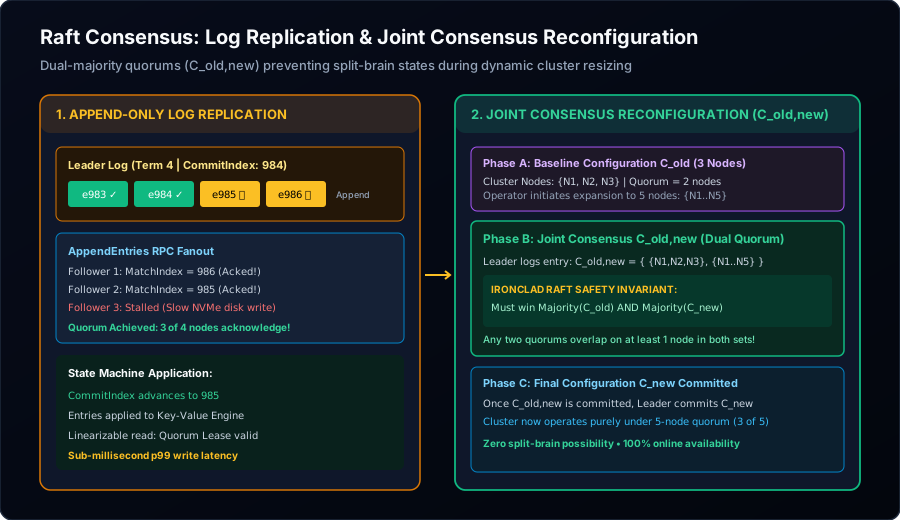
Figure 2: Raft Log Replication & Joint Consensus ($C_{old,new}$): Dual-majority voting mechanism preventing split-brain states during dynamic cluster membership changes.
High-Throughput Linearizable Reads: Quorum Leases
In real-world transactional applications, read operations typically outnumber write operations by 10:1 or 100:1. If every read query required appending an entry to the Raft log and waiting for a full round-trip consensus commit, read throughput would be throttled to a few thousand queries per second.
However, simply reading local state machine memory directly from the leader is treacherous. In the presence of a network partition, a partitioned leader might be deposed without its knowledge while another partition elects a new leader. Reading from the deposed "zombie" leader would return stale, dirty data, violating linearizability.
1. ReadIndex (Safe but High Latency)
To provide linearizable reads safely, early Raft implementations introduced ReadIndex:
- The leader records its current
commitIndexasreadIndex. - The leader broadcasts a minimal heartbeat round-trip (empty
AppendEntries) to a quorum of followers to verify it is still the legitimate leader. - Once the quorum confirms leadership, the leader waits until its state machine has applied entries up to
readIndex, and then serves the read.
While safe, ReadIndex still requires a full network round-trip for every single read query, imposing a 1ms to 10ms latency penalty.
2. Monotonic Quorum Leases (Zero-Network Linearizable Reads)
The state-of-the-art solution in 2026 is Monotonic Quorum Leases. When a leader successfully receives heartbeat acknowledgments from a majority of followers, it acquires a time-bounded lease:
LeaseDuration = ElectionTimeout * BoundedFactor (e.g., 500ms)
LeaseExpiration = MonotonicTime.Now() + LeaseDuration
Because followers cannot initiate an election until their election timer (e.g., 1,500ms) expires, and because followers grant the leader a renewal on every heartbeat, the leader is mathematically guaranteed that no other leader can be elected during the active lease window.
Within this lease window, the leader serves read requests directly out of memory with zero network round-trips, pushing read throughput beyond 1,500,000 operations per second per node with sub-100-microsecond latency!
The Clock Drift Rule: To prevent clock drift bugs across physical servers, modern Raft engines never rely on wall-clock time (NTP). They utilize the processor's monotonic hardware counter (
CLOCK_MONOTONIC_RAWon Linux / TSC register) and deduct a conservative maximum clock drift bound ($\Delta$) from the lease expiration.
Dynamic Cluster Membership: Joint Consensus ($C_{old,new}$)
Production distributed systems cannot remain static. Servers suffer hardware failures, storage arrays fill up, and instances must be replaced. In traditional databases, changing cluster membership required shutting down the entire database. Raft solves this through automated, online membership changes.
1. The Pitfall of Naive Configuration Changes
Why can't a cluster simply switch from a 3-node configuration ($C_1 = \{A, B, C\}$) to a 5-node configuration ($C_2 = \{A, B, C, D, E\}$) in a single step?
Because network latency is unpredictable, different nodes switch configurations at different times. If Node A and Node B switch to $C_2$ while Node C remains in $C_1$:
- Node C (in $C_1$) can form a majority with Node B: $\{B, C\}$ is a majority of 3.
- Node D and Node E (in $C_2$) can form a majority with Node A: $\{A, D, E\}$ is a majority of 5.
Two disjoint majorities have formed simultaneously, electing two separate leaders and causing catastrophic split-brain data corruption!
2. The Mathematical Elegance of Joint Consensus
To guarantee that overlapping disjoint quorums can never form, Raft employs a two-phase protocol called Joint Consensus. During the transition, the cluster enters an intermediate configuration denoted as $C_{old,new}$:
- Logging Joint Configuration: The leader appends a special configuration entry $C_{old,new}$ to its log and replicates it to all nodes in both $C_{old}$ and $C_{new}$.
- The Dual-Majority Voting Rule: While operating under $C_{old,new}$, any consensus decision (electing a leader or committing an entry) requires two independent majorities simultaneously:
- A strict majority of the nodes in $C_{old}$, AND
- A strict majority of the nodes in $C_{new}$.
- Safety Guarantee: Because any majority of $C_{old}$ overlaps with any other majority of $C_{old}$, and any majority of $C_{new}$ overlaps with any other majority of $C_{new}$, it is mathematically impossible for two independent majorities to agree on conflicting decisions.
- Committing the Final Configuration: Once the $C_{old,new}$ entry has been safely committed across both majorities, the leader appends the final configuration $C_{new}$ to its log. Once $C_{new}$ is committed, the old nodes can be safely decommissioned and powered down.
Log Compaction & Snapshot Streaming
In an active OLTP database running millions of transactions per day, an append-only log will eventually consume all available disk space. Furthermore, replaying gigabytes of log entries upon a server reboot would cause intolerable recovery times.
Raft resolves this with Log Compaction via Snapshotting:
1. Local Snapshots
Periodically (e.g., every 100,000 log entries), each node independently takes an atomic snapshot of its state machine, writes the compacted state to disk, and discards all log entries up through lastIncludedIndex.
2. The InstallSnapshot RPC
What happens when a follower was partitioned for three days and its log is so far behind that the leader has already pruned the required log entries?
The leader cannot send standard AppendEntries. Instead, it streams its latest snapshot over the network using the InstallSnapshot RPC in discrete, rate-limited chunks (typically 16MB per chunk). The follower replaces its entire log and state machine with the snapshot, updates its commitIndex, and seamlessly rejoins the live consensus stream.
Production Implementation: Pre-Vote & Lease Engine in Go
Here is how the Pre-Vote campaign and monotonic lease verification are structured in a modern production Raft node:
// =====================================================================
// PRODUCTION RAFT PRE-VOTE & LEASE LOGIC IN GO
// =====================================================================
package raft

import (
	"sync"
	"sync/atomic"
	"time"
)

type NodeState int
const (
	Follower NodeState = iota
	PreCandidate
	Candidate
	Leader
)

type RaftNode struct {
	mu           sync.RWMutex
	id           int
	peers        []int
	state        NodeState
	currentTerm  uint64
	votedFor     int
	log          []LogEntry
	commitIndex  uint64

	// Pre-Vote tracking
	preVotesGranted int

	// Quorum Lease Management
	leaseDuration    time.Duration
	leaseExpiration  atomic.Int64 // Monotonic nanoseconds
	heartbeatAcks    map[int]time.Time
}

// 1. Triggered when election timeout expires
func (r *RaftNode) HandleElectionTimeout() {
	r.mu.Lock()
	defer r.mu.Unlock()

	// In 2026, never increment term immediately! Enter PreCandidate first.
	r.state = PreCandidate
	r.preVotesGranted = 1 // Vote for self
	nextTerm := r.currentTerm + 1
	lastIndex, lastTerm := r.lastLogInfo()

	for _, peer := range r.peers {
		if peer == r.id {
			continue
		}
		go r.sendPreVoteRPC(peer, nextTerm, lastIndex, lastTerm)
	}
}

// 2. Peer processing an incoming Pre-Vote request
func (r *RaftNode) ProcessPreVote(candidateId int, proposedTerm uint64, lastLogIndex uint64, lastLogTerm uint64) bool {
	r.mu.RLock()
	defer r.mu.RUnlock()

	// Invariant A: Reject if current leader lease is still active (Leader is healthy!)
	now := time.Now().UnixNano()
	if now
Summary: The 2026 Distributed Consensus Checklist
When architecting or deploying distributed consensus in 2026, never settle for a textbook vanilla implementation. Enforce these production-hardened engineering standards:
- Mandate the Pre-Vote Protocol: Stop network-partitioned nodes from incrementing terms and throwing healthy clusters into election livelocks.
- Leverage Monotonic Quorum Leases: Eliminate network round-trips for read traffic. Deliver millions of linearizable reads per second out of memory with mathematical safety.
- Reconfigure via Joint Consensus: Protect your cluster against split-brain majorities during cluster scaling using dual-majority transitions ($C_{old,new}$).
- Batch and Pipeline Log Replication: Keep NVMe write pipelines and 100GbE network fabrics 100% saturated using vectorized I/O and asynchronous commit batching.
- Enforce Strict Snapshot Rate Limiting: Stream snapshots in bounded chunks to prevent disk or network saturation from starving heartbeats and triggering false leader elections.
By mastering the deep mechanics of Raft, systems architects can build distributed engines that guarantee absolute linearizable correctness, survive arbitrary hardware chaos, and scale gracefully to planetary operational volumes.