Table of Contents (Jump to section)
For more than a decade, the software engineering industry rallied around Werner Vogels' famous DevOps battle cry: "You Build It, You Run It." The promise was intoxicating: tear down the adversarial wall between software developers and centralized operations teams, empower product squads with end-to-end autonomy, and accelerate release cycles from quarterly marathons to multiple daily continuous deployments.
Yet, by the mid-2020s, the unvarnished reality of unrestrained DevOps had mutated into an organizational nightmare: The Cognitive Overload Crisis. Developers who were hired to build customer-facing business logic and high-throughput backend services found themselves buried under an avalanche of infrastructure complexity. An engineer creating a simple microservice was suddenly expected to be an expert in writing 800-line Helm charts, debugging complex Kubernetes ingress controllers, provisioning Terraform modules, configuring AWS IAM assume-role trust relationships, and managing Prometheus alerting rules.
According to comprehensive industry Developer Experience (DevEx) surveys in 2026, software engineers in traditional DevOps organizations spend up to 35% to 42% of their working hours wrestling with infrastructure, deployment tooling, and broken shared staging environments. Rather than enabling velocity, "You Build It, You Run It" fragmented organizational knowledge, created shadow IT, and triggered severe developer burnout.
To solve this crisis, forward-thinking technology companies have pivoted to Platform Engineering. By treating the platform as a product, developers as internal customers, and infrastructure as self-service Golden Paths (Paved Roads), modern Internal Developer Platforms (IDPs) eliminate cognitive overload, automate compliance guardrails, and slash time-to-market.
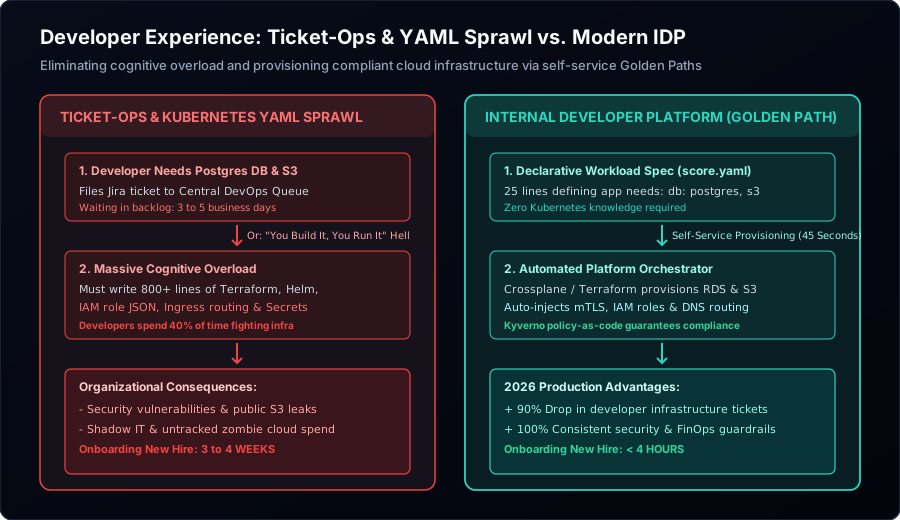
Figure 1: The friction of legacy Ticket-Ops / DevOps YAML overload vs. Self-Service Internal Developer Platforms with automated Golden Paths.
The Paradigm Shift: From DevOps Chaos to Platform Engineering
Platform Engineering is not the antithesis of DevOps; it is the maturation of DevOps. It recognizes that requiring every software engineer to understand the intricacies of Linux kernel networking, container runtime sandboxes, and cloud provider IAM policies is an inefficient allocation of engineering capital.
1. Golden Paths vs. Golden Cages
The foundational design philosophy of modern platform engineering is the Golden Path (originally championed by Spotify): a supported, automated, and documented "paved road" for taking a service from an empty Git repository to production.
- Paved Road, Not a Cage: A Golden Path does not forbid developers from experimenting with specialized architectures. If a team genuinely needs a custom Rust microservice with specialized GPU drivers, they can go off-road—provided they accept the operational responsibility. However, for 95% of standard applications (APIs, workers, event consumers), the Golden Path provides an effortless, zero-friction self-service experience.
- Self-Service over Ticket-Ops: In legacy organizations, requesting a cloud database, an S3 bucket, or a DNS record required opening a Jira ticket to a centralized infrastructure queue, stalling deployment for 3 to 5 business days. An IDP exposes an API, CLI, or web portal where developers provision compliant infrastructure in under 60 seconds with zero human gatekeeping.
- Context-Aware Dynamic Provisioning: Developers declare what their workload needs (e.g., "I need a PostgreSQL 17 database with 20GB of storage"), not how to construct it on AWS or GCP. The platform orchestrator interprets the context: in local development, it spins up a Docker container; in an ephemeral PR preview, it creates a serverless database branch; in production, it provisions a Multi-AZ Amazon RDS cluster with automated backups and encryption keys.
The Four Architectural Tiers of an Internal Developer Platform
In 2026, enterprise IDPs are structured across four modular, decoupled architectural layers:
1. The Developer Interface Tier (Portals & CLIs)
The entry point for engineers. Modern IDPs leverage open-source developer portals like Backstage (CNCF) or SaaS internal portals like Port and Cortex. The portal provides:
- Unified Software Catalog: A single pane of glass displaying all microservices, API specifications, documentation, and operational health scores.
- Software Templates (Scaffolding): One-click project generation that provisions a GitHub repository with CI/CD pipelines, container buildfiles, observability agents, and pre-configured linting rules in 30 seconds.
- Self-Service Action Hub: Direct buttons to trigger rollbacks, adjust replica counts, spin up preview environments, or request temporary production access.
2. The Workload Specification Tier: The Score Standard
The breakthrough standard that eliminated Kubernetes YAML sprawl in 2026 is Score (The Open Workload Specification). Instead of developers maintaining duplicate Helm values files for development, staging, and production, they maintain a single, clean score.yaml file:
# =====================================================================
# PRODUCTION SCORE SPECIFICATION (score.yaml)
# Declares workload requirements independently of target infrastructure
# =====================================================================
apiVersion: score.dev/v1b1
metadata:
  name: billing-service

service:
  ports:
    http:
      port: 8080
      targetPort: 8080

containers:
  backend:
    image: .
    variables:
      PORT: "8080"
      DATABASE_URL: "postgresql://${resources.db.username}:${resources.db.password}@${resources.db.host}:${resources.db.port}/${resources.db.name}"
      CACHE_URL: "redis://${resources.cache.host}:${resources.cache.port}"
    resources:
      requests:
        cpu: "250m"
        memory: "512Mi"
      limits:
        cpu: "1000m"
        memory: "1Gi"

resources:
  db:
    type: postgres
    params:
      version: "17"
  cache:
    type: redis
3. The Platform Orchestration Tier
The brain of the IDP. The orchestrator (such as Humanitec, Kratix, or custom Kubernetes Operators powered by Crossplane) takes the environment-agnostic score.yaml and matches it against the target environment's Resource Definitions. It dynamically generates and applies the necessary Kubernetes manifests, Terraform runs, or CloudFormation templates.
4. The Infrastructure Control Plane
The physical cloud substrates: AWS EKS, Google Cloud GKE, bare-metal Kubernetes clusters, and cloud provider managed services (RDS, DynamoDB, S3, Cloudflare). Developers never interact with this layer directly.
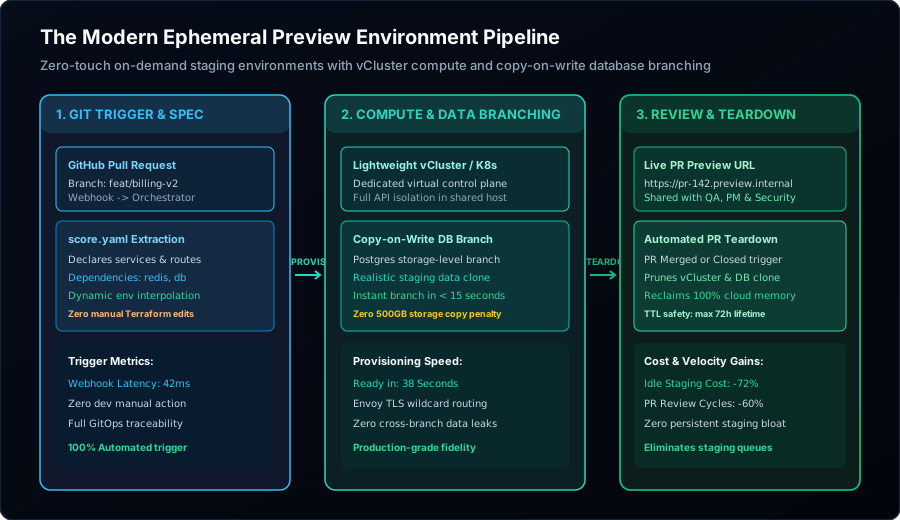
Figure 2: The Modern Ephemeral Preview Pipeline: Git branch push -> lightweight vCluster namespace provisioning -> copy-on-write database branch -> automated teardown on PR merge.
The Death of Static Staging: Ephemeral Preview Environments
Historically, the biggest bottleneck in the software release lifecycle was Shared Staging Environments. Organizations maintained a single static "staging" or "QA" cluster where all feature branches were deployed before production. This model suffered from fatal systemic flaws:
- Staging Queue Contention: Feature A could not be tested because Feature B broke staging. Developers spent hours on Slack asking: "Who is currently using staging?"
- State Contamination: One team's test script inserted corrupted test data or ran a destructive migration, breaking testing for all other teams.
- Massive Idle Cloud Waste: Static staging environments run 24/7, burning thousands of dollars over weekends and holidays while sitting completely idle.
1. Modern Ephemeral Architecture
In 2026, elite platform teams have replaced static staging with Ephemeral On-Demand Preview Environments. Every single Git Pull Request automatically provisions a dedicated, fully isolated, production-like environment with its own unique URL:
https://pr-142.preview.mangobaz.com2. Compute Isolation: Virtual Clusters (vCluster)
Rather than spinning up slow, expensive dedicated cloud Kubernetes clusters for every PR (which takes 15 minutes and costs hundreds of dollars), modern IDPs use Virtual Kubernetes Clusters (vCluster). A vCluster runs as a set of lightweight pods inside a shared host Kubernetes cluster, providing an isolated virtual API server, virtual namespace, and virtual RBAC boundaries in under 20 seconds with near-zero overhead.
3. The Data Breakthrough: Copy-on-Write Database Branching
Compute has always been easy to virtualize; data was the hard problem. An ephemeral backend service is useless if its database is empty. But copying a 500GB production or staging database for every single pull request takes hours and exhausts disk storage.
The solution adopted in 2026 is Storage-Level Copy-on-Write Database Branching (powered by serverless database platforms like Neon, PlanetScale, or ZFS/EBS snapshotting):
- When a PR opens, the orchestrator issues a storage API call to create a database branch from staging.
- Using copy-on-write page virtualization, the branch is ready in under 15 seconds.
- The branch contains 100% of the realistic schema and data from staging, but consumes zero additional storage initially!
- When the ephemeral service executes destructive migrations, updates records, or inserts test tuples, only the modified pages are written to the branch's delta layer.
- The live staging database remains completely untouched.
4. Automated Teardown and Cloud Cost Reclaim
When the pull request is merged into main or closed, a webhook triggers the platform orchestrator to destroy the vCluster, tear down the database branch, and release the DNS record. If a PR sits inactive for 72 hours, an automated TTL garbage collector hibernates the environment. This eliminates 100% of idle cloud staging costs, slashing infrastructure bills by over 70%.
Automating Compliance: Policy-as-Code & FinOps Guardrails
In traditional organizations, security and financial governance were handled by human review boards: Architecture Review Boards (ARBs), Security Audits, and FinOps approvals. In a modern IDP, compliance is shifted left and automated through Policy-as-Code.
1. Automated Security Guardrails with Kyverno
When the platform orchestrator generates Kubernetes manifests, admission controllers (such as Kyverno or Open Policy Agent / Gatekeeper) validate policies before pods can schedule:
# =====================================================================
# KYVERNO POLICY: ENFORCING PRODUCTION READINESS & SECURITY STANDARDS
# =====================================================================
apiVersion: kyverno.io/v1
kind: ClusterPolicy
metadata:
  name: enforce-platform-guardrails
spec:
  validationFailureAction: Enforce
  rules:
    - name: require-run-as-non-root
      match:
        resources:
          kinds: [Pod]
      validate:
        message: "Platform Rule: Containers must run as non-root!"
        pattern:
          spec:
            securityContext:
              runAsNonRoot: true
    - name: require-resource-limits
      match:
        resources:
          kinds: [Pod]
      validate:
        message: "Platform Rule: Memory and CPU limits must be declared!"
        pattern:
          spec:
            containers:
              - resources:
                  limits:
                    memory: "?*"
                    cpu: "?*"
2. Real-Time FinOps Attribution
By integrating OpenCost into the developer workflow, modern IDPs provide real-time cost attribution directly inside pull requests. When an engineer modifies CPU requests or adds an in-memory cache, an automated GitHub bot posts an exact financial estimate:
FinOps Bot: "This pull request increases estimated monthly infrastructure spend by +$14.20/month (from $38.10 to $52.30). Budget remaining in Team Billing allocation: $1,420.00. Approved automatically."
Production Blueprint: GitHub Actions Ephemeral Workflow
Here is how modern engineering teams automate ephemeral preview deployments using GitHub Actions and a platform orchestrator:
# =====================================================================
# GITHUB ACTIONS: ON-DEMAND EPHEMERAL PREVIEW PIPELINE
# =====================================================================
name: Ephemeral Preview Environment

on:
  pull_request:
    types: [opened, synchronize, reopened, closed]

jobs:
  ephemeral:
    runs-on: ubuntu-latest
    steps:
      - name: Checkout Code
        uses: actions/checkout@v4

      # If PR is closed or merged: Execute Instant Automated Teardown
      - name: Teardown Ephemeral Environment
        if: github.event.action == 'closed'
        run: |
          echo "Tearing down ephemeral environment for PR #${{ github.event.number }}..."
          curl -X DELETE "https://api.platform.internal/v1/environments/pr-${{ github.event.number }}" \
            -H "Authorization: Bearer ${{ secrets.PLATFORM_API_TOKEN }}"

      # If PR is active: Provision Environment and Post URL
      - name: Deploy Ephemeral Stack
        if: github.event.action != 'closed'
        run: |
          # 1. Build and push container image
          IMAGE_TAG="ghcr.io/mangobaz/billing:${{ github.sha }}"
          docker build -t "$IMAGE_TAG" .
          docker push "$IMAGE_TAG"

          # 2. Deploy via Platform Orchestrator using score.yaml
          PREVIEW_URL=$(curl -s -X POST "https://api.platform.internal/v1/environments" \
            -H "Authorization: Bearer ${{ secrets.PLATFORM_API_TOKEN }}" \
            -H "Content-Type: application/json" \
            -d '{
              "env_name": "pr-${{ github.event.number }}",
              "score_file": "score.yaml",
              "image": "'"$IMAGE_TAG"'",
              "branch_database": true
            }' | jq -r '.preview_url')

          # 3. Post preview URL back to GitHub PR discussion
          gh pr comment ${{ github.event.number }} --body "🚀 **Ephemeral Preview Ready:** [$PREVIEW_URL]($PREVIEW_URL)"
        env:
          GH_TOKEN: ${{ secrets.GITHUB_TOKEN }}
Real-World Impact: Measuring Platform ROI
Engineering leadership teams evaluate platform engineering through rigorous DORA (DevOps Research and Assessment) and Developer Experience (DevEx) metrics. In our implementations across enterprise engineering teams in 2026, transitioning to a modern IDP produced decisive gains:
| Engineering Metric | Legacy Ticket-Ops / DevOps | Modern Internal Developer Platform | Business Impact |
|---|---|---|---|
| New Engineer Onboarding Time | 3 to 4 Weeks | 4 Hours | Instant Developer Productivity |
| Cloud Resource Provisioning | 3 to 5 Days (Jira Ticket) | 45 Seconds (Self-Service) | Unblocked Innovation Velocity |
| PR Review & QA Lead Time | 4.2 Days | 1.1 Days | -73.8% Shorter Release Cycles |
| Monthly Idle Staging Cloud Spend | $184,000 / month | $38,000 / month | -$146,000 Monthly Savings (-79%) |
| Security Vulnerabilities in Prod | 14 per quarter | 0 per quarter | Guaranteed Automated Compliance |
Summary: The 2026 Platform Engineering Standard
The era of treating every software engineer as a part-time Kubernetes administrator is officially over. When building or modernizing your organization's internal developer platform in 2026, enforce these golden principles:
- Pave Golden Paths, Not Golden Cages: Make the right architectural way the easiest way. Automate standard patterns while leaving escape hatches for specialized requirements.
- Abstract via Score: Replace thousands of lines of environment-specific Kubernetes YAML with clean, declarative, workload-centric specifications.
- Standardize on Ephemeral Stacks: Eliminate static shared staging bottlenecks. Provision lightweight vClusters and copy-on-write database branches on every pull request, and tear them down on merge.
- Shift Compliance Left: Automate security and FinOps guardrails using Kyverno and OpenCost. Give developers real-time feedback inside their daily Git workflows.
By empowering product teams with intuitive self-service platforms, technology leaders liberate their engineers to focus on what truly matters: building world-class software that delights customers and drives business value.