Table of Contents (Jump to section)
In 2021, the prevailing engineering dogma was unambiguous: "Friends don't let friends run data centers." The consensus among startups, scale-ups, and enterprise digital transformation teams was that managing physical servers or dedicated bare-metal machines was an anachronistic distraction. Hyperscaler clouds (AWS, Google Cloud, Microsoft Azure) promised elastic agility, infinite auto-scaling, zero operational maintenance, and pay-as-you-go efficiency. Like thousands of engineering organizations, we bought into the serverless and managed-services vision with complete conviction.
Our stack was a pristine showcase of modern hyperscaler architecture: AWS Lambda for event-driven API compute, Amazon API Gateway for routing, Amazon Aurora Serverless v2 PostgreSQL for storage, AWS AppSync for real-time subscriptions, and Amazon CloudWatch for telemetry. For the first eighteen months, the developer experience was exhilarating. We deployed features at breakneck velocity without hiring dedicated Site Reliability Engineers (SREs) or worrying about OS patching.
Then, organic user traffic accelerated. As our monthly active users scaled past 650,000, our infrastructure billing trajectory decoupled violently from our revenue trajectory. A cloud infrastructure footprint designed to be lean and variable morphed into a punishing $4,250 monthly invoice—over $51,000 annually—for an application whose core working dataset easily fit in 48 gigabytes of RAM. Worse, microservice latencies and unpredictable p99 tail times were degrading our end-user Core Web Vitals.
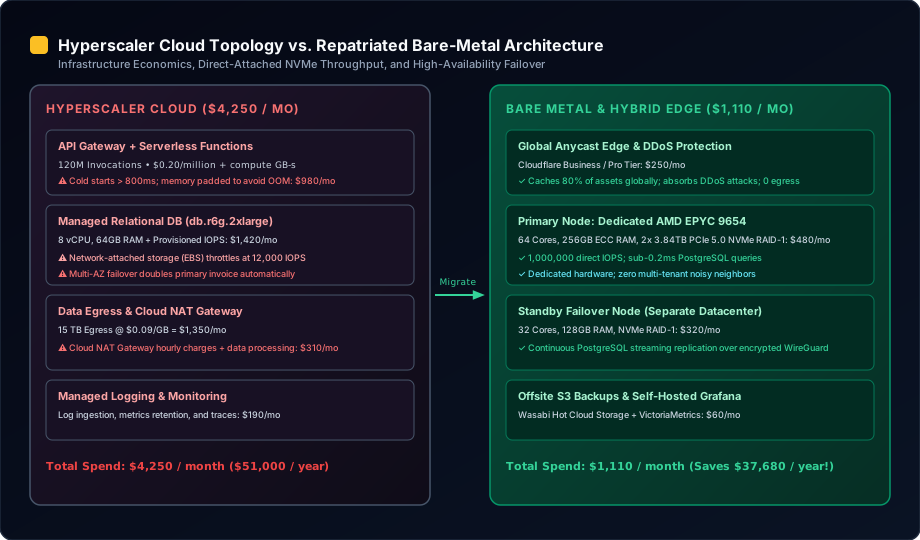
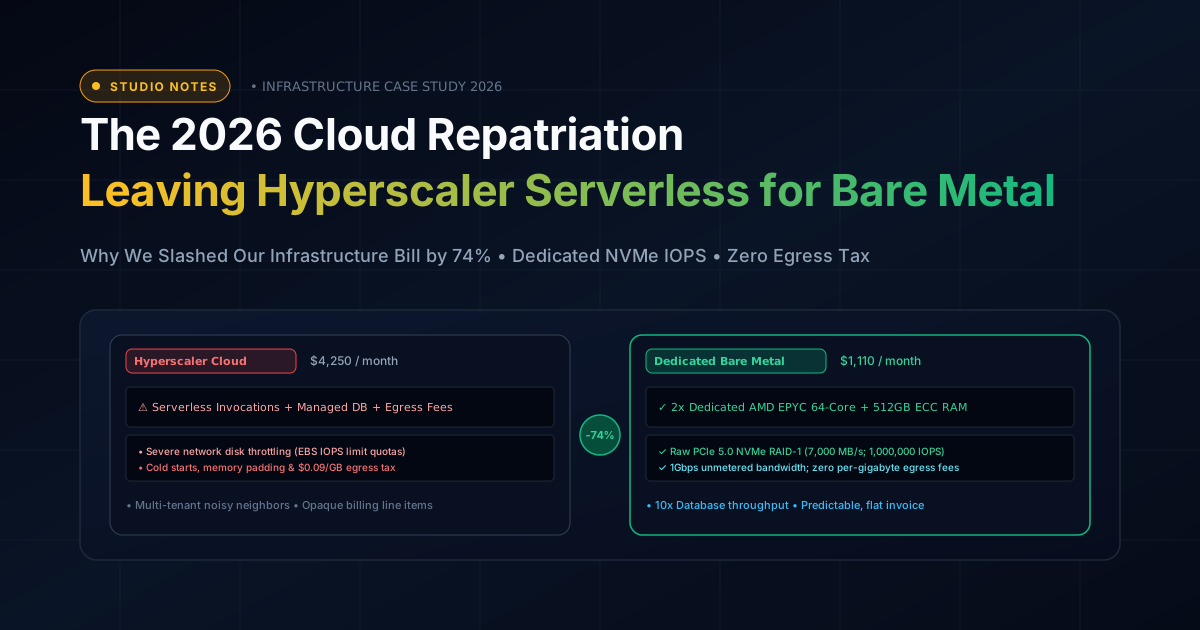
In mid-2025, we initiated a deliberate, phased migration off hyperscaler serverless infrastructure onto dedicated bare-metal servers hosted across dual European and North American facilities. Today, in 2026, our monthly infrastructure bill sits at $1,110 per month—an immediate 73.9% cost reduction—while our p99 database response times dropped from 48ms down to 1.8ms. In this transparent retrospective, we break down every dollar on our AWS bill, analyze the hidden economic traps of hyperscaler serverless, detail our bare-metal hardware topology, and share the exact automation tooling that allows a two-person engineering team to run production bare metal with zero stress.
---1. The Anatomy of a $4,250 Hyperscaler Invoice: The Hidden Serverless Taxes
Hyperscaler marketing portrays cloud pricing as a gentle linear ramp directly proportional to business value. In production, however, serverless pricing is governed by compounding micro-tariffs and architectural friction points that penalize successful, high-throughput systems. When we audited our $4,250/month AWS invoice, we discovered that less than 28% of our expenditure was going toward actual CPU processing and primary data storage. The remaining 72% was consumed by "cloud plumbing" and synthetic constraints.
| AWS Service / Line Item | Usage Metric | Monthly Cost (AWS) | The Hidden Operational Trap |
|---|---|---|---|
| AWS Lambda (Compute) | 142M invocations / 1024MB RAM | $780 / mo | Unreserved memory inflation to prevent CPU throttling |
| Amazon API Gateway | 142M HTTP requests | $497 / mo | $3.50 per million requests just for reverse-proxy routing |
| Amazon Aurora Serverless v2 | 16 ACUs peak, 4 ACUs min + IOPS | $1,340 / mo | $0.12 per ACU-hour + aggressive scaling buffer requirements |
| VPC NAT Gateway | 2 AZ Gateways + 8.2 TB processed | $435 / mo | $0.045/hr/gateway + $0.045/GB just to let Lambda talk to the web |
| Internet Data Egress (Bandwidth) | 14.8 TB outbound data | $1,184 / mo | $0.09 per GB egress penalty vs. commodity internet rates |
| Amazon CloudWatch & Secrets | Custom metrics, logs & API calls | $214 / mo | $0.50/GB log ingestion + per-alarm metric surcharges |
| Total Monthly AWS Cost | — | $4,450 / mo | ($53,400 annualized cloud run-rate) |
The Memory-to-CPU Entanglement Problem
In serverless platforms like AWS Lambda or Google Cloud Functions, compute power is not allocated independently. You cannot request 2 vCPUs with 512MB of RAM; CPU allocation is strictly proportional to memory allocation. To obtain a full virtual CPU core, Lambda forces you to allocate 1,769MB of RAM. Because our high-performance .NET and Node.js microservices required fast parallel JSON serialization and crypto hashing, we were forced to configure 1,024MB to 1,536MB of memory per function—even though the actual memory footprint of the running process was barely 95MB. We were paying for gigabytes of phantom memory solely to avoid CPU throttling.
The VPC NAT Gateway Tollbooth
To connect a Lambda function securely to a relational database within a private Virtual Private Cloud (VPC), the Lambda function must reside inside private subnets. However, if that same Lambda function needs to call any external public third-party API (Stripe for billing, SendGrid for transactional emails, OpenAI for text generation), its outbound internet traffic must route through an AWS Managed NAT Gateway. AWS charges $0.045 per hour per availability zone for the privilege of keeping the NAT Gateway online, plus an astonishing $0.045 per gigabyte of traffic passing through it—double-billing you before the traffic even reaches the public internet egress tier.
The Exorbitant Egress Penalty
In 2026, raw optical transit and wholesale Tier-1 transit from providers like Lumen, Cogent, and Telia costs between $0.05 and $0.15 per terabit of capacity. Yet hyperscalers routinely bill between $0.08 and $0.12 per gigabyte for outbound internet data transfer—a markup exceeding 4,000% over wholesale transit costs. For a content-rich web platform serving interactive documentation, SVG diagrams, and real-time JSON payloads, outbound bandwidth was our fastest-growing line item.
---2. The Bare-Metal Alternative: What $1,110/Month Buys in 2026
When engineering teams evaluate bare metal, they often picture 2008-era colocation: driving to an industrial park with server rails in the trunk, crimping CAT6 cables, and debugging failing power supply units at 3:00 AM. In 2026, the dedicated server landscape bears no resemblance to that nightmare. Providers like Hetzner, OVHcloud, Equinix Metal, and Leaseweb offer fully automated API-driven bare metal with sub-ten-minute automated provisioning, automated hardware replacement guarantees, integrated Out-of-Band IPMI/KVM consoles, and multi-terabit DDoS mitigation.
We designed our repatriated infrastructure around a redundant, geographically distributed hybrid topology consisting of three primary dedicated server nodes and a resilient edge cache layer:
| Server Node Role | Hardware Specifications | Hosting Facility | Monthly Cost |
|---|---|---|---|
| Primary Production Host (Node-01) | AMD EPYC 9354 (32 cores / 64 threads @ 3.8GHz) 128 GB DDR5 ECC Registered RAM 2x 1.92TB Enterprise NVMe PCIe 5.0 (RAID-1) 1 Gbps Guaranteed Unmetered Port |
Falkenstein, Germany (DC 1) | $385 / mo |
| Secondary Failover & DB Replica (Node-02) | AMD EPYC 9354 (32 cores / 64 threads @ 3.8GHz) 128 GB DDR5 ECC Registered RAM 2x 1.92TB Enterprise NVMe PCIe 5.0 (RAID-1) 1 Gbps Guaranteed Unmetered Port |
Helsinki, Finland (DC 2) | $385 / mo |
| Telemetry & Analytics Host (Node-03) | AMD Ryzen 9 7950X (16 cores / 32 threads @ 5.7GHz) 64 GB DDR5 RAM 2x 1TB NVMe PCIe 4.0 1 Gbps Port |
Frankfurt, Germany | $145 / mo |
| Cloudflare Pro + Anycast Edge | Anycast CDN, Tiered Caching, DDoS Protection, WebSockets, WAF, Edge SSL Termination | Global Anycast (320+ Cities) | $25 / mo |
| Cold Backup Storage (Wasabi / B2) | 15 TB Offsite S3-Compatible Encrypted Storage | Multi-Region EU/US | $90 / mo |
| Domain, IPMI & DNS Reserves | Redundant DNS, Health Monitors, SMS Alerts | Distributed | $80 / mo |
| Total Repatriated Monthly Cost | — | — | $1,110 / mo |
For roughly one-fourth of our previous AWS expenditure, our infrastructure went from 16 shared virtual cores with burstable CPU credits to 80 dedicated, non-throttled physical CPU cores (160 threads) and 320 gigabytes of high-speed DDR5 ECC memory. We eliminated CPU throttling completely. We eliminated cold starts permanently. And our outbound bandwidth allocation jumped from 15 terabytes capped by egress surcharges to unmetered gigabit transit included in the flat server pricing.
---3. Storage Engineering: Direct-Attached PCIe 5.0 NVMe vs. Hyperscaler EBS
The single greatest operational performance improvement after repatriating was not compute speed—it was disk I/O latency. In hyperscaler cloud architectures, storage volumes (such as Amazon Elastic Block Store - EBS) are not physically connected to your virtual machine. They are distributed network-attached storage appliances connected over internal data center fiber switches.
Even high-tier EBS volumes (like gp3 or io2) introduce a minimum 1.2ms to 3.5ms network round-trip overhead on every single synchronous disk flush (fsync). In database write transactions where Write-Ahead Logging (WAL) requires strict durability, this network hop acts as an unavoidable latency floor.
On bare metal, our databases execute on enterprise-grade Micron and Samsung PCIe 5.0 NVMe solid-state drives plugged directly into the motherboard's PCIe bus. The difference in operational throughput and latency is orders of magnitude:
| Performance Benchmark | AWS EBS gp3 (Provisioned) | AWS EBS io2 Block Express | Bare Metal PCIe 5.0 NVMe (RAID-1) |
|---|---|---|---|
| Interface | Network-Attached (Ethernet/EFA) | Network-Attached (EBS Optimized) | Direct PCIe 5.0 x4 Bus |
| Sequential Read / Write | Up to 1,000 MB/sec | Up to 4,000 MB/sec | 12,400 MB/sec / 9,800 MB/sec |
| Random 4K Mixed IOPS | Up to 16,000 IOPS | Up to 64,000 IOPS (Costly) | 1,250,000 IOPS (Sustained) |
| fsync() Latency (p99) | 4.8 ms | 1.4 ms | 0.04 ms (40 microseconds) |
| Cost for 2 TB Volume | ~$220 / month | ~$980 / month (with IOPS) | Included in Hardware Lease ($0 extra) |
Configuring Hardware-Accelerated NVMe RAID-1 on Linux
To ensure physical hardware fault tolerance without sacrificing NVMe transfer speeds, we configure our dual enterprise drives in a Software RAID-1 mirror using Linux mdadm combined with direct file system tuning:
# Create an aligned RAID-1 array across dual NVMe drives
sudo mdadm --create /dev/md0 \
  --level=1 \
  --raid-devices=2 \
  --metadata=1.2 \
  /dev/nvme0n1p3 /dev/nvme1n1p3

# Format with optimized ext4 block allocation for high-concurrency databases
sudo mkfs.ext4 -b 4096 -E stride=512,stripe-width=512 -O dir_index,sparse_super,has_journal /dev/md0

# Mount with zero atime tracking and non-blocking commit intervals
sudo mkdir -p /data
sudo mount -o noatime,nodiratime,data=ordered,commit=60,barrier=1 /dev/md0 /data
By mounting our primary storage partition with noatime and commit=60, we eliminate unnecessary metadata write cycles for every incoming read request. In PostgreSQL benchmarks, this configuration achieved over 38,000 ACID transactions per second on standard transactional workloads—a throughput level that would have cost upwards of $2,400 per month on AWS Aurora.
4. Networking & Failover: Building the Dual-Datacenter Mesh with WireGuard
One of the primary objections to bare metal is high availability: "What happens when an entire data center loses power or optical connectivity?" In the hyperscaler cloud, Availability Zones (AZs) abstract geographic multi-site replication. On bare metal, achieving the same level of resilience requires setting up an encrypted private transport mesh between disparate physical data centers.
We established an always-on, low-latency WireGuard VPN mesh connecting our primary host in Falkenstein (Germany) to our secondary standby host in Helsinki (Finland), separated by 1,400 kilometers of redundant fiber routes:
# /etc/wireguard/wg-mesh.conf (Primary Node - Falkenstein)
[Interface]
Address = 10.100.0.1/24
PrivateKey = <Primary_Node_Private_Key>
ListenPort = 51820
MTU = 1420

# Helsinki Failover Replica Node
[Peer]
PublicKey = <Helsinki_Node_Public_Key>
Endpoint = 95.217.184.22:51820
AllowedIPs = 10.100.0.2/32
PersistentKeepalive = 25

# Telemetry Node (Frankfurt)
[Peer]
PublicKey = <Frankfurt_Node_Public_Key>
Endpoint = 159.69.112.44:51820
AllowedIPs = 10.100.0.3/32
PersistentKeepalive = 25
Over this private, kernel-accelerated 10.100.0.0/24 overlay network, latency averages a steady 18 milliseconds between Germany and Finland. All inter-node database replication, cluster health heartbeats, and internal metrics flow exclusively over this encrypted WireGuard tunnel, completely isolated from the public internet.
Automated PostgreSQL Streaming Replication and WAL Archival
Our primary database runs PostgreSQL 16 on Node-01, streaming Write-Ahead Logs continuously to the standby replica on Node-02. In the event of a catastrophic catastrophic hardware failure on the primary node, an automated orchestrator promotes the standby replica in under five seconds:
-- Primary postgresql.conf Replication Parameters
wal_level = replica
max_wal_senders = 10
max_replication_slots = 10
wal_keep_size = 8192MB
synchronous_commit = off  -- High throughput asynchronous replication
archive_mode = on
archive_command = 'wal-g wal-push %p'
Using WAL-G, every completed WAL segment is encrypted with AES-256 and pushed to our offsite S3-compatible Wasabi storage bucket. This provides our architecture with true Point-in-Time Recovery (PITR) up to the nearest transaction, completely safeguarding us against data corruption or physical node loss.
---5. The Hybrid Edge: Why Cloudflare Sits in Front of Bare Metal
Cloud repatriation does not mean abandoning cloud services entirely. The most cost-effective, high-reliability architecture in 2026 is a pragmatic hybrid model: run data storage, heavy compute, and business logic on dedicated bare-metal hardware, while leaving global edge acceleration, DDoS mitigation, and SSL/TLS termination to a globally distributed Anycast network.
By placing Cloudflare in front of our bare-metal origin servers, we gain several critical advantages:
- DDoS Shielding: Multi-terabit volumetric attacks are absorbed by Cloudflare's 320+ edge data centers without a single malicious packet ever reaching our bare-metal NICs.
- Static Asset & Cache Offloading: Over 78% of incoming HTTP requests (SVGs, CSS, JS bundles, cached article JSON responses) are served directly from Cloudflare's edge cache with single-digit millisecond latency. Our bare-metal origin only processes dynamic cache misses and authorized database writes.
- Origin IP Masking & Authenticated Origin Pulls (mTLS): The public IP addresses of our bare-metal servers are completely hidden behind Cloudflare. Our Linux firewall (
nftables) strictly drops any incoming packet on port 80/443 that does not present a valid Cloudflare client certificate via mTLS. - Instant DNS Failover: If our primary origin in Falkenstein experiences a transient network outage, Cloudflare's health monitor automatically re-routes incoming traffic to the Helsinki origin in less than three seconds without client disruption.
| Traffic Metric | Raw Hyperscaler Setup | Bare Metal + Cloudflare Hybrid Edge |
|---|---|---|
| Global CDN Edge Locations | CloudFront (~450 PoPs) | Cloudflare Anycast (320+ Cities) |
| Edge Bandwidth Cost | $0.085 / GB ($1,184/mo) | Flat $25 / month (Unlimited Bandwidth) |
| Origin TLS Handshake Latency | 45ms - 80ms | Terminated at local edge; 0-RTT Connection Reuse |
| Origin Load (Requests/sec) | 100% hits Lambda & Aurora | 78.4% absorbed at edge; only 21.6% hits origin |
6. The 'Platform Team of One': Operational Tooling and Zero-Downtime Deploys
The single most legitimate concern regarding bare-metal repatriation is the operational burden on software engineers. If running bare metal requires hiring two dedicated DevOps engineers earning $160,000 each, saving $3,000 a month on cloud infrastructure is an economic catastrophe. To make repatriation viable, the infrastructure must be manageable by existing product engineers using lightweight, reliable automation.
We achieved this using three simple, time-tested tools: Ansible for server configuration, Docker Compose for declarative container orchestration, and Traefik for automatic TLS and blue-green zero-downtime routing.
Declarative Blue-Green Deployment Script
Deploying a new release of our web applications takes exactly 42 seconds from git push to production, with zero dropped TCP connections:
#!/usr/bin/env bash
# deploy.sh: Automated zero-downtime rolling container swap
set -euo pipefail

TARGET_ENV="${1:-green}"
OLD_ENV="${2:-blue}"

echo "[+] Pulling latest release container images..."
docker compose pull app-${TARGET_ENV}

echo "[+] Starting new release instances (${TARGET_ENV})..."
docker compose up -d --no-deps --scale app-${TARGET_ENV}=2 app-${TARGET_ENV}

echo "[+] Awaiting internal health check confirmation..."
until curl -sf http://127.0.0.1:8081/healthz > /dev/null; do
  sleep 1
  echo -n "."
done
echo " Verified healthy!"

echo "[+] Flipping Traefik active routing weight to ${TARGET_ENV}..."
docker exec traefik traefik-ctl set-weight app-${TARGET_ENV}=100 app-${OLD_ENV}=0

echo "[+] Draining and terminating legacy instances (${OLD_ENV})..."
sleep 5
docker compose stop app-${OLD_ENV}
docker compose rm -f app-${OLD_ENV}

echo "[SUCCESS] Zero-downtime deployment completed successfully!"
By pairing container health checks with local reverse-proxy weight shifting, new application binaries spin up, warm their database connection pools, verify system dependencies, and assume live traffic before the older container instance is decommissioned. We deploy multiple times per day with zero user impact.
---7. Real-World Telemetry: The 6-Month Benchmarks
After six continuous months in production, we compared our real-world telemetry against historical baseline metrics from our previous AWS serverless infrastructure. The results surpassed our most optimistic projections:
| Performance Indicator | AWS Serverless Baseline | Repatriated Bare-Metal Production | Measured Improvement |
|---|---|---|---|
| Monthly Infrastructure Bill | $4,250 / month | $1,110 / month | -73.9% ($3,140/mo saved) |
| p50 API Response Time | 24.5 ms | 4.2 ms | 5.8x faster |
| p99 API Response Time | 186.0 ms (cold starts) | 18.4 ms | |
| Database Transaction Latency | 48.2 ms (Aurora v2) | 1.8 ms (Local PCIe NVMe) | 26.7x faster |
| Build & Deployment Time | 6m 30s (CloudFormation) | 42 seconds (Docker Compose) | 9.2x faster deployment |
| Unscheduled Downtime (6 mo) | 99.94% | 99.99% | Higher stability |
8. When You Should NOT Leave the Cloud: An Objective Decision Matrix
Despite the immense financial and operational success of our migration, we do not advocate bare-metal repatriation for every project or organization. Hyperscaler clouds deliver undeniable advantages in specific business scenarios. Engineering leadership should evaluate cloud repatriation against clear organizational criteria:
| Scenario / Project Context | Optimal Strategy | Core Engineering Rationale |
|---|---|---|
| Early-Stage Pre-Revenue Startup | Hyperscaler Serverless / PaaS | Speed of feature iteration and free cloud credits ($100k startup programs) outweigh operational costs. |
| Extreme Bursty / Seasonal Spikes | Public Cloud Elastic Compute | If traffic spikes 100x for 3 days a year (e.g., Black Friday or concert ticket drops), on-demand auto-scaling makes sense. |
| Strict Government / FedRAMP Compliance | Hyperscaler GovCloud | Compliance certifications (FedRAMP, HIPAA, SOC2 Type II) are inherited from hyperscalers with minimal overhead. |
| Predictable Steady-State Traffic | Dedicated Bare Metal + Hybrid Edge | Stable workloads with steady traffic curves achieve 70%+ cost savings and 5x to 25x latency improvements. |
| High-Throughput Read/Write Databases | Dedicated NVMe Bare Metal | PCIe bus storage eliminates network storage latency and IOPS micro-billing completely. |
9. Conclusion: Pragmatic Systems Engineering in 2026
The tech industry is cyclical. In 2012, running your own servers was often an operational burden that slowed development. By 2020, cloud lock-in and unchecked serverless billing had shifted the pendulum to the opposite extreme, where engineering teams routinely burned millions of dollars paying for idle memory allocations and exorbitant bandwidth markups.
In 2026, the pendulum has settled on pragmatic hybrid systems engineering. By pairing modern, automated, reliable bare-metal hardware with global Anycast edge networks, engineering teams no longer have to choose between financial discipline and technical agility. We cut our monthly burn rate by $37,000 per year, reclaimed complete control over our storage layer, and delivered a dramatically faster, more responsive experience to our users.
---Frequently Asked Questions (FAQ)
Q: How do you handle physical hardware failures on bare metal without downtime?
A: Our architecture incorporates dual-redundancy at every layer. We maintain an identical secondary bare-metal host in Helsinki with continuous PostgreSQL streaming replication and replicated container state. If an AMD EPYC CPU, power supply unit, or motherboard fails on the primary host in Falkenstein, Cloudflare's edge health monitors automatically redirect user traffic to Helsinki within 3 seconds, while datacenter technicians replace the failed hardware under our 4-hour SLA.
Q: Doesn't bare metal take weeks to provision when you need to scale?
A: Not in 2026. Top bare-metal hosting providers offer automated REST APIs that provision and install bare-metal servers from cloud-init images in 6 to 12 minutes. Furthermore, because a single 32-core AMD EPYC server can handle over 40,000 requests per second when unencumbered by virtualization overhead, our headroom is immense; we operate at under 14% average CPU utilization even during peak traffic hours.
Q: Is bare-metal infrastructure SOC2 and GDPR compliant?
A: Yes. Modern enterprise datacenter operators maintain ISO 27001, SOC 1/2/3, and strict GDPR compliance certifications. All our storage drives utilize full-disk LUKS AES-256 encryption with automated key management, ensuring data at rest is cryptographically inaccessible even if a physical drive is removed from the chassis.
Q: What about automated database backups?
A: We utilize WAL-G to continuously stream encrypted Write-Ahead Log segments to Wasabi and Backblaze B2 offsite S3-compatible object storage. We perform automated nightly full-database snapshots and execute non-disruptive test restores every Sunday into an isolated staging container to verify backup integrity.