Table of Contents (Jump to section)
For more than two decades, the software engineering industry operated under a single, unchallenged dogma: The Cloud is the Computer. Applications transitioned from standalone desktop software to web applications, where client browsers were reduced to thin, dumb terminals. Under this cloud-centric paradigm, every user interaction—every keystroke, toggle, drag, or button click—depended on an asynchronous HTTP POST request crossing the public internet to a centralized server.
While the cloud unlocked frictionless collaboration and centralized deployment, it imposed a severe user experience tax. Modern web applications are plagued by network latency, loading spinners, and the dreaded Optimistic UI Rollback: an interface that pretends to accept a user's input, only to flash or revert seconds later when an elevator or tunnel causes an ephemeral network drop. If the user loses internet connectivity entirely, the application ceases to function.
In 2026, the computing power of client devices—smartphones, tablets, and laptops equipped with multi-core ARM chips, unified memory, and ultra-fast NVMe storage—has outpaced the latency of the public internet. Furthermore, modern browsers have unlocked low-level hardware capabilities that were once exclusive to native desktop operating systems. The result is a monumental paradigm shift: Local-First Software Architecture.
In a local-first application, the primary copy of the data lives locally on the client's device. Read and write queries execute against an embedded database running directly inside the client process in microseconds. The cloud is relegated from an authoritative gatekeeper to an untrusted, asynchronous synchronization relay. In this guide, we will dissect how to engineer production-grade local-first systems in 2026 using Conflict-Free Replicated Data Types (CRDTs), WebAssembly SQLite backed by the Origin Private File System (OPFS), and Web Worker thread isolation.
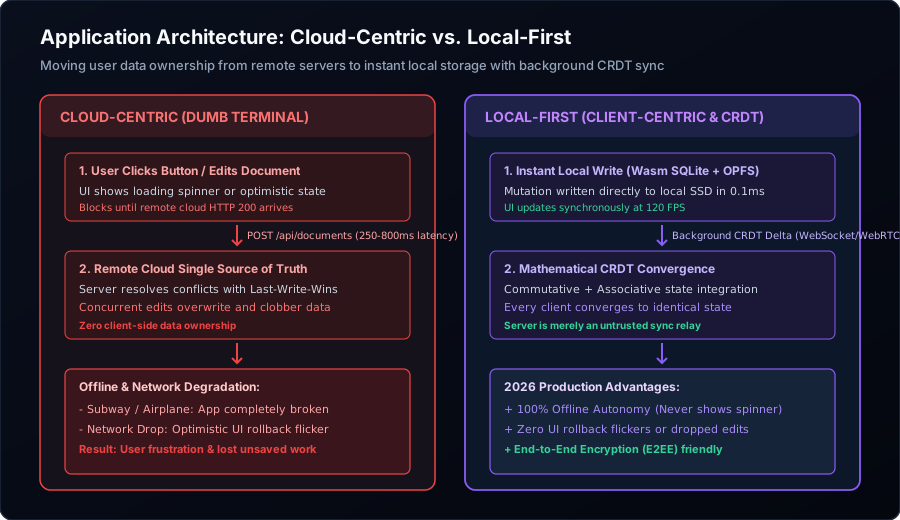
Figure 1: Architectural comparison: Cloud-centric request/response with optimistic UI rollbacks vs. Local-First architecture with local-read/write and background CRDT synchronization.
The Seven Ideals of Local-First Software
Pioneered in research by Martin Kleppmann, Adam Wiggins, Peter van Hardenberg, and Mark McGranaghan, local-first software is defined by seven core architectural tenets:
- Zero-Latency Interaction: All data reads and writes execute synchronously against local storage in under 1 millisecond. The user never waits on a network round-trip to view or mutate their data.
- Multi-Device Ubiquity: Users access and edit their data across phones, tablets, and desktop workstations. State reconciles seamlessly across all devices upon reconnection.
- Offline by Default: The application functions completely and indefinitely without an internet connection. Going offline is not treated as an exceptional error state; it is the default operational baseline.
- Autonomous Collaboration: Multiple users can concurrently edit shared documents or workspaces simultaneously without locking records or overwriting each other's work.
- The Longevity of Data: The user retains ownership of their data in open, readable file formats (e.g., SQLite). Even if the company operating the cloud sync servers goes bankrupt or shuts down, the user's data remains accessible forever.
- User Control and Privacy: Because data is stored and processed locally, applications can implement true End-to-End Encryption (E2EE). Cloud sync relays merely store and route encrypted binary blobs, preventing server operators from reading sensitive user content.
- Retained Cloud Flexibility: The cloud is retained for what it does best: automated backup, real-time message routing, and cross-organization sharing.
The Client Storage Engine: WebAssembly SQLite via OPFS
To deliver on the promise of zero-latency local-first software, the browser must provide a storage engine that is fast, structured, ACID-compliant, and durable across page refreshes.
1. Why IndexedDB Failed the Local-First Era
Historically, the only structured storage API available in browsers was IndexedDB. However, every senior web engineer who has built complex client-side applications has encountered IndexedDB's crippling limitations:
- No SQL or Relational Joins: IndexedDB is a primitive object store. Querying complex relational graphs requires manual JavaScript cursor loops, which saturate main-thread CPU cycles.
- Implicit Transaction Auto-Commit: If an asynchronous microtask (like an unresolved Promise) yields during an IndexedDB transaction, the browser automatically commits and closes the transaction, triggering subtle race conditions.
- Catastrophic I/O Overhead: IndexedDB implementations in major browsers layer multiple levels of serialization, IPC, and SQLite translations, yielding pathetic write performance (often under 500 writes per second).
2. The Breakthrough: The Origin Private File System (OPFS)
The game-changing standard that unlocked local-first performance in 2026 is the Origin Private File System (OPFS), part of the File System Access API. OPFS provides a private, sandboxed filesystem root accessible exclusively to your web origin.
Crucially, inside a Dedicated Web Worker, OPFS exposes the FileSystemSyncAccessHandle interface. Unlike standard asynchronous browser file APIs, a sync access handle provides synchronous, raw byte read and write operations directly to underlying operating system storage blocks:
// Inside a Dedicated Web Worker: Zero-overhead synchronous filesystem access
const root = await navigator.storage.getDirectory();
const fileHandle = await root.getFileHandle("app_database.sqlite3", { create: true });
const syncHandle: FileSystemSyncAccessHandle = await fileHandle.createSyncAccessHandle();

// Synchronous binary read and write operations at native NVMe SSD speeds
const buffer = new Uint8Array(4096);
syncHandle.read(buffer, { at: 0 });
syncHandle.write(buffer, { at: 4096 });
syncHandle.flush();
3. SQLite in WebAssembly: Native Speeds in the Sandbox
By compiling SQLite's official C codebase to WebAssembly using Emscripten and binding its Virtual File System (VFS) to OPFS via FileSystemSyncAccessHandle, browsers can now run a full, production-grade SQLite engine at over 65,000 IOPS—matching native desktop application performance!
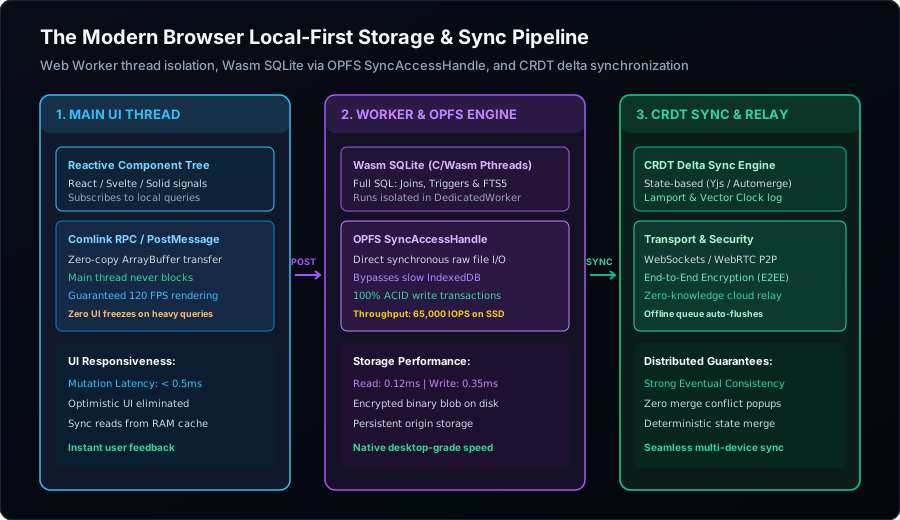
Figure 2: The Browser Storage & Sync Pipeline: Main UI thread reactive queries -> Web Worker with Wasm SQLite + OPFS SyncAccessHandle -> WebSocket delta exchange with Lamport/Vector Clock reconciliation.
Thread Isolation: The Web Worker Pipeline
A fundamental rule of modern frontend engineering is: Never block the Main Thread. If a user triggers a complex analytical SQL aggregation or merges a 10MB CRDT state vector on the main thread, the browser will drop frames, causing visible stutter in CSS animations, input lag, and catastrophic UX degradation.
In a modern local-first architecture, all database operations, cryptographic signing, and CRDT synchronizations are completely offloaded to a background Dedicated Web Worker:
// =====================================================================
// BROWSER MAIN THREAD: REACTIVE HOOK BINDING TO WORKER SQLITE
// =====================================================================
import { useEffect, useState } from "react";
import * as Comlink from "comlink";
import type { DatabaseWorkerApi } from "./db.worker";

// Wrap Web Worker in Comlink RPC
const worker = new Worker(new URL("./db.worker.ts", import.meta.url), { type: "module" });
const dbApi = Comlink.wrap(worker);

export function useLiveQuery(sql: string, params: any[] = []): T[] {
  const [data, setData] = useState([]);

  useEffect(() => {
    let isMounted = true;

    // Execute initial query against Wasm SQLite
    dbApi.query(sql, params).then((results) => {
      if (isMounted) setData(results);
    });

    // Subscribe to reactive table mutation events from the worker
    const unsubscribe = dbApi.onTableChange(Comlink.proxy((changedTable: string) => {
      // Re-run query if table was mutated locally or via remote CRDT delta
      dbApi.query(sql, params).then((results) => {
        if (isMounted) setData(results);
      });
    }));

    return () => {
      isMounted = false;
      unsubscribe.then(unsub => unsub());
    };
  }, [sql, JSON.stringify(params)]);

  return data;
}
The Conflict Resolution Engine: CRDTs (Conflict-Free Replicated Data Types)
When multiple users edit data offline or on separate devices, their local database states inevitably diverge. In traditional systems, resolving these differences required complex centralized locking or Last-Write-Wins (LWW) heuristics, which silently overwrite and discard user work.
Local-first software solves this with Conflict-Free Replicated Data Types (CRDTs). A CRDT is a specialized mathematical data structure that can be replicated across multiple independent nodes. Even if nodes receive mutations in different orders, or while completely disconnected, they are guaranteed to converge to the exact same state once all mutations have been exchanged.
1. Mathematical Foundations: The Join-Semilattice
State-based CRDTs (CvRDTs) rely on the mathematical properties of a bounded join-semilattice: a partially ordered set equipped with a merge operator ($\sqcup$) that satisfies three strict axioms:
- Commutativity: $A \sqcup B = B \sqcup A$ (The order in which two updates arrive does not affect the final state).
- Associativity: $(A \sqcup B) \sqcup C = A \sqcup (B \sqcup C)$ (Grouping of updates does not matter; packets can be batched arbitrarily).
- Idempotency: $A \sqcup A = A$ (Applying the same update multiple times produces no side effects, enabling safe network retries).
2. The Text & Sequence Dilemma: RGA and YATA
While simple counters (PN-Counters) and maps (LWW-Element-Set) are straightforward, collaborative text and array editing is notoriously difficult. If User A types "C" at index 0 and User B types "D" at index 0 simultaneously, naive index-based insertion results in character transposition, duplication, or corruption.
Modern production CRDT libraries—such as Yjs (using the YATA algorithm) and Automerge (using RGA / Fugue)—solve this by assigning every character an immutable, globally unique identifier consisting of a (client_id, clock_seq) tuple, along with explicit cryptographic pointers to the character's left and right origin neighbors. When merging concurrent insertions between the same two neighbors, the algorithm deterministically orders conflicting characters using the client ID as a mathematical tie-breaker.
3. Implementing Collaborative CRDT Sync in TypeScript
Here is how a modern local-first application integrates Yjs with an embedded SQLite persistence layer and a WebSocket delta relay:
// =====================================================================
// PRODUCTION CRDT SYNC ENGINE (YJS + WEBSOCKET DELTA RELAY)
// =====================================================================
import * as Y from "yjs";
import { fromUint8Array, toUint8Array } from "js-base64";

export class LocalFirstSyncEngine {
  private doc: Y.Doc;
  private ws: WebSocket | null = null;
  private isOnline: boolean = navigator.onLine;

  constructor(private documentId: string, private onLocalStatePersist: (binaryState: Uint8Array) => Promise) {
    this.doc = new Y.Doc();

    // 1. Observe local document changes
    this.doc.on("update", async (update: Uint8Array, origin: any) => {
      // Avoid re-emitting updates received from remote network
      if (origin !== "remote-network") {
        // Persist update immediately to local SQLite OPFS database
        await this.onLocalStatePersist(Y.encodeStateAsUpdate(this.doc));

        // If online, broadcast binary delta to remote peers
        if (this.ws && this.ws.readyState === WebSocket.OPEN) {
          this.ws.send(update);
        }
      }
    });

    this.initNetworkSync();
  }

  // 2. Manage WebSocket Network Sync
  private initNetworkSync() {
    window.addEventListener("online", () => this.connectWebSocket());
    window.addEventListener("offline", () => this.cleanupWebSocket());

    if (this.isOnline) {
      this.connectWebSocket();
    }
  }

  private connectWebSocket() {
    this.ws = new WebSocket(`wss://sync.mangobaz.com/v1/documents/${this.documentId}`);
    this.ws.binaryType = "arraybuffer";

    this.ws.onopen = () => {
      // Send our current state vector to the server
      const stateVector = Y.encodeStateVector(this.doc);
      this.ws?.send(stateVector);
    };

    this.ws.onmessage = (event: MessageEvent) => {
      const incomingDelta = new Uint8Array(event.data);

      // Atomically apply remote delta into our local CRDT doc
      Y.applyUpdate(this.doc, incomingDelta, "remote-network");
    };
  }

  private cleanupWebSocket() {
    if (this.ws) {
      this.ws.close();
      this.ws = null;
    }
  }

  public getSharedMap(name: string): Y.Map {
    return this.doc.getMap(name);
  }
}
End-to-End Encryption (E2EE): Zero-Knowledge Sync
One of the most transformative advantages of local-first software is that the cloud server does not need to understand your application schema. Because the client handles validation, querying, and CRDT merging, the cloud server functions merely as an untrusted message broker and binary blob store.
By leveraging the browser's native Web Crypto API (window.crypto.subtle), applications can encrypt CRDT update vectors using AES-256-GCM on the client before transmitting them across WebSockets. The cloud sync server sees only opaque ciphertext, guaranteeing complete user privacy against surveillance, data leaks, and unauthorized access.
// Client-Side E2EE Encryption of CRDT Update Vectors
export async function encryptDelta(update: Uint8Array, key: CryptoKey): Promise {
  const iv = crypto.getRandomValues(new Uint8Array(12)); // 96-bit initialization vector
  const ciphertext = await crypto.subtle.encrypt(
    { name: "AES-GCM", iv },
    key,
    update
  );

  // Combine IV + Ciphertext into single payload
  const payload = new Uint8Array(iv.length + ciphertext.byteLength);
  payload.set(iv, 0);
  payload.set(new Uint8Array(ciphertext), iv.length);
  return payload;
}
Tombstone Pruning and State Garbage Collection
In distributed CRDT systems, deleting an item cannot immediately free memory. The system must record a tombstone—a cryptographic marker proving that the item existed and was deleted—to prevent an offline node from reconnecting later and re-inserting the item.
If left unmanaged, tombstones accumulate over months of usage, causing memory bloat and sluggish sync times. In 2026, production local-first architectures employ Vector Clock Compaction (State Snapshots):
- Nodes track peers using Vector Clocks (a map of
client_id -> max_sequence_number). - When all authorized user devices have acknowledged receiving mutations up to timestamp $T$, all tombstones older than $T$ are safely pruned from the active CRDT document.
- The pruned state is flattened into a compacted baseline snapshot in SQLite, reducing database size by up to 90%.
Summary: The 2026 Local-First Architectural Blueprint
The convergence of modern browser capabilities and distributed consensus algorithms has made local-first architecture the definitive design pattern for high-fidelity web and mobile applications:
- Local-First, Cloud-Assisted: Store data in an embedded client database. Make the UI respond instantly to local writes without waiting for network round-trips.
- Harness OPFS & Web Workers: Run WebAssembly SQLite inside Dedicated Web Workers using
FileSystemSyncAccessHandle. Achieve 65,000+ IOPS directly against local flash storage without dropping a single UI frame. - Reconcile via CRDTs: Eliminate merge conflicts and optimistic rollback flickers using state-based CRDT algorithms (Yjs/Automerge). Let mathematics guarantee eventual consistency across devices.
- Protect Privacy with E2EE: Encrypt CRDT deltas on the client using AES-GCM. Turn your cloud backend into a secure, zero-knowledge sync relay.
By breaking free from cloud-centric request-response bottlenecks, software engineers in 2026 can build applications that feel instantaneously fast, function seamlessly everywhere on Earth, and return unconditional data ownership to their users.