Table of Contents (Jump to section)
For over a decade, enterprise data infrastructure suffered under the weight of an awkward architectural compromise: the Lambda Architecture. Organizations maintained two fundamentally disjointed data pipelines. On one side was a real-time event streaming pipeline powered by Apache Kafka, delivering low-latency alerts and operational dashboards. On the other side was a massive, slow-moving batch processing pipeline (Hadoop, MapReduce, or hourly Spark jobs) responsible for writing immutable data lakes, correcting streaming errors, and powering business intelligence reports.
The operational overhead of Lambda architecture was notoriously punishing. Engineering teams were forced to maintain duplicate business logic in two different programming languages, recompute historical aggregations nightly, and reconcile discrepancies when streaming state diverged from batch data. Furthermore, Apache Kafka itself carried significant operational debt: it required an entirely separate distributed cluster—Apache ZooKeeper—to manage metadata and controller elections, while keeping massive volumes of historical event logs on expensive provisioned block storage (EBS / NVMe).
In 2026, the streaming and data lakehouse landscapes have finally unified. With the maturation of KRaft (Kafka Raft Metadata Mode), the enterprise rollout of KIP-405 Tiered Storage, and the explosive adoption of Apache Iceberg as the open transactional table standard, the traditional boundary between real-time streaming and analytical data warehousing has evaporated.
In this masterclass tutorial, we will deconstruct how modern data architects build unified streaming lakehouses. We will dissect KRaft's internal consensus protocol, configure multi-tiered cloud storage, enforce end-to-end Exactly-Once Semantics (EOS v2), and stream high-throughput Kafka topics directly into ACID-compliant Apache Iceberg tables with sub-30-second query freshness.
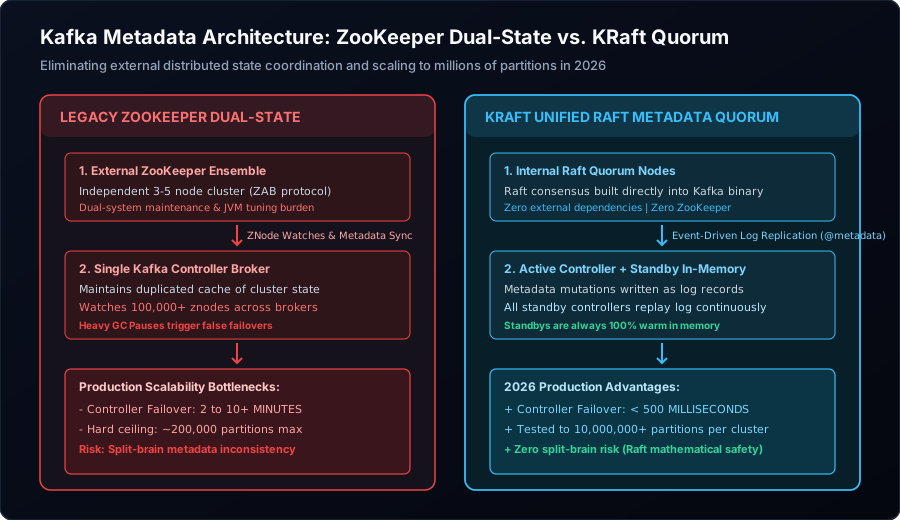
Figure 1: Architectural evolution: Fragile ZooKeeper dual-metadata consensus vs. KRaft unified event-driven metadata quorum with sub-second failover.
The Death of ZooKeeper: Inside the KRaft Consensus Engine
For early generations of Kafka, Apache ZooKeeper was an indispensable dependency. ZooKeeper stored cluster topology, broker registrations, dynamic topic configurations, and partition leader/ISR (In-Sync Replicas) states. However, as enterprise clusters scaled beyond 100,000 partitions, ZooKeeper became Kafka's ultimate Achilles' heel.
1. The Dual-Metadata State Problem
In the ZooKeeper model, metadata lived in two separate places:
- The external ZooKeeper ensemble (which maintained the canonical tree of ZNodes via the ZAB atomic broadcast protocol).
- The active Kafka Controller (a single designated broker that loaded the entire ZooKeeper state into memory and sent RPC commands to other brokers).
This dual-state design introduced severe synchronization hazards. Whenever the active controller broker suffered a hardware failure, network hiccup, or a prolonged Java Full GC pause, a new controller had to be elected. The new controller was forced to read the complete state of every single partition, topic, and replica out of ZooKeeper across the network.
For large clusters managing 200,000+ partitions, this failover process routinely took 5 to 15 minutes. During this protracted window, no new topics could be created, partition reassignment was paralyzed, and any broker failure resulted in cluster-wide write stalls and cascading consumer timeouts.
2. The KRaft Paradigm Shift (KIP-500 & KIP-833)
KRaft (Kafka Raft Metadata mode) completely eliminates ZooKeeper by internalizing consensus directly into the Kafka binary. Instead of treating metadata as an external key-value hierarchy, KRaft treats cluster metadata as an internal, append-only, replicated event log stored on a dedicated internal topic: @metadata.
Under KRaft:
- Dedicated Controller Quorum: A small subset of brokers (typically 3 or 5 nodes) are designated as the KRaft Controller Quorum. They run an optimized implementation of the Raft consensus protocol.
- Instantaneous In-Memory Standbys: One controller is elected as the active Raft Leader. The remaining standby controllers do not sit idle; they continuously replicate the
@metadatapartition and apply events to an in-memory state machine in real time. - Sub-500ms Failover: When the active KRaft leader fails, the remaining quorum members instantly detect the missing heartbeat and elect a new leader in under 500 milliseconds. Because the new leader's in-memory metadata state is already 100% warm, cluster operations resume immediately with zero cold-start delay.
- Scale Ceiling Smashed: By discarding the overhead of ZooKeeper watches and network ZNode serialization, modern KRaft clusters comfortably manage over 10,000,000 partitions on a single cluster.
3. Production KRaft Configuration Recipe
To configure a high-availability, multi-node KRaft cluster in 2026, deploy the following configuration across your controller and broker nodes:
# =====================================================================
# KAFKA 3.8+ / 4.0 KRAFT QUORUM & BROKER CONFIGURATION
# =====================================================================

# Declare node roles (Combined broker+controller or isolated)
process.roles=broker,controller
node.id=1

# Quorum voters: format is node_id@host:port
controller.quorum.voters=1@kafka-01.internal:9093,2@kafka-02.internal:9093,3@kafka-03.internal:9093

# Network listeners
listeners=PLAINTEXT://kafka-01.internal:9092,CONTROLLER://kafka-01.internal:9093
inter.broker.listener.name=PLAINTEXT
controller.listener.names=CONTROLLER

# Storage directories
log.dirs=/var/lib/kafka/data
metadata.log.dir=/var/lib/kafka/metadata

# Raft performance tuning
controller.quorum.election.timeout.ms=1000
controller.quorum.fetch.timeout.ms=2000
metadata.max.idle.interval.ms=500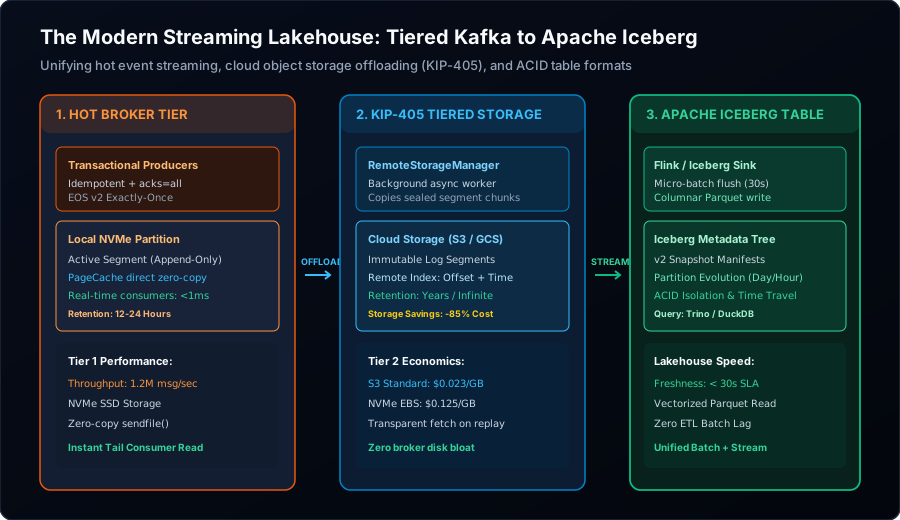
Figure 2: The Modern Streaming Lakehouse: Hot local NVMe partition caching with automated cloud object tiered storage (KIP-405) and zero-copy Apache Iceberg Parquet compaction.
Slashing Cloud Costs by 85%: KIP-405 Tiered Storage
Historically, one of the most painful operational dilemmas in Apache Kafka was data retention vs. storage cost. Kafka partitions store events in immutable segment files (typically 1GB per segment). To guarantee low-latency writes and fast page-cache reads, these segments resided on local attached disks: AWS EBS gp3/io2 volumes, Azure Managed Disks, or bare-metal NVMe drives.
Because high-performance block storage costs between $0.08 and $0.16 per GB/month, retaining weeks or months of raw event logs was financially prohibitive. Organizations were forced to enforce aggressive 24-hour or 7-day retention limits, prematurely truncating event histories and forcing downstream systems to consume data immediately.
1. Architecture of Tiered Storage (Remote Storage Manager)
Introduced in KIP-405 and battle-hardened for enterprise production in modern Kafka releases, Tiered Storage decouples compute from storage by dividing partition data into two distinct tiers:
- The Local Tier (Hot NVMe Cache): Contains the active append segment and the most recent sealed segments. This tier satisfies 99% of all real-time consumer traffic (tail-reads) directly out of local memory and NVMe flash with sub-millisecond latency.
- The Remote Tier (Cold Cloud Object Storage): As soon as a local log segment reaches its size limit (e.g., 1GB) and is sealed, a background worker thread managed by the
RemoteStorageManager(RSM) asynchronously streams the segment and its offset/timestamp index files to cloud object storage (Amazon S3, Google Cloud Storage, or MinIO).
2. The Remote Index and Transparent Replay
Once an immutable segment is safely acknowledged in cloud object storage, Kafka's local retention policy purges the local copy from the broker's disk. However, the broker retains a lightweight Remote Log Metadata index.
When an analytical query, historical backfill job, or auditing consumer requests offsets from 6 months ago, the Kafka broker detects that the requested offsets reside in Tier 2. The broker streams the segment directly from cloud object storage over HTTP and serves it to the consumer using the standard Kafka consumer protocol. The consumer application requires zero code changes or special drivers!
The Economic Math: Amazon S3 Standard costs approximately $0.023/GB/month, while S3 Infrequent Access is under $0.0125/GB/month. By offloading 95% of historical partition data from EBS gp3 ($0.08/GB) to S3, enterprise streaming architectures slash overall infrastructure costs by over 80% to 85% while unlocking years of historical event replay on demand.
3. Enabling Tiered Storage in Production
To activate KIP-405 on a Kafka broker cluster backed by Amazon S3, configure the following properties in server.properties:
# =====================================================================
# KIP-405 TIERED STORAGE CONFIGURATION (AMAZON S3 BACKEND)
# =====================================================================

# Enable tiered storage on the cluster
remote.log.storage.system.enable=true

# Remote Storage Manager plugin class and classpath
remote.log.manager.class.name=org.apache.kafka.server.log.remote.storage.RemoteLogManager
remote.log.metadata.manager.class.name=org.apache.kafka.server.log.remote.storage.TopicBasedRemoteLogMetadataManager

# Remote storage implementation (S3 plugin)
remote.log.storage.manager.class.name=io.aiven.kafka.tieredstorage.RemoteStorageManager
remote.log.storage.manager.impl.prefix=remote.log.s3.
remote.log.s3.s3.bucket.name=mangobaz-kafka-tiered-storage-prod
remote.log.s3.s3.region=us-east-1

# Local retention vs Remote retention
# Keep 12 hours of data locally on NVMe; retain 365 days in S3
log.local.retention.ms=43200000
log.retention.ms=31536000000

# Segment upload thread pool
remote.log.manager.thread.pool.size=16
Streaming Directly into the Lakehouse: Apache Iceberg
While Kafka provides the ultimate immutable real-time log, downstream data analysts, data scientists, and ML models do not query Kafka topics directly. They require columnar compression (Apache Parquet), expressive SQL joins, filter pushdowns, and ACID transactions.
In the past, getting data from Kafka into a data lake required heavy, fragile batch ETL jobs. In 2026, the gold standard is direct continuous streaming ingestion into Apache Iceberg.
1. Why Apache Iceberg Won the Table Format Wars
Unlike legacy Hive-style tables (which tracked datasets by directory layout on disk, causing catastrophic race conditions during file renaming), Apache Iceberg tracks all files using an explicit, hierarchical Metadata Tree:
- Iceberg Catalog: Stores the pointer to the latest table metadata file (e.g., AWS Glue, Nessie, or REST Catalog).
- Metadata File (
vN.metadata.json): Stores the table schema, partition specs, and an array of historical snapshots. - Manifest List (
snap-N.avro): Represents a snapshot and points to one or more manifest files. - Manifest Files (
manifest-N.avro): Stores the exact list of individual Parquet data files, along with partition boundaries and per-column min/max statistics for instant predicate pushdown. - Data Files (
*.parquet): The actual compressed columnar data blocks.
Because Iceberg commits are atomic swaps of the root metadata pointer, writers can commit new streaming micro-batches continuously while analytical engines (Trino, DuckDB, Spark, ClickHouse) query the table with full ACID snapshot isolation and zero table locking.
2. Streaming Ingestion Pipeline with Apache Flink & Iceberg
The premier engine for streaming Kafka events into Iceberg is Apache Flink. Flink's native checkpointing mechanism aligns perfectly with Iceberg's snapshot model:
-- =====================================================================
-- FLINK SQL: CONTINUOUS STREAMING SINK FROM KAFKA TO APACHE ICEBERG
-- =====================================================================

-- 1. Create Kafka Source Table
CREATE TABLE kafka_transactions (
    transaction_id VARCHAR,
    account_id VARCHAR,
    amount_cents BIGINT,
    currency VARCHAR(3),
    event_time TIMESTAMP(3),
    WATERMARK FOR event_time AS event_time - INTERVAL '5' SECOND
) WITH (
    'connector' = 'kafka',
    'topic' = 'financial.transactions.v1',
    'properties.bootstrap.servers' = 'kafka-01.internal:9092,kafka-02.internal:9092',
    'properties.group.id' = 'flink-iceberg-ingest-group',
    'scan.startup.mode' = 'latest-offset',
    'format' = 'json'
);

-- 2. Create Destination Apache Iceberg Lakehouse Table
CREATE TABLE iceberg_catalog.lakehouse.transactions (
    transaction_id STRING,
    account_id STRING,
    amount_cents BIGINT,
    currency STRING,
    event_time TIMESTAMP(3),
    dt DATE,
    hour INT
) PARTITIONED BY (dt, hour)
WITH (
    'write.format.default' = 'parquet',
    'write.parquet.compression-codec' = 'zstd',
    'write.metadata.previous-versions-max' = '10',
    'history.expire.max-snapshot-age-ms' = '86400000'
);

-- 3. Execute Continuous Streaming Pipeline with Partition Projection
INSERT INTO iceberg_catalog.lakehouse.transactions
SELECT
    transaction_id,
    account_id,
    amount_cents,
    currency,
    event_time,
    CAST(event_time AS DATE) AS dt,
    EXTRACT(HOUR FROM event_time) AS hour
FROM kafka_transactions;
3. Managing Small Files & Automated Compaction
When streaming data into Parquet files with low latency (e.g., committing snapshots every 30 seconds), you inevitably encounter the "Small File Problem": hundreds of tiny 5MB Parquet files that degrade analytical read performance.
Modern Iceberg architectures resolve this with concurrent asynchronous compaction. While Flink continues appending micro-batch data files to the live table, an automated maintenance worker runs periodic rewrite operations in the background without interrupting streaming writes or analytical queries:
-- Trino / Spark SQL maintenance command: Rewriting small Parquet files into 512MB chunks
CALL iceberg_catalog.system.rewrite_data_files(
    table => 'lakehouse.transactions',
    strategy => 'binpack',
    options => map('max-file-size-bytes', '536870912', 'min-file-size-bytes', '134217728')
);

-- Expire obsolete historical snapshots older than 24 hours
CALL iceberg_catalog.system.expire_snapshots(
    table => 'lakehouse.transactions',
    older_than => TIMESTAMP '2026-10-18 00:00:00.000'
);
Enforcing Exactly-Once Semantics (EOS v2) Across the Pipeline
In high-stakes enterprise domains (payments, supply chain, automated telemetry), duplicate messages or partial writes are completely unacceptable. Modern Kafka achieves end-to-end Exactly-Once Semantics (EOS v2) through the convergence of three mechanisms:
- Idempotent Producers: Each producer is assigned a 64-bit Producer ID (PID). For each topic-partition, the producer maintains a strictly monotonically increasing sequence number for every message. If a transient network glitch causes a retry, the Kafka broker inspects the sequence number and transparently discards duplicates before persisting to disk.
- Transactional Coordinator & Two-Phase Commit (2PC): When a stream processor (such as Kafka Streams or Flink) reads an event from Topic A, computes a state change, and writes to Topic B, it wraps the entire sequence in a transaction. The Transaction Coordinator writes an initial commit marker to the internal
__transaction_statelog, instructs partition leaders to write commit markers, and marks the transaction complete. - Isolation Level: Downstream consumers configure
isolation.level=read_committed. The consumer's fetcher automatically buffers incoming messages and only exposes records to application code once an explicitCOMMITmarker is observed in the log. Aborted transactions are skipped in memory with zero application leakage.
// Production Exactly-Once Producer Configuration in Java / C#
Properties props = new Properties();
props.put(ProducerConfig.BOOTSTRAP_SERVERS_CONFIG, "kafka-01.internal:9092");
props.put(ProducerConfig.ENABLE_IDEMPOTENCE_CONFIG, "true");
props.put(ProducerConfig.ACKS_CONFIG, "all"); // Require all ISR acknowledgments
props.put(ProducerConfig.TRANSACTIONAL_ID_CONFIG, "tx-billing-pipeline-node-01");
props.put(ProducerConfig.MAX_IN_FLIGHT_REQUESTS_PER_CONNECTION, "5");

KafkaProducer producer = new KafkaProducer(props);
producer.initTransactions();

try {
    producer.beginTransaction();
    producer.send(new ProducerRecord("orders.v1", orderId, jsonPayload));
    producer.send(new ProducerRecord("audit.v1", orderId, "TRANSACTION_AUTHORIZED"));
    producer.commitTransaction();
} catch (ProducerFencedException | OutOfOrderSequenceException e) {
    // Fatal transaction error: Close producer immediately
    producer.close();
} catch (KafkaException e) {
    // Transient error: Abort and retry
    producer.abortTransaction();
}
Operational Runbook: Monitoring KRaft & Storage Health
To ensure high availability and prevent data loss across your Kafka and Iceberg infrastructure, deploy these automated observability checks:
1. Inspecting KRaft Quorum Membership & Replication Lag
# Check KRaft leader ID, voter IDs, and active metadata log offset
bin/kafka-metadata-shell.sh --snapshot /var/lib/kafka/metadata/__cluster_metadata-0/00000000000000000000.checkpoint

# Query real-time KRaft voter status using the kafka-metadata-quorum tool
bin/kafka-metadata-quorum.sh --bootstrap-server kafka-01.internal:9092 describe --status

# Expected output:
# LeaderId:            1
# LeaderEpoch:         14
# HighWatermark:       948120
# MaxFollowerLag:      0
# MaxFollowerLagTimeMs: 12
2. Monitoring Tiered Storage Offload Backlog
# Monitor JMX MBean for Remote Storage Manager upload throughput and error rates
# Metric: kafka.server:type=RemoteLogManager,name=RemoteLogManagerBytesUploadedPerSec
# Metric: kafka.server:type=RemoteLogManager,name=RemoteLogManagerErrorsPerSec

curl -s localhost:7071/metrics | grep -E "RemoteLogManagerBytes|RemoteLogManagerErrors"
Summary: The Unified Data Architecture Checklist
The convergence of Apache Kafka and Apache Iceberg marks the definitive end of the fragmented Lambda Architecture. When designing enterprise streaming data platforms in 2026, adhere to these architectural standards:
- Standardize on KRaft: Discard ZooKeeper. Leverage in-memory Raft standby controllers for sub-second failover and multi-million partition scalability.
- Activate KIP-405 Tiered Storage: Confine expensive NVMe block storage to hot active writes (12 to 24 hours). Offload historical segments asynchronously to S3/GCS to cut infrastructure costs by up to 85% while enabling infinite historical stream replay.
- Stream Directly to Apache Iceberg: Eliminate batch ETL lag by streaming events directly into Parquet-backed Iceberg tables. Leverage automated background compactions to keep table scans blazing fast for modern SQL analytical engines.
- Enforce EOS v2: Protect transactional integrity with idempotent producers, 2PC transaction coordinators, and
read_committedisolation levels.
By pairing Kafka's high-throughput event log with Apache Iceberg's open transactional table format, modern software engineering teams achieve the holy grail of data systems: sub-second operational event streaming unified seamlessly with planetary-scale analytical intelligence.