Table of Contents (Jump to section)
Asynchronous programming in Rust is frequently heralded as a triumph of zero-cost abstractions. In languages like Go, Erlang, or Java (with Project Loom), asynchronous concurrency is achieved through stackful green threads (coroutines) managed by a heavyweight runtime. In those environments, every coroutine allocates its own resizable call stack, and context switches involve saving and restoring CPU registers.
Rust took an entirely different, uncompromising path: stackless, poll-based state machines with zero runtime cost. An async fn in Rust does not allocate an independent thread stack, nor does it require a garbage collector to track memory lifetimes. Instead, the Rust compiler transforms your asynchronous control flow into a compact, contiguous enum representing an explicit finite state machine. When paused at an .await point, the future consumes only the exact bytes required to store its local variables.
However, this zero-cost model introduces some of the steepest conceptual hurdles in modern systems engineering: self-referential structs, the mathematical necessity of Pin<&mut Self>, the mechanics of Waker dispatch, and the treacherous footgun of cancellation safety in tokio::select!.
In this architectural deep dive, we will peel back the abstraction layers of asynchronous Rust as of 2026. We will trace execution from compiler-synthesized state machines down to raw memory addresses, dissect the Tokio work-stealing scheduler's 256-slot ring buffers, and engineer robust, cancellation-safe network engines.
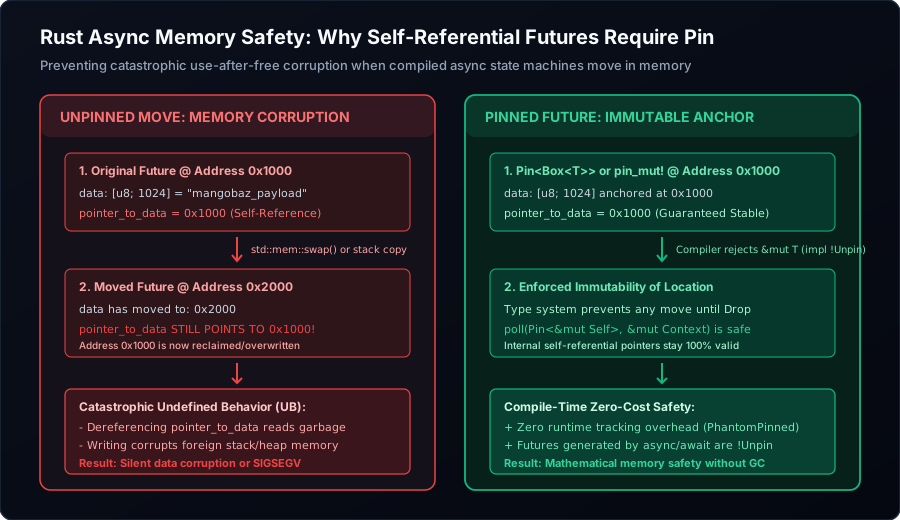
Figure 1: Memory layout and pointer invalidation: Why self-referential async state machines require Pin<&mut Self> to prevent catastrophic memory corruption upon moving.
The Core Abstraction: The Future Trait and Poll Mechanics
At the epicenter of Rust's asynchronous model lies the standardized std::future::Future trait. Defined in the standard library, its contract is deceptively simple:
pub trait Future {
    type Output;

    fn poll(self: Pin<&mut Self>, cx: &mut Context<'_>) -> Poll<Self::Output>;
}

pub enum Poll<T> {
    Ready(T),
    Pending,
}
1. Pull vs. Push Concurrency
Most asynchronous programming languages (such as JavaScript with Promises or C# with Tasks) operate on a push-based model. When you create a Promise or Task, execution starts immediately in the background, and callbacks or continuation queues are triggered upon completion.
Rust futures are strictly pull-based (demand-driven). In Rust, futures do nothing unless polled. If you construct a future and do not pass it to an executor (like Tokio) or .await it, zero CPU cycles are consumed, zero network packets are sent, and zero system calls are made. This lazy evaluation gives Rust programs immense composability, allowing timeouts, cancellation, and racing to be implemented without thread synchronization primitives.
2. The Execution Loop and the Context
When an asynchronous runtime polls a future:
- The executor invokes
Future::poll(), passing a mutable reference to aContext. - The
Contextencapsulates a&Waker. If the future can complete immediately (for example, reading from an already-buffered socket), it returnsPoll::Ready(output). - If the operation must wait on an external event (such as an incoming TCP packet or an NVMe Direct I/O completion), the future registers the
Wakerwith an I/O reactor (likemioor Linuxio_uring) and returnsPoll::Pending. - The executor does not busy-poll in a tight CPU loop. Instead, the current worker thread moves on to execute other active tasks or parks until the registered
Wakerwakes it up.
The Mystery of Pinning: Why Pin Exists
Every Rust developer encounters Pin<P>, and almost every developer initially struggles with it. Why does poll() take Pin<&mut Self> instead of a standard mutable reference &mut Self?
1. The Origin: Self-Referential Structs
In standard synchronous Rust, structs are strictly non-self-referential. A struct cannot easily contain a field that points directly to another field within the same struct, because Rust guarantees that any value can be moved in memory (via assignment, passing by value, or std::mem::swap). Moving a struct copies its bytes to a new stack or heap address. If a struct contained a pointer to itself, moving it would cause that pointer to become an invalid, dangling reference to the old location.
However, asynchronous functions routinely require self-referential references across .await points! Consider this ordinary async function:
async fn process_packet() -> Result<usize, std::io::Error> {
    let mut buffer = [0u8; 1024];
    let slice: &mut [u8] = &mut buffer[0..512]; // Internal reference to local variable

    tokio::fs::File::open("packet.bin").await?.read_exact(slice).await?;

    Ok(slice.len())
}
When the compiler transforms process_packet into a state machine, the local variable buffer and the reference slice must both be preserved inside the generated state struct across the .await boundary. The generated compiler struct looks conceptually like this:
// Conceptually generated by the Rust compiler
enum ProcessPacketStateMachine {
    Start,
    WaitingOnOpen {
        buffer: [u8; 1024],
    },
    WaitingOnRead {
        buffer: [u8; 1024],
        slice: *mut [u8], // DANGER: Raw pointer pointing directly into self.buffer!
    },
    Done,
}
Notice that slice points directly to the memory address of buffer inside the same struct! If this future is moved to another thread or relocated on the heap while waiting for read_exact, buffer moves to a new memory address, but slice still points to the old, reclaimed memory address. Dereferencing slice would trigger catastrophic use-after-free undefined behavior (UB).
2. The Pin Invariant
To eliminate this risk without introducing a garbage collector, Rust introduced the Pin type wrapper. Pin wraps a pointer type (such as &mut T or Box<T>) and guarantees an ironclad contract:
The Pin Invariant: Once a value that does not implement
Unpinhas been pinned, it is guaranteed that the memory containing that value will never be moved or reallocated until itsDropdestructor has run.
3. Unpin vs. !Unpin
Rust uses auto-traits to distinguish between types that care about memory location and types that do not:
Unpin(The Default): Almost every standard Rust type (i32,String,Vec<T>, custom structs) implementsUnpin. For these types, pinning does nothing. APin<&mut String>can be freely converted back into a&mut StringusingPin::get_mut()because moving a string does not invalidate any internal pointers.!Unpin(Pinned Only): Types generated byasync { ... }blocks andasync fnautomatically implement!Unpinif they contain references across an.awaitpoint. Custom types can opt out ofUnpinby including astd::marker::PhantomPinnedfield. For a!Unpintype, you cannot obtain a mutable reference&mut TfromPin<&mut T>using safe code. You can only access it through pinned projection.
4. Pinning in Practice: Heap vs. Stack
There are two ways to pin a future in production Rust:
use std::pin::Pin;

// 1. Heap Pinning (Box::pin): Allocates on heap, easy and versatile
let pinned_boxed_future: Pin<Box<dyn Future<Output = ()>>> = Box::pin(async {
    // async work
});

// 2. Stack Pinning (tokio::pin! macro): Zero allocations, anchors directly to current stack frame
let local_future = async {
    // async work
};
tokio::pin!(local_future); // Shadowed as Pin<&mut LocalFuture>

// Pinned future can now be safely passed to poll() or tokio::select!
local_future.await;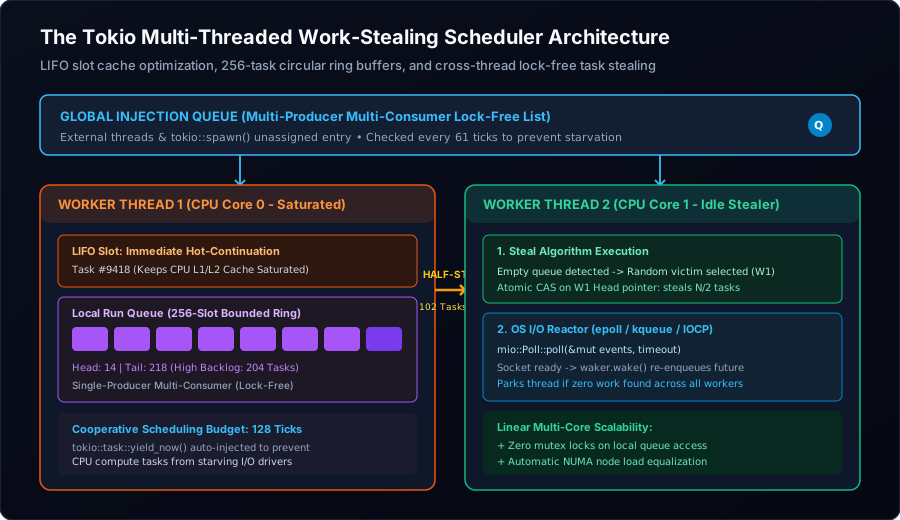
Figure 2: The Tokio multi-threaded work-stealing runtime architecture: LIFO slot optimization, local 256-task ring queues, epoll driver integration, and cross-thread task stealing.
The Waker Subsystem: How Asynchronous Notifications Work
How does an idle worker thread know when an external I/O event is ready without polling every sleeping future? The answer lies in the Waker contract.
1. RawWaker and the Manual VTable
Because Rust operates without a standard runtime, Waker is designed to be compatible with bare-metal embedded systems, custom operating system kernels, and high-performance runtimes alike. It is powered by a manual virtual dispatch table: RawWakerVTable:
pub struct RawWakerVTable {
    clone: unsafe fn(*const ()) -> RawWaker,
    wake: unsafe fn(*const ()),
    wake_by_ref: unsafe fn(*const ()),
    drop: unsafe fn(*const ()),
}
When an asynchronous runtime schedules a task, it constructs a pointer to the task header (containing an atomic state flag and reference count) and wraps it in a RawWaker. When wake() is called:
- The task's atomic state transitions from
WAITINGtoNOTIFIED. - The task pointer is pushed back into the executor's ready queue.
- If the worker thread was sleeping in a system call (like Linux
epoll_waitor WindowsGetQueuedCompletionStatusEx), an event file descriptor (eventfd) or completion port signal unparks the worker thread immediately.
Inside the Engine: The Tokio Work-Stealing Runtime
Tokio's multi-threaded runtime is one of the fastest concurrent schedulers ever constructed in software engineering. Rather than relying on a single shared mutex-protected queue (which collapses under core contention), Tokio uses a decentralized work-stealing design based on the Chase-Lev deque algorithm.
1. The Three Queues
Every Tokio multi-threaded runtime instance consists of three distinct tiers of task storage:
- The LIFO Slot: A single-task slot on each worker thread. When a task wakes another task (e.g. sending a message across an unbounded channel), Tokio places the awakened task directly into the current worker's LIFO slot. Because the waking task and the awakened task frequently share data, running the awakened task immediately maximizes CPU L1/L2 cache locality and eliminates memory bus invalidations.
- The Local Run Queue (256 Tasks): A bounded circular ring buffer allocated per worker thread. Accessing the local queue requires zero mutex locks. The worker thread pushes and pops from the tail using fast atomic instructions.
- The Global Injection Queue: A multi-producer multi-consumer (MPMC) lock-free linked list. Tasks spawned from non-runtime threads (or overflowed from local 256-slot queues) enter here. To ensure fair scheduling and prevent starvation, each worker thread checks the global queue every 61 ticks.
2. The Work-Stealing Algorithm
When a worker thread finishes all tasks in its LIFO slot and local queue:
- It checks the global injection queue.
- If the global queue is empty, it chooses a random victim worker thread.
- It executes a half-steal: it atomically locks the victim's head pointer and steals half of the victim's backlog (e.g., stealing 64 tasks if the victim has 128 tasks). This automatically load-balances multi-threaded throughput across all CPU cores with minimal contention.
3. Cooperative Scheduling and the 128-Tick Yield Rule
Because Rust futures are cooperatively scheduled, a rogue compute-heavy loop (like sorting a 10-million-element array) could monopolize a worker thread, preventing network I/O tasks from being polled. To prevent this, Tokio enforces an internal cooperative scheduling budget:
// Cooperatively yielding execution back to Tokio scheduler
pub async fn compute_intensive_task(data: &[u8]) {
    for (i, chunk) in data.chunks(1024).enumerate() {
        process_chunk(chunk);

        // Every 128 iterations, yield execution to allow I/O drivers to run
        if i % 128 == 0 {
            tokio::task::yield_now().await;
        }
    }
}
The Silent Killer: Cancellation Safety in tokio::select!
In production Rust microservices, the most prevalent and insidious category of bugs stems from cancellation unsafety.
In Rust, cancellation is not a signal, nor is it an exception. Cancellation is simply dropping the future (calling its Drop destructor). When you use tokio::select! or tokio::time::timeout, the branch that completes first wins; all competing branches that did not complete are immediately dropped in-place.
1. An Insidious Real-World Bug: Partial Reads
Consider this standard network packet receiver:
use tokio::io::AsyncReadExt;
use tokio::net::TcpStream;

async fn handle_connection(mut socket: TcpStream) {
    let mut header_buf = [0u8; 8];

    tokio::select! {
        // DANGER: read_exact is NOT cancellation-safe!
        res = socket.read_exact(&mut header_buf) => {
            match res {
                Ok(_) => process_header(&header_buf),
                Err(e) => eprintln!("Socket error: {}", e),
            }
        }
        _ = tokio::time::sleep(std::time::Duration::from_millis(500)) => {
            println!("Heartbeat timeout, resetting connection monitoring");
        }
    }
}
Why is read_exact notoriously cancellation-unsafe?
- Suppose the network sends 4 of the 8 required bytes.
read_exactreads those 4 bytes intoheader_bufand yieldsPoll::Pendingwaiting for the remaining 4 bytes. - While waiting, the 500ms timeout fires in the second branch of
select!. - The timeout branch wins. Tokio immediately drops the
socket.read_exactfuture. - The internal state of
read_exact(recording that 4 bytes were already read) is completely discarded! Those 4 bytes are permanently lost from the TCP stream. The next timehandle_connectionattempts to read from the socket, it reads byte 5 thinking it is byte 1, causing catastrophic protocol framing corruption.
2. The Rules of Cancellation Safety
To write bulletproof async code, memorize the cancellation safety rules of common async primitives:
| Operation | Cancellation Safe? | Explanation |
|---|---|---|
AsyncReadExt::read() |
YES | Reads whatever bytes are available in one chunk. If dropped before any bytes arrive, zero bytes are consumed. |
AsyncReadExt::read_exact() |
NO | If cancelled midway through a multi-byte sequence, partially read bytes are lost forever. |
AsyncWriteExt::write() |
YES | Writes whatever bytes can fit in the buffer. |
AsyncWriteExt::write_all() |
NO | If cancelled midway, partial bytes have been written to the wire; the remainder are lost. |
tokio::sync::mpsc::Receiver::recv() |
YES | Messages are only removed from the queue if recv() yields Some(msg). |
tokio::sync::Mutex::lock() |
YES | If cancelled while waiting in the lock queue, the reservation is cleanly removed. |
3. Architecting Cancellation-Safe Systems
To safely handle framing and multi-step protocols under tokio::select!, use framed streams via tokio_util::codec or retain state in an outer persistent buffer:
use bytes::BytesMut;
use tokio::io::AsyncReadExt;
use tokio::net::TcpStream;

pub struct CancellationSafeFramedReader {
    socket: TcpStream,
    buffer: BytesMut,
}

impl CancellationSafeFramedReader {
    pub fn new(socket: TcpStream) -> Self {
        Self {
            socket,
            buffer: BytesMut::with_capacity(8192),
        }
    }

    /// Fully cancellation-safe: Partial reads remain safely buffered in `self.buffer`!
    pub async fn read_frame(&mut self) -> Result<Vec<u8>, std::io::Error> {
        loop {
            // Check if we have a complete 8-byte length prefix
            if self.buffer.len() >= 8 {
                let length = u64::from_be_bytes(self.buffer[0..8].try_into().unwrap()) as usize;
                if self.buffer.len() >= 8 + length {
                    let _ = self.buffer.split_to(8); // Consume header
                    let packet = self.buffer.split_to(length).to_vec();
                    return Ok(packet);
                }
            }

            // Read available chunk into persistent buffer
            let bytes_read = self.socket.read_buf(&mut self.buffer).await?;
            if bytes_read == 0 {
                return Err(std::io::Error::new(std::io::ErrorKind::UnexpectedEof, "Connection closed"));
            }
        }
    }
}
Building a Custom Future: Zero-Allocation Timer
To cement your mastery of the async substrate, let's implement a production-grade custom future from scratch without using any high-level async convenience macros:
use std::future::Future;
use std::pin::Pin;
use std::sync::atomic::{AtomicBool, Ordering};
use std::sync::Arc;
use std::task::{Context, Poll, Waker};
use std::thread;
use std::time::Duration;

pub struct HardwareTimerFuture {
    state: Arc<TimerSharedState>,
}

struct TimerSharedState {
    completed: AtomicBool,
    waker: std::sync::Mutex<Option<Waker>>,
}

impl HardwareTimerFuture {
    pub fn new(duration: Duration) -> Self {
        let state = Arc::new(TimerSharedState {
            completed: AtomicBool::new(false),
            waker: std::sync::Mutex::new(None),
        });

        let thread_state = Arc::clone(&state);
        thread::spawn(move || {
            thread::sleep(duration);
            thread_state.completed.store(true, Ordering::Release);
            if let Some(waker) = thread_state.waker.lock().unwrap().take() {
                waker.wake(); // Notify Tokio worker to re-poll!
            }
        });

        Self { state }
    }
}

impl Future for HardwareTimerFuture {
    type Output = &'static str;

    fn poll(self: Pin<&mut Self>, cx: &mut Context<'_>) -> Poll<Self::Output> {
        // 1. Check if the hardware background thread finished
        if self.state.completed.load(Ordering::Acquire) {
            return Poll::Ready("Timer Expired");
        }

        // 2. Register current task's Waker
        let mut lock = self.state.waker.lock().unwrap();
        *lock = Some(cx.waker().clone());

        // 3. Double-check to prevent race condition if thread finished during lock
        if self.state.completed.load(Ordering::Acquire) {
            Poll::Ready("Timer Expired")
        } else {
            Poll::Pending
        }
    }
}
Summary: The 2026 Rust Async Checklist
Mastering asynchronous systems programming in Rust requires internalizing these four foundational principles:
- Futures Are Inert State Machines: They execute zero instructions until explicitly polled by a runtime executor.
- Pinning Prevents Invalidation:
Pin<&mut Self>mathematically guarantees that self-referential compiler-generated pointers never dangle due to memory moves. - Tokio Balances Latency and Throughput: The LIFO slot preserves CPU cache warmth for correlated tasks, while the 256-slot ring buffers and half-steal algorithm eliminate core starvation.
- Design for Cancellation by Default: Never invoke cancellation-unsafe operations (like
read_exactorwrite_all) inside branches oftokio::select!ortimeout. Always anchor intermediate stream state in persistent buffers.
Armed with these insights, you can architect high-throughput asynchronous services in Rust that push millions of operations per second with mathematical memory safety and deterministic sub-millisecond p99 latencies.