Table of Contents (Jump to section)
In distributed systems engineering, availability is not governed merely by how much compute capacity you provision; it is governed by how ruthlessly you manage incoming concurrency. When traffic surges—whether from a sudden flash sale, malicious denial-of-service botnets, distributed credential stuffing, or poorly configured internal microservices caught in retry storms—an unthrottled backend will quickly exhaust its thread pools, saturate database connection pools, and spiral into catastrophic cascading failure.
Historically, rate limiting was treated as an afterthought: a simplistic fixed-window counter slapped onto an ingress reverse proxy. However, at enterprise scale in 2026—where microservice architectures span hundreds of Kubernetes pods and process hundreds of thousands of requests per second—simplistic rate limiting falls apart. Naive algorithms suffer from boundary burst spikes that double nominal limits, distributed implementations face destructive race conditions and Redis network bottlenecks, and static rate limits fail completely when downstream dependencies slow down and queue depths balloon.
In this comprehensive architectural guide, we dissect the mechanics of enterprise traffic shaping. We will analyze the mathematical tradeoffs of modern rate limiting algorithms, build high-performance atomic Redis Lua scripts, architect a multi-tier local/distributed hybrid caching topology, and implement adaptive concurrency limits based on Little's Law to guarantee system survivability under unprecedented load.
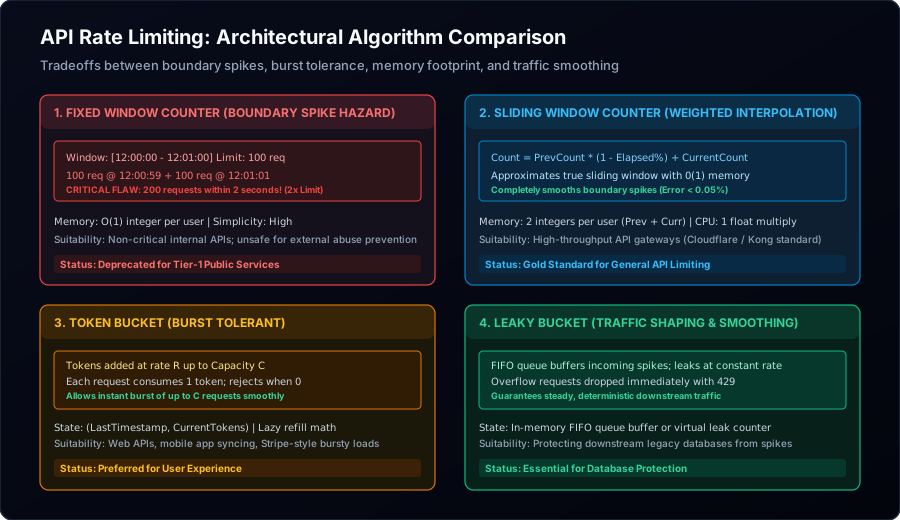
Figure 1: Comprehensive architectural comparison of rate limiting algorithms: Boundary spike vulnerabilities in Fixed Window vs. memory and CPU characteristics of Sliding Window Counter, Token Bucket, and Leaky Bucket.
1. The Mathematics and Tradeoffs of Core Rate Limiting Algorithms
Every rate limiting algorithm represents a deliberate engineering compromise between four constraints: burst tolerance, temporal smoothing, memory footprint per client, and computational overhead. Choosing the wrong algorithm can either throttle legitimate bursty users or expose your infrastructure to double-capacity shockwaves.
Algorithm 1: Fixed Window Counter (The Boundary Spike Trap)
The fixed window counter is the most intuitive algorithm: divide time into fixed intervals (e.g., 60-second windows) and increment a counter for each arriving request. If the counter exceeds the maximum allowed quota $M$, reject subsequent requests until the window expires.
The Mathematical Flaw: While fixed windows require only a single counter ($O(1)$ memory), they suffer from a severe boundary spike hazard. Consider a limit of 100 requests per minute. If a client transmits 100 requests at 12:00:59 and another 100 requests at 12:01:01, both windows individually comply with the quota. However, across a rolling 2-second interval, the backend absorbed 200 requests—200% of the configured safe capacity. In production, this burst shockwave routinely knocks down downstream database connection pools.
Algorithm 2: Sliding Window Log (Exact Precision, Severe Memory Cost)
To eliminate boundary spikes, the sliding window log tracks the exact timestamp of every request made by a client within the rolling time window $[t - W, t]$. In Redis, this is conventionally implemented using a Sorted Set (ZSET) where both the score and member represent the UNIX timestamp in milliseconds.
When a request arrives:
- Prune all members with scores older than $t - W$ via
ZREMRANGEBYSCORE. - Query the current cardinality using
ZCARD. - If cardinality < $M$, append the new timestamp via
ZADDand accept; otherwise, reject.
The Tradeoff: While mathematically flawless, the sliding window log incurs an $O(N)$ memory cost per client, where $N$ is the number of requests in the window. If you allow 10,000 requests per hour per enterprise client across 100,000 active tenants, Redis must store 1 billion 64-bit integer timestamps, requiring gigabytes of high-speed RAM and causing heavy garbage collection churn. Consequently, sliding logs are unviable for high-throughput public APIs.
Algorithm 3: Sliding Window Counter (Weighted Approximated Interpolation)
Pioneered by Cloudflare and widely adopted by modern gateways like Envoy and Kong, the Sliding Window Counter combines the $O(1)$ memory efficiency of fixed windows with the smoothness of sliding logs through weighted linear interpolation.
Instead of tracking discrete timestamps, the system maintains two consecutive fixed-window counters: the previous window counter ($C_{prev}$) and the current window counter ($C_{curr}$). When a request arrives at timestamp $t$ with an elapsed fraction of the current window $f \in [0, 1)$, the estimated rolling request count $C_{est}$ is calculated as:
C_est = (C_prev * (1 - f)) + C_currFor example, assume a window size of 60 seconds and a limit of 100 requests. Suppose the client made 80 requests in the previous minute ($C_{prev} = 80$). If the client submits a request at 15 seconds into the current minute ($f = \frac{15}{60} = 0.25$) and has already made 30 requests in the current minute ($C_{curr} = 30$):
C_est = (80 * (1 - 0.25)) + 30 = (80 * 0.75) + 30 = 60 + 30 = 90Because $90 < 100$, the request is permitted, and $C_{curr}$ is incremented to 31. Under real-world traffic distributions, the estimation error of sliding window counter interpolation is less than 0.05%, completely smoothing boundary spikes while requiring only two integer counters per client.
Algorithm 4: Token Bucket (Burst-Tolerant Traffic Shaping)
The Token Bucket algorithm models rate limiting using a centralized bucket of capacity $B$ that continuously refills with tokens at a constant rate $R$ tokens per second. Each inbound request consumes $k$ tokens (typically 1). If the bucket contains sufficient tokens, the request is immediately dispatched. If the bucket is empty, the request is rejected with HTTP 429.
Crucially, Token Bucket decouples the average sustained arrival rate ($R$) from the permissible burst volume ($B$). A client that has been idle can fire up to $B$ requests instantaneously, accommodating legitimate bursty user behavior (such as rendering a dashboard that triggers 15 concurrent REST calls) without suffering false rejections.
Algorithm 5: Leaky Bucket (Constant Egress Smoothing)
Unlike the Token Bucket, which allows bursts up to bucket capacity, the Leaky Bucket algorithm enforces a strictly constant egress rate. Incoming requests enter a FIFO queue (the bucket). Requests leak out of the bottom of the bucket at a constant rate $R$. If the queue is full (exceeds depth $Q$), incoming requests overflow and are dropped.
Leaky Bucket is the algorithm of choice when protecting downstream services that are hypersensitive to burst concurrency—such as legacy billing engines, batch PDF renderers, or external payment gateways with stringent per-second limits. However, it imposes latency buffering penalties on end users, making it less ideal for interactive web applications.
Algorithmic Comparison Matrix
| Algorithm | Burst Allowance | Boundary Spike Risk | Memory per Client | CPU Operations | Production Suitability |
|---|---|---|---|---|---|
| Fixed Window | Window Cap | Critical (Up to 2x limit) | $O(1)$ (1 integer) | 1 Atomic Increment | Low-risk internal metrics only |
| Sliding Log | None | Zero | $O(N)$ (N timestamps) | Pruning + Set Cardinality | Low-volume, high-value operations |
| Sliding Counter | Smooth rolling | Zero (<0.05% error) | $O(1)$ (2 integers) | 1 Float multiply + 1 increment | API Gateways (Cloudflare, Kong) |
| Token Bucket | Configurable ($B$) | Zero | $O(1)$ (2 numbers: count + ts) | Timestamp delta calculation | Interactive REST / GraphQL APIs (AWS, Stripe) |
| Leaky Bucket | Zero (Strictly shaped) | Zero | $O(Q)$ (Queue buffer) | Timer / Dequeue scheduler | Ingest pipelines, batch workers |
2. Atomic Distributed Rate Limiting with Redis Lua Scripting
In a horizontally scaled environment, multiple gateway nodes handle requests concurrently for the same client. A naive implementation that executes discrete Redis commands—such as GET tokens, calculate balance in application memory, and execute SET tokens—suffers from fatal race conditions. Under high concurrency, 50 parallel requests will read the same stale token balance, allowing massive over-consumption.
To guarantee strict linearizability without expensive distributed locks, rate limiting operations must execute atomically within Redis's single-threaded event loop. This is achieved using Redis Lua scripts executed via EVALSHA.
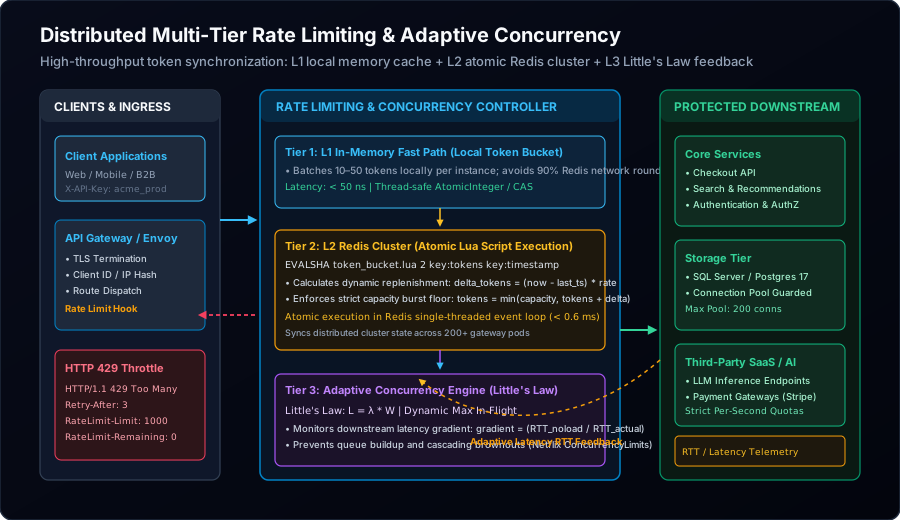
Figure 2: Multi-tier rate limiting architecture: L1 in-memory local token batching, L2 atomic Redis cluster synchronization via Lua script, and L3 Little's Law adaptive concurrency throttling.
Production Token Bucket Lua Script
Rather than running an active background timer to refill tokens every millisecond (which would incinerate CPU cycles across millions of keys), the token bucket is updated lazily upon request arrival. The script computes the time elapsed since the last recorded request ($\Delta t$), multiplies it by the refill rate, and replenishes the bucket up to its maximum capacity.
-- =====================================================================
-- PRODUCTION-GRADE TOKEN BUCKET LUA SCRIPT (ATOMIC EVALSHA)
-- KEYS[1]: Rate limit key (e.g., "ratelimit:{tenant_id}:{route}")
-- ARGV[1]: Max bucket capacity (burst limit)
-- ARGV[2]: Refill rate (tokens per millisecond)
-- ARGV[3]: Current UNIX timestamp in milliseconds
-- ARGV[4]: Requested tokens (cost of current request, default 1)
-- =====================================================================

local key = KEYS[1]
local capacity = tonumber(ARGV[1])
local refill_rate_per_ms = tonumber(ARGV[2])
local now_ms = tonumber(ARGV[3])
local requested = tonumber(ARGV[4])

-- Retrieve current bucket state: tokens balance and last update timestamp
local data = redis.call("HMGET", key, "tokens", "last_updated")
local tokens = tonumber(data[1])
local last_updated = tonumber(data[2])

if tokens == nil then
    -- First request for this key: initialize to full capacity
    tokens = capacity
    last_updated = now_ms
else
    -- Compute time elapsed since last request
    local elapsed_ms = math.max(0, now_ms - last_updated)
    local generated_tokens = elapsed_ms * refill_rate_per_ms
    tokens = math.min(capacity, tokens + generated_tokens)
    last_updated = now_ms
end

-- Determine if sufficient tokens are available
local allowed = 0
local remaining = tokens
local retry_after_ms = 0

if tokens >= requested then
    allowed = 1
    tokens = tokens - requested
    remaining = math.floor(tokens)
else
    allowed = 0
    remaining = math.floor(tokens)
    -- Calculate milliseconds until enough tokens accumulate
    local missing_tokens = requested - tokens
    retry_after_ms = math.ceil(missing_tokens / refill_rate_per_ms)
end

-- Persist updated state with dynamic TTL to prevent Redis memory leaks
-- TTL set to time required to refill bucket from 0 to capacity + 60s buffer
local ttl_seconds = math.ceil((capacity / refill_rate_per_ms) / 1000) + 60
redis.call("HMSET", key, "tokens", tokens, "last_updated", last_updated)
redis.call("EXPIRE", key, ttl_seconds)

-- Return: { allowed (1/0), remaining_tokens, retry_after_ms }
return { allowed, remaining, retry_after_ms }
Benchmark: Sub-Millisecond Redis Execution
By compiling the Lua script into Redis bytecode via SCRIPT LOAD and calling it with EVALSHA, execution takes between 0.2ms and 0.6ms on modern cloud infrastructure (AWS ElastiCache / Redis Enterprise). Because the script performs only HMGET, basic arithmetic, and HMSET, a single Redis node can comfortably evaluate 80,000 to 120,000 rate limit checks per second per CPU core.
3. High-Throughput Architecture: Multi-Tier Synchronization
When an API platform scales to 500,000 requests per second across 150 gateway instances, directing every individual rate limit check over the network to a central Redis cluster introduces two major problems:
- Network Latency Floor: Even a sub-millisecond Redis roundtrip adds 0.5ms–1.5ms of network I/O per API call, degrading end-to-end response times.
- Cluster Saturation: 500k RPS requires a massive Redis cluster solely to execute counter increments, drastically inflating infrastructure costs.
The Solution: Two-Tier Local/Distributed Hybrid Caching
To eliminate 90% of Redis network calls, high-scale architectures employ a two-tier synchronization pattern:
- Tier 1 (L1 In-Memory Fast Path): Each API Gateway pod maintains a local, thread-safe token bucket (backed by lock-free
AtomicIntegerorInterlocked.Add). Instead of querying Redis for every request, the gateway pod "leases" a batch of tokens (e.g., 50 tokens) from Redis in a single network roundtrip. The next 50 requests are processed purely in local memory with zero network latency (< 50 nanoseconds). - Tier 2 (L2 Centralized Redis State): When the local token pool drops below a low-water mark (e.g., 10 tokens remaining), a background asynchronous task dispatches a lease request to Redis to acquire the next batch.
- Redis Cluster Partitioning: To prevent cross-slot communication penalties in Redis Cluster mode, keys are formatted with hash tags:
{tenant_id}:ratelimit:route. This guarantees that all rate-limiting keys for a specific tenant reside on the exact same Redis hash slot and shard.
4. Beyond Static Limits: Adaptive Concurrency Limiting (Little's Law)
The most pervasive failure mode in enterprise rate limiting is the reliance on static requests-per-second (RPS) thresholds. Engineering teams benchmark an API in staging, observe that it handles 2,000 RPS at 15ms latency, and configure a hard limit of 2,000 RPS in production. However, distributed systems are dynamic:
- A database disk I/O stall occurs, causing query times to inflate from 10ms to 400ms.
- At 400ms latency, 2,000 RPS produces 800 concurrent in-flight requests ($2000 \times 0.4$), completely saturating the Web server's thread pool and database connection pool.
- Queue depths explode, leading to memory exhaustion, thread pool starvation, and total service brownout.
Static rate limits protect against malicious volume, but they cannot protect against internal capacity collapse. To prevent brownouts, production systems implement Adaptive Concurrency Limiting based on queueing theory and feedback control loops.
The Mathematics: Little's Law and Congestion Avoidance
According to Little's Law, the average number of concurrent requests in a stable system ($L$) equals the long-term average arrival rate ($\lambda$) multiplied by the average time a request spends in the system ($W$):
\[L = \lambda \cdot W\]When a downstream service degrades, its processing time ($W$) increases. If the arrival rate ($\lambda$) remains constant, concurrency ($L$) must increase proportionally. Once concurrency exceeds the physical capacity of worker threads or connection pools, queuing latency dominates, causing an exponential death spiral.
To prevent this, we borrow the TCP Vegas Congestion Control Algorithm, popularized for microservices by Netflix ConcurrencyLimits. We track the unloaded baseline roundtrip time ($RTT_{noload}$) during idle periods, and continuously measure the actual observed latency ($RTT_{actual}$) of requests passing through the system.
We calculate the latency gradient:
\[Gradient = \frac{RTT_{noload}}{RTT_{actual}}\]We then dynamically adjust the maximum allowed in-flight concurrency ($Limit_{t+1}$):
\[Limit_{t+1} = Limit_t \cdot Gradient + \text{Headroom}\]When the downstream service is healthy, $RTT_{actual} \approx RTT_{noload}$, so $Gradient \approx 1.0$, allowing the concurrency limit to gently grow to absorb traffic. When the downstream service experiences congestion, $RTT_{actual}$ increases, causing $Gradient < 1.0$. The concurrency limit automatically shrinks, actively shedding load before queues overflow.
Production C# / ASP.NET Core Adaptive Concurrency Middleware
The following middleware implements an adaptive concurrency controller with EWMA (Exponentially Weighted Moving Average) latency tracking, protecting downstream database and downstream microservice dependencies.
// =====================================================================
// PRODUCTION ADAPTIVE CONCURRENCY LIMITER (LITTLE'S LAW & GRADIENT)
// =====================================================================
using System;
using System.Diagnostics;
using System.Threading;
using System.Threading.Tasks;
using Microsoft.AspNetCore.Http;
using Microsoft.Extensions.Logging;

public class AdaptiveConcurrencyMiddleware
{
    private readonly RequestDelegate _next;
    private readonly ILogger<AdaptiveConcurrencyMiddleware> _logger;

    // Concurrency tracking
    private int _inFlightRequests = 0;
    private double _currentLimit = 50.0; // Initial safe concurrency floor
    private const double MinLimit = 10.0;
    private const double MaxLimit = 500.0;
    private const double HeadroomRatio = 0.15; // 15% queue headroom
    private const double SmoothingAlpha = 0.1; // EWMA factor

    // Latency metrics in milliseconds
    private double _rttNoLoad = 15.0; // Baseline unloaded latency
    private double _smoothedRtt = 15.0;
    private readonly object _limitLock = new();

    public AdaptiveConcurrencyMiddleware(
        RequestDelegate next,
        ILogger<AdaptiveConcurrencyMiddleware> logger)
    {
        _next = next;
        _logger = logger;
    }

    public async Task InvokeAsync(HttpContext context)
    {
        // 1. Check if adding this request violates the adaptive concurrency limit
        int currentInFlight = Interlocked.Increment(ref _inFlightRequests);

        if (currentInFlight > (int)_currentLimit)
        {
            // Concurrency ceiling reached: shed load immediately
            Interlocked.Decrement(ref _inFlightRequests);
            context.Response.StatusCode = StatusCodes.Status429TooManyRequests;
            context.Response.Headers["Retry-After"] = "1";
            context.Response.Headers["X-RateLimit-Reason"] = "Adaptive-Concurrency-Exceeded";
            await context.Response.WriteAsync("Service is operating at maximum safe capacity.");
            return;
        }

        var stopwatch = Stopwatch.StartNew();
        try
        {
            await _next(context);
        }
        finally
        {
            stopwatch.Stop();
            Interlocked.Decrement(ref _inFlightRequests);
            UpdateAdaptiveLimit(stopwatch.Elapsed.TotalMilliseconds);
        }
    }

    private void UpdateAdaptiveLimit(double elapsedMs)
    {
        lock (_limitLock)
        {
            // Update baseline unloaded RTT if we observe a faster response
            if (elapsedMs
5. Standardizing Client-Facing Headers and Backoff Strategies
When an API client is throttled, the gateway must return unambiguous metadata enabling intelligent client recovery. Failing to standardize rate limit headers causes uncoordinated client retries that exacerbate outages.
The IETF RateLimit Headers Standard
Modern APIs conform to the IETF HTTP Working Group standard (RFC draft draft-ietf-httpapi-ratelimit-headers):
RateLimit-Limit: The maximum number of allowed requests in the current quota period.RateLimit-Remaining: The number of remaining requests in the current quota period.RateLimit-Reset: The number of seconds remaining until the quota fully resets.Retry-After: Sent with HTTP 429 to dictate how many seconds the client must pause before retrying.
Client Implementation: Exponential Backoff with Full Jitter
When a client receives an HTTP 429 or 503 response, retrying at fixed intervals produces destructive thundering herd synchronization. Clients must apply Exponential Backoff with Full Jitter (as documented by Marc Brooker at AWS):
// =====================================================================
// EXPONENTIAL BACKOFF WITH FULL JITTER IN .NET
// =====================================================================
public async Task<HttpResponseMessage> ExecuteWithBackoffAsync(
    Func<Task<HttpResponseMessage>> action,
    int maxRetries = 5,
    int baseDelayMs = 100,
    int maxDelayMs = 10000)
{
    var random = new Random();

    for (int attempt = 0; attempt <= maxRetries; attempt++)
    {
        var response = await action();

        // If request succeeded or client error (except 429), return immediately
        if ((int)response.StatusCode != 429 && (int)response.StatusCode < 500)
        {
            return response;
        }

        if (attempt == maxRetries)
        {
            return response; // Quota completely exhausted
        }

        // Calculate exponential ceiling: min(maxDelay, baseDelay * 2^attempt)
        int exponentialCeiling = (int)Math.Min(maxDelayMs, baseDelayMs * Math.Pow(2, attempt));

        // Full Jitter: Sleep uniformly between 0 and exponentialCeiling
        int sleepMs = random.Next(0, exponentialCeiling);

        // If server provided explicit Retry-After, honor it
        if (response.Headers.RetryAfter?.Delta.HasValue == true)
        {
            sleepMs = Math.Max(sleepMs, (int)response.Headers.RetryAfter.Delta.Value.TotalMilliseconds);
        }

        await Task.Delay(sleepMs);
    }

    throw new InvalidOperationException("Retry pipeline exhausted.");
}
6. Production Checklist: Designing for Failure
When deploying rate limiting and traffic shaping infrastructure to production, follow these architectural principles:
- Fail-Open vs. Fail-Closed Strategy: Decide your failure posture. For standard customer API endpoints, if Redis becomes unreachable, the rate limiter should fail open (allow traffic through and log an alert). For authentication, credential verification, and expensive LLM endpoints, the limiter must fail closed (reject unmetered traffic to prevent catastrophic financial or security exploits).
- Tiered Client Identification: Never rate limit solely on IP address. Mobile carrier gateways (CGNAT) and enterprise corporate proxies route thousands of distinct users through a single public IP. Identify clients via verified JWT
subclaims, hashed API keys (X-API-Key), and fallback to IP only for unauthenticated endpoints. - Circuit Breaker on the Limiter: Wrap Redis rate-limiting calls in a circuit breaker (e.g., Polly or Resilience4j). If Redis p99 latency spikes beyond 10ms, trip the circuit to bypass Redis and protect the primary request path.
- Load Shedding Priority: When adaptive concurrency limits trigger, shed traffic hierarchically. Reject background webhooks, analytics pings, and batch exports first; preserve interactive checkout and authentication requests until the absolute breaking point.
Summary
Rate limiting is no longer a static gatekeeper; it is an active, dynamic feedback control system. By combining Sliding Window Counters for smooth boundary enforcement, Atomic Redis Lua scripts for linearizable distributed quota management, L1/L2 local caching to eliminate network bottlenecks, and Little's Law adaptive concurrency to dynamically throttle load during brownouts, backend engineering teams can guarantee 99.999% platform availability even under extreme traffic volatility.