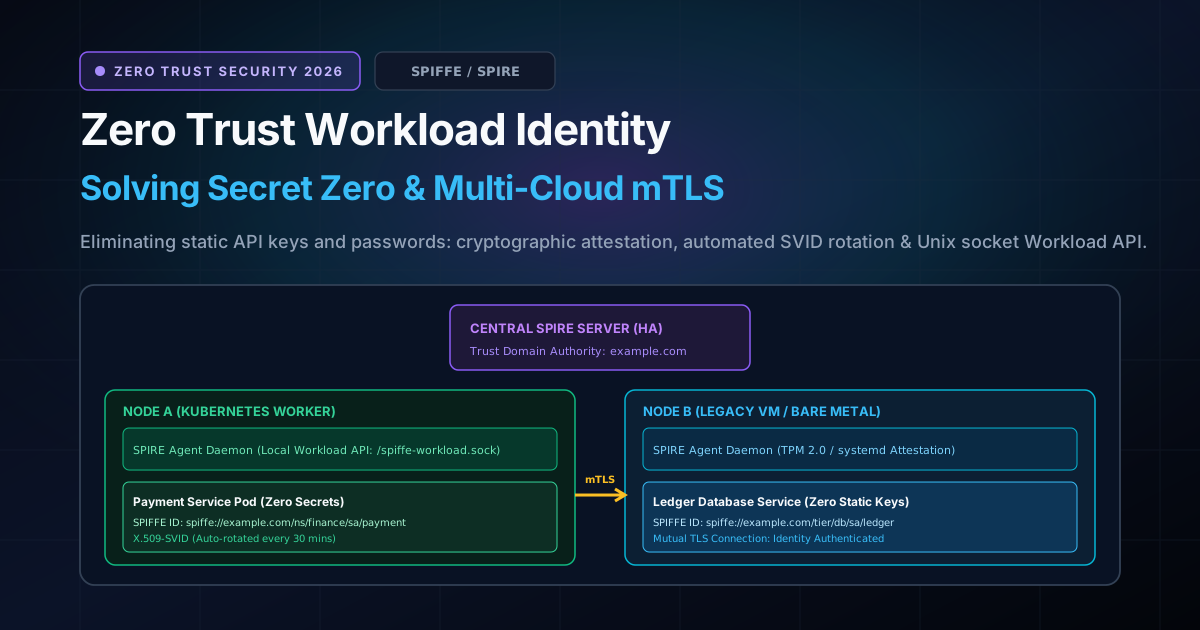
Table of Contents (Jump to section)
For decades, enterprise software security operated on a flawed perimeter model: the Castle-and-Moat Architecture. Organizations built heavily fortified boundary firewalls, VPNs, and Web Application Firewalls (WAFs) around their data centers. Once network traffic crossed the perimeter wall, the internal network was treated as completely trusted. Microservices communicated over unencrypted HTTP, and services authenticated to one another and external databases using long-lived static credentials: API keys, database passwords, and hardcoded private keys.
In the modern era of hybrid cloud, multi-region Kubernetes clusters, serverless functions, and autonomous AI agents, the perimeter is completely dead. There is no "internal network." Ephemeral containers spin up and down across dynamic IP addresses hundreds of times an hour. When attackers breach an edge service or exploit a third-party software supply chain vulnerability, unencrypted internal traffic and static secrets allow them to laterally move across your entire infrastructure within minutes.
To combat this, the industry introduced secret management platforms (such as HashiCorp Vault, AWS Secrets Manager, and Azure Key Vault). But traditional secret managers immediately encounter an inescapable cryptographic paradox known as "The Secret Zero Dilemma": To authenticate to Vault to fetch a database password, your microservice needs a client token. Where do you securely store that initial token? If you store it in an environment variable, a configuration file, or a Kubernetes secret, you have not eliminated static secrets—you have merely moved the vulnerability to a different file on disk!
The definitive solution adopted by hyperscalers in 2026 is Zero Trust Workload Identity powered by the SPIFFE (Secure Production Identity Framework for Everyone) and SPIRE (SPIFFE Runtime Environment) open-source standards. By shifting authentication from "what a service knows" (static passwords and bearer tokens) to "what a service is" (cryptographically attested platform identity), SPIFFE and SPIRE solve Secret Zero, automate mutual TLS (mTLS) across heterogeneous clouds, and enforce zero-trust security without storing a single secret on disk.
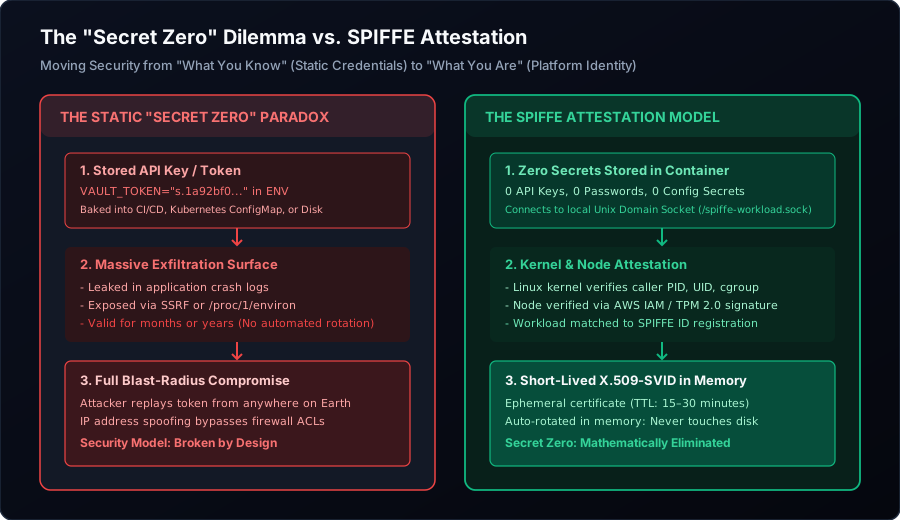
Figure 1: The fragile static Secret Zero paradox vs. SPIFFE's two-stage cryptographic kernel and node attestation model.
Core Concepts: The Anatomy of SPIFFE
To architect a zero-trust identity system, we must first master the standardized primitives defined by the Cloud Native Computing Foundation (CNCF) SPIFFE project:
1. The SPIFFE ID
A SPIFFE ID is a standardized Uniform Resource Identifier (URI) that provides a globally unique, human-readable, and machine-verifiable identity for any software workload. It follows a strict URI syntax:
spiffe://<trust-domain>/<workload-path>- Trust Domain: Defines the administrative security boundary managing the identity authority (e.g.,
prod.mangobaz.comoraws.finance.internal). - Workload Path: Defines the specific workload within that domain based on its contextual execution metadata:
- Kubernetes:
spiffe://prod.mangobaz.com/ns/billing/sa/payment-processor - Bare-Metal VM:
spiffe://prod.mangobaz.com/datacenter/us-east/host/db-node-01 - AI Tool Agent:
spiffe://prod.mangobaz.com/agent/rag-retriever/session/84fa2
- Kubernetes:
2. The SVID (SPIFFE Verifiable Identity Document)
A SPIFFE ID is merely an identifier; an SVID is the cryptographic credential that proves a workload actually owns that identity. SPIFFE specifies two SVID formats:
- X.509-SVID (The Transport Standard): An X.509 digital certificate where the SPIFFE ID is encoded in the
Subject Alternative Name (SAN)extension as a URI. Workloads use X.509-SVIDs to establish automatic, cryptographically verified Mutual TLS (mTLS) connections. Every packet on the wire is encrypted, and both client and server cryptographically verify each other's identity on every TCP handshake. - JWT-SVID (The Application Standard): A JSON Web Token containing the SPIFFE ID in the
subclaim, digitally signed by the trust domain authority. JWT-SVIDs are used when traffic passes through Layer 7 proxies that terminate TLS or when calling HTTP REST APIs that require bearer authentication.
The Ephemeral Lifespan Rule: Unlike traditional SSL certificates valid for 1 to 2 years, SVIDs have an ephemeral lifespan measured in minutes (typically 15 to 60 minutes). Because SVIDs are rotated automatically in memory, a compromised or intercepted certificate becomes useless almost immediately, shrinking the failure blast radius to near zero.
How SPIRE Solves "Secret Zero" via Attestation
SPIRE (SPIFFE Runtime Environment) is the production-ready reference implementation of the SPIFFE specifications. It consists of two primary components:
- SPIRE Server: The central Certificate Authority (CA) and control plane. It manages registration entries, signs SVIDs, and coordinates trust bundles across federated domains.
- SPIRE Agent: A lightweight daemon that runs locally on every physical host, virtual machine, or Kubernetes worker node. It exposes the local Workload API over a Unix Domain Socket (UDS) and manages SVID caching and rotation on behalf of local processes.
SPIRE eliminates Secret Zero through a two-stage cryptographic verification pipeline known as Attestation:
Stage 1: Node Attestation (Verifying the Host)
Before a SPIRE Agent can request identities for local applications, it must mathematically prove its own legitimacy to the SPIRE Server. Node attestation leverages hardware-backed or cloud-provider root-of-trust mechanisms:
- AWS: Validating the node's cryptographically signed AWS EC2 Instance Identity Document (IID).
- Kubernetes: Validating the Projected Service Account Token issued by the Kubernetes API server.
- Bare-Metal / On-Premise: Validating the node's hardware TPM 2.0 (Trusted Platform Module) endorsement key or x509 boot certificate.
Stage 2: Workload Attestation (Verifying the Process)
Once the node is verified, individual containers or microservices on that node request an SVID. Crucially, the application presents zero credentials or tokens! It simply connects to the local Unix Domain Socket (/run/spire/sockets/workload.sock).
When the application connects, the SPIRE Agent interrogates the Linux kernel using the SO_PEERCRED socket option:
// SPIRE Agent queries Linux Kernel via socket peer credentials
struct ucred cred;
socklen_t len = sizeof(struct ucred);
getsockopt(client_socket_fd, SOL_SOCKET, SO_PEERCRED, &cred, &len);

// Linux Kernel returns tamper-proof kernel attributes:
// cred.pid = 41208 (Caller Process ID)
// cred.uid = 10001 (Caller User ID)
// cred.gid = 10001 (Caller Group ID)
The SPIRE Agent inspects the caller's process attributes in /proc/41208/: its cgroup hierarchy, container image SHA256 digest, SELinux context, binary checksum, and Kubernetes Pod labels. If these attributes match a pre-registered policy on the SPIRE Server, the agent mints an X.509-SVID in memory and returns it to the application over the socket.
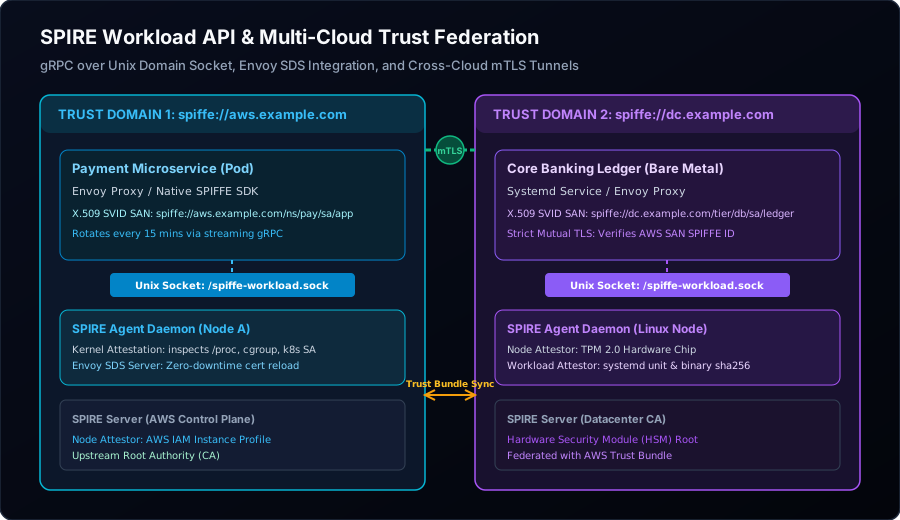
Figure 2: Architecture of the SPIRE Workload API over Unix Domain Sockets, Envoy SDS dynamic secret reloading, and cross-cloud mTLS trust federation.
Consuming the Workload API in C# and Go
How does an application consume an SVID in production? Modern microservices have two primary integration paths:
Path A: Proxy-Level mTLS via Envoy Secret Discovery Service (SDS)
In a service mesh or sidecarless deployment, application code never touches certificates. The local proxy (Envoy) points its Secret Discovery Service (SDS) configuration directly to the SPIRE Agent's Unix Domain Socket. When the SPIRE Agent rotates the SVID every 15 minutes, it streams the new certificate to Envoy via gRPC. Envoy seamlessly reloads the TLS context without dropping active TCP connections or restarting pods!
# Envoy SDS Configuration connecting directly to local SPIRE Agent
static_resources:
  secrets:
    - name: "spiffe://prod.mangobaz.com/ns/billing/sa/payment"
      sds_config:
        api_config_source:
          api_type: GRPC
          transport_api_version: V3
          grpc_services:
            - google_grpc:
                target_uri: "unix:/run/spire/sockets/workload.sock"
Path B: Native Workload API Integration in Code (.NET / C#)
If you prefer native code without proxy sidecars, applications can query the SPIRE Workload API directly over gRPC. Below is a production-grade C# implementation using the official SPIFFE gRPC protocol:
using System;
using System.IO;
using System.Net.Sockets;
using System.Security.Cryptography.X509Certificates;
using System.Threading;
using System.Threading.Tasks;
using Grpc.Net.Client;

public class SpiffeWorkloadClient
{
    private readonly string _socketPath;

    public SpiffeWorkloadClient(string socketPath = "/run/spire/sockets/workload.sock")
    {
        _socketPath = socketPath;
    }

    /// <summary>
    /// Connects to SPIRE Workload API over Linux Unix Domain Socket and fetches X.509-SVID
    /// </summary>
    public async Task<X509Certificate2> FetchX509SvidAsync(CancellationToken cancellationToken = default)
    {
        var socketEndpoint = new UnixDomainSocketEndPoint(_socketPath);

        // Configure gRPC channel to communicate over Unix Domain Socket
        using var channel = GrpcChannel.ForAddress("http://localhost", new GrpcChannelOptions
        {
            HttpHandler = new SocketsHttpHandler
            {
                ConnectCallback = async (context, token) =>
                {
                    var socket = new Socket(AddressFamily.Unix, SocketType.Stream, ProtocolType.Unspecified);
                    await socket.ConnectAsync(socketEndpoint, token);
                    return new NetworkStream(socket, ownsSocket: true);
                }
            }
        });

        // Instantiate SPIFFE SpiffeWorkloadAPI Client
        var client = new Spiffe.Workload.SpiffeWorkloadAPI.SpiffeWorkloadAPIClient(channel);

        // Stream X.509 SVIDs from SPIRE Agent
        using var call = client.FetchX509SVID(new Spiffe.Workload.X509SVIDRequest(), cancellationToken: cancellationToken);

        if (await call.ResponseStream.MoveNext(cancellationToken))
        {
            var response = call.ResponseStream.Current;
            var svidMsg = response.Svids[0];

            Console.WriteLine($"[SPIFFE] Successfully received SVID: {svidMsg.SpiffeId}");

            // Load DER encoded X.509 Certificate and Private Key directly into memory
            byte[] certDer = svidMsg.X509Svid.ToByteArray();
            byte[] keyDer = svidMsg.X509SvidKey.ToByteArray();

            var cert = new X509Certificate2(certDer);
            using var rsa = System.Security.Cryptography.RSA.Create();
            rsa.ImportPkcs8PrivateKey(keyDer, out _);

            return cert.CopyWithPrivateKey(rsa);
        }

        throw new InvalidOperationException("SPIRE Agent returned empty SVID stream.");
    }
}
Multi-Cloud & Cross-Cluster Trust Federation
One of the most powerful capabilities of SPIFFE is Trust Domain Federation. In enterprise architectures, systems rarely reside in a single cloud provider. You may run user-facing web services in AWS Elastic Kubernetes Service (EKS), machine learning pipelines in Google Cloud Platform (GCP), and mission-critical ledger databases in an on-premise datacenter.
Historically, securing cross-cloud communication required setting up complex IPsec VPN tunnels, static firewalls, and sharing master CA certificates. If the master CA was compromised, all clouds were compromised.
How SPIFFE Federation Works
Under SPIFFE Federation, each cloud environment operates as an independent trust domain with its own local SPIRE Server and private root signing keys:
- Domain A:
spiffe://aws.mangobaz.com - Domain B:
spiffe://gcp.mangobaz.com - Domain C:
spiffe://datacenter.mangobaz.com
The SPIRE Servers exchange their public Trust Bundles (root CA certificates) via the standardized SPIFFE Federation API over an HTTPS/OIDC endpoint. Crucially, private keys are never shared!
When Payment Service in AWS connects to Database Service in your datacenter:
- The AWS pod presents its SVID:
spiffe://aws.mangobaz.com/ns/finance/sa/pay. - The Datacenter database validates the AWS SVID using its locally cached AWS Trust Bundle.
- The database verifies that the client's SPIFFE ID matches its authorization policy:
ALLOW mTLS connection IF peer.spiffe_id == "spiffe://aws.mangobaz.com/ns/finance/sa/pay" - Direct, encrypted mutual TLS is established over the public internet without requiring shared VPNs or static database passwords!
Securing Non-Human Identities (NHI) & Agentic AI in 2026
As autonomous AI agents, LLM tool runners, and background worker bots proliferate across cloud architectures, they represent the single fastest-growing attack vector for credential theft. Developers frequently give AI agents static admin API tokens to access databases, vector stores, and external APIs.
In 2026, leading security architectures integrate SPIFFE with HashiCorp Vault Dynamic Secrets:
- The AI Agent tool runner is assigned a short-lived SPIFFE ID (e.g.,
spiffe://prod.mangobaz.com/agent/sql-analyzer). - When the agent needs database access, it authenticates to Vault using its JWT-SVID as a cryptographic identity document.
- Vault validates the JWT-SVID against the SPIRE Server's public keys.
- Vault dynamically generates a temporary, 10-minute database credential scoped strictly to read-only queries for that agent.
- When the agent finishes its task, the credential automatically expires. No human ever saw the password, and no static key was ever stored in code.
Architectural Comparison: Static Secrets vs. SPIFFE/SPIRE
| Security Dimension | Traditional Static Credentials | Secret Managers (Vault/AWS SM) | SPIFFE / SPIRE (2026 Standard) |
|---|---|---|---|
| Identity Basis | What you know (Password / Key) | What you know (Vault Token) | What you are (Cryptographic Attestation) |
| Secret Zero Vulnerability | Vulnerable everywhere | Vulnerable at token storage point | Mathematically Eliminated |
| Credential Lifespan | Months to Years | Hours to Days | 15 to 60 Minutes (Ephemeral) |
| Credential Rotation | Manual / High Outage Risk | Scripted / Semi-automated | 100% Automated in Memory |
| Multi-Cloud mTLS | Complex shared CAs / VPNs | Custom PKI synchronization | Native Out-of-the-Box Federation |
| Disk Storage | Plaintext on disk / ConfigMaps | Encrypted on disk | Zero Disk Footprint (Memory Only) |
Production Implementation Roadmap for 2026
If you are planning to modernize your cloud security posture and transition toward zero-trust workload identities, follow this battle-tested engineering sequence:
- Establish a Consistent Trust Domain Hierarchy: Choose clean, descriptive domain names (e.g.,
spiffe://<env>.<organization>.com). Avoid putting dynamic or ephemeral identifiers (like pod UUIDs) into trust domain roots. - Deploy SPIRE Server in High Availability (HA): Run SPIRE Server with a distributed relational backend (PostgreSQL or AWS Aurora) and an external Cloud KMS or Hardware Security Module (HSM) for root key signing.
- Install SPIRE Agent as a Kubernetes DaemonSet: Mount the SPIRE Workload API Unix Domain Socket into application pods using a Kubernetes
hostPathvolume or CSI driver (spiffe-csi-driver). - Enforce mTLS at the Proxy Layer First: Integrate SPIRE with Envoy or Istio SDS before modifying application code. This provides instant encrypted transport security across all existing services without writing a single line of business logic.
- Federate Progressively: Establish SPIFFE federation between staging and production clusters or cross-cloud environments before attempting cross-organization integrations.
Conclusion: The Identity-Driven Cloud
The era of trusting network perimeters, IP addresses, and static passwords has drawn to an irrevocable close. In a world where infrastructure is ephemeral and software supply chains are constantly scrutinized, security cannot rely on secrets that can be copied, printed, or leaked.
By implementing SPIFFE and SPIRE, modern engineering teams establish an immutable, cryptographic root of trust for every container, virtual machine, and AI agent. Eliminating Secret Zero is not merely a compliance checkbox—it is the foundational architectural pillar of resilient, self-securing distributed systems in 2026.