
Table of Contents (Jump to section)
For more than a decade, Apache Kafka has served as the central nervous system of enterprise computing, powering real-time event streaming for financial transactions, observability telemetry, and distributed microservices. Yet for that same decade, platform engineers suffered under the operational tax of an external consensus dependency: Apache ZooKeeper. ZooKeeper introduced dual-system configuration drift, security segregation overhead, and severe controller failover pauses that brought high-partition clusters to a standstill during maintenance events.
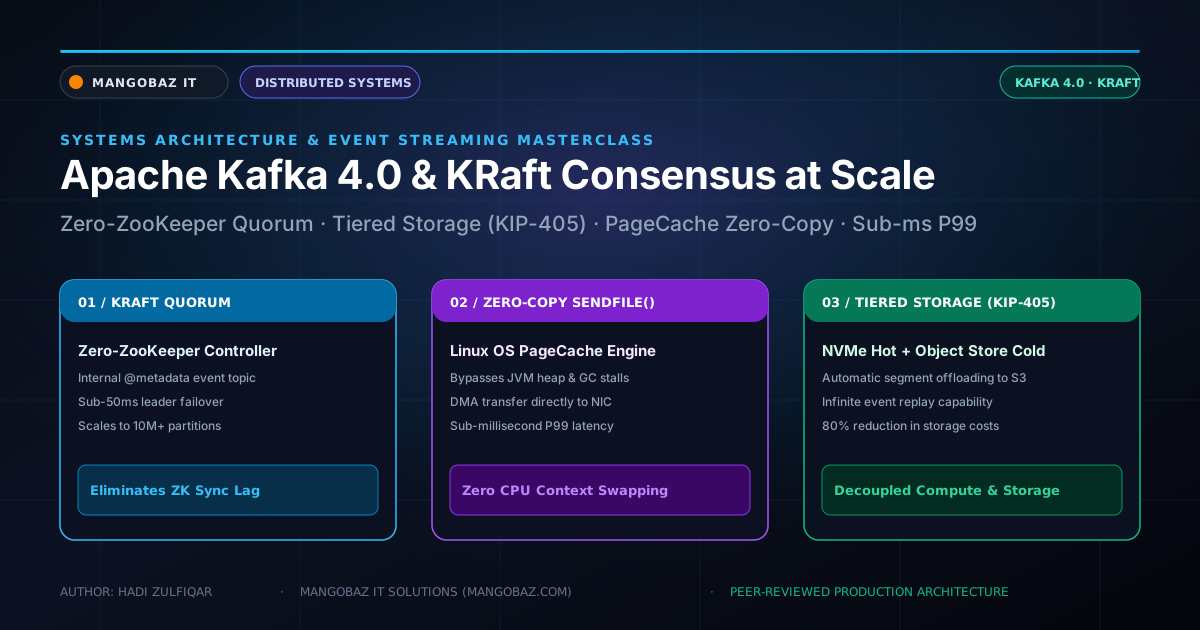
With the release of Apache Kafka 4.0, the ZooKeeper era is officially dead. Kafka now operates entirely on KRaft (Kafka Raft Metadata Mode): an event-driven consensus protocol built directly into the broker architecture. Combined with Tiered Storage (KIP-405), Kafka transforms from a short-retention messaging buffer into a cloud-native, infinitely scalable event store capable of decoupling compute from storage and slashing cloud infrastructure bills by more than 80%.

In this systems engineering masterclass, we dissect the internal mechanics of KRaft consensus, explore how Linux OS PageCache and the sendfile() system call achieve zero-copy throughput, examine KIP-405 Tiered Storage internals, tune producer and consumer pipelines for sub-millisecond P99 latency, and provide a production-grade C# / .NET 9 implementation for high-throughput streaming.
1. The Demise of ZooKeeper: Why KRaft Was Inevitable
To understand the performance leaps in Kafka 4.0, we must examine the architectural flaws of the legacy ZooKeeper model. In Kafka 2.x and earlier:
- Dual-System Metadata Drift: Cluster state (topics, partitions, replicas, ACLs) resided in ZooKeeper zNodes, while message data resided on Kafka broker disks. Synchronizing state across two distinct distributed systems created race conditions and configuration anomalies.
- The Synchronous Controller Bottleneck: Exactly one broker was elected active Controller. When metadata changed, the Controller loaded all zNodes into JVM heap, calculated differential state updates, and pushed individual synchronous RPC requests (
UpdateMetadataRequestandLeaderAndIsrRequest) to every broker in the cluster. - Disastrous Controller Failover: If the active Controller broker crashed, the newly elected Controller had to execute a full dump of ZooKeeper metadata—reading hundreds of thousands of zNodes over the network before it could initialize. In clusters with 200,000+ partitions, Controller failover routinely took between 2 and 10 minutes, during which no topic creation, partition rebalancing, or leadership election could occur.
| Architectural Dimension | Legacy ZooKeeper (Kafka ≤ 2.8) | KRaft Consensus (Kafka 4.0) | Production Impact |
|---|---|---|---|
| Metadata Storage | External ZooKeeper zNode hierarchical tree | Internal @metadata replicated commit log |
Eliminates external software dependencies and dual-network topologies. |
| Controller Failover Time | 120 to 600 seconds (O(N) zNode scan) | < 50 milliseconds (O(1) in-memory switch) | Virtually instantaneous leader transition with zero downtime for producers/consumers. |
| Partition Scalability Limit | ~200,000 to 400,000 per cluster | 10,000,000+ per cluster | 25x scalability increase; enables massive multi-tenant cluster consolidation. |
| Metadata Propagation | Active push via point-to-point RPCs | Reactive pull: Brokers replicate @metadata log |
Linear scaling across thousands of broker instances without controller CPU exhaustion. |
2. KRaft Consensus Internals: The Metadata Quorum
KRaft adapts the formal Raft consensus algorithm specifically to Kafka's log-centric paradigm. Instead of storing metadata in a tree or key-value store, metadata changes are recorded as immutable event records within a special, single-partition internal topic named @metadata.
Controller Roles & Election
A subset of nodes in the cluster are designated as the Controller Quorum (typically 3 or 5 nodes for Byzantine-resilient fault tolerance). At any given moment, the quorum operates under three explicit roles:
- Leader: Receives all cluster metadata RPCs (topic creation, partition reassignment, ACL alterations), appends the corresponding records to its local
@metadatapartition, and replicates them to follower controllers. - Follower (Voter): Participates in Raft voting and maintains a hot in-sync replica of the
@metadatalog in RAM. Because followers actively consume the log in real time, if the Leader dies, an election occurs and the new Leader assumes control in under 30 milliseconds without loading state from disk! - Observer (Broker): Standard Kafka brokers that do not vote in the consensus quorum, but continuously fetch records from the active Controller Leader to maintain their local in-memory metadata cache.
Event Sourcing for Cluster State
Every cluster event—such as PartitionChangeRecord, RegisterBrokerRecord, or TopicRecord—is assigned a monotonically increasing Log Sequence Number (LSN). To prevent the @metadata log from growing infinitely, the active Controller periodically generates a Metadata Snapshot. When a newly launched broker joins the cluster, it downloads the latest snapshot in a single streaming operation and replays only the recent delta records.
3. Hardware & OS Kernel Mechanics: The Zero-Copy PageCache Engine
A common interview question asks: "How does Kafka achieve millions of messages per second on standard hardware while running inside the Java Virtual Machine?"
The answer lies in what Kafka refuses to do: Kafka does not cache message payloads inside JVM heap memory.
The Anti-Pattern of JVM In-Memory Caching
Storing millions of event objects in the JVM heap introduces severe penalties:
- Object Overhead: A 16-byte raw string wrapped in a Java object requires 48 to 64 bytes of JVM memory (header pointers, alignment padding). Memory consumption inflates by 200% to 400%.
- Garbage Collection Stop-The-World: Scanning gigabytes of short-lived objects forces JVM Garbage Collection sweeps (ZGC / G1GC), introducing 50ms to 500ms latency spikes that destroy P99 predictability.
Harnessing the Linux Kernel PageCache
Kafka treats the operating system kernel as its primary cache. When a producer publishes a message batch:
- The broker issues a standard
write()system call. - The kernel copies the data into the Linux OS PageCache (unreserved host RAM) and immediately marks the page as "dirty."
- The write call returns success to Kafka immediately (~1 microsecond), without waiting for physical NVMe/SSD disk write heads.
- Background kernel threads (
pdflush/flusher) flush dirty pages to disk sequentially in large, efficient I/O blocks.
Because Kafka only appends to disk and reads sequentially, disk head movement is eliminated. Sequential disk writes achieve raw NVMe bus speeds exceeding 3,500 MB/s!
The Magic of sendfile() Zero-Copy Data Transfer
When consumers fetch messages, conventional network server software performs four context switches and four memory copies:
$$\text{Disk} \xrightarrow{\text{DMA}} \text{OS PageCache} \xrightarrow{\text{CPU Copy}} \text{JVM User Memory} \xrightarrow{\text{CPU Copy}} \text{OS Socket Buffer} \xrightarrow{\text{DMA}} \text{NIC}$$Kafka bypasses the CPU and JVM user space completely using the Linux sendfile() system call (exposed in Java via FileChannel.transferTo()):
Data moves directly from OS PageCache RAM to the Network Interface Card (NIC) via Direct Memory Access (DMA). The CPU does not touch a single message byte, context switching is cut in half, and throughput scales to line-rate 100GbE networking.
---4. KIP-405 Tiered Storage: Scaling from Days to Decades
Historically, Kafka was constrained by physical disk capacity. Storing 7 days of raw telemetry at 50,000 events/second required dozens of terabytes of expensive cloud block storage (AWS EBS gp3/io2, Azure Managed Disks), costing tens of thousands of dollars per month. Teams were forced to truncate data after 48 to 72 hours, exporting historical archives to data lakes via fragile batch jobs.
Tiered Storage (KIP-405) fundamentally transforms Kafka by decoupling compute from storage across two distinct tiers:
1. Hot Tier (Local NVMe Storage)
Active partition log segments currently being written by producers reside locally on fast NVMe drives. Tail consumers reading data produced within the last 4 to 24 hours hit PageCache and local flash storage with sub-millisecond P99 response times.
2. Cold Tier (Cloud Object Storage)
Once a partition segment reaches a configured age (local.retention.ms) or size (local.retention.bytes), the broker's RemoteLogManager asynchronously streams the sealed log segment and its index to cloud object storage (Amazon S3, Google Cloud Storage, or Azure Blob). Local disk space is reclaimed immediately.
Zero-Impact Historical Replays
When an auditor, analytics engine, or ML training pipeline replays 6 months of historical events, the broker streams data directly from S3. Historical consumers never touch local NVMe drives or evict dirty pages from OS PageCache, guaranteeing that real-time transactional producers and consumers suffer zero latency degradation!
| Storage Tier | Media Type | Average Cost per GB/Month | Target Retention Duration |
|---|---|---|---|
| Local Hot Tier | AWS EBS io2 / gp3 SSD | \$0.080 - \$0.125 | 4 to 24 Hours |
| Remote Cold Tier | Amazon S3 Standard | \$0.023 | 1 to 6 Months |
| Archive Tier | Amazon S3 Glacier Instant Retrieval | \$0.004 | 1 to 7 Years (Compliance) |
5. Producer & Consumer Tuning for Sub-Millisecond P99
Achieving extreme throughput while maintaining strict low-latency guarantees requires balancing batching parameters and compression algorithms.
Producer Micro-Batching Mechanics
Publishing messages one by one generates massive network frame overhead and OS syscall saturation. To optimize throughput, producers aggregate events into micro-batches:
# Recommended Production Producer Configuration
linger.ms=10                    # Wait up to 10ms to assemble larger message batches
batch.size=131072               # 128 KB batch buffer size (default 16 KB is too small)
compression.type=zstd           # Zstandard level 3: highest throughput/compression ratio
acks=all                        # Zero data loss: await commit from all in-sync replicas
min.insync.replicas=2           # Minimum in-sync replicas required for successful ack
max.in.flight.requests.per.connection=5
enable.idempotence=true         # Eliminates duplicates caused by transient network retries
Why Zstandard (zstd) Dominates Snappy and Gzip
While Snappy is lightweight and Gzip achieves high compression at heavy CPU expense, Facebook's Zstandard (zstd) provides the ideal trade-off. At level 3, zstd matches Snappy's compression speed while matching Gzip's compression ratio. Reducing network bandwidth by 45% translates directly into higher NIC throughput and lower AWS inter-AZ transfer costs.
Eliminating Consumer Rebalance Storms: Cooperative Sticky Assignor
In older Kafka consumer groups, adding or removing a consumer triggered an Eager Rebalance. The group coordinator revoked all partitions from all consumers. Every consumer stopped processing, re-joined the group, and waited for partition re-assignment—inducing a 5 to 30-second cluster-wide "stop-the-world" processing outage.
In Kafka 4.0, always configure the Cooperative Sticky Assignor:
partition.assignment.strategy=org.apache.kafka.clients.consumer.CooperativeStickyAssignorWith Cooperative Sticky assignment, consumers retain their currently assigned partitions and continue processing uninterrupted. Only the specific partitions that must migrate to new consumers are paused and reassigned, reducing rebalance latency from seconds to under 150 milliseconds.
---6. Production C# / .NET 9 High-Throughput Implementation
Below is a production-hardened C# implementation demonstrating an idempotent, high-throughput producer utilizing Confluent.Kafka with structured batching, and a resilient background consumer loop.
1. High-Throughput Resilient Producer
using System.Text.Json;
using Confluent.Kafka;
using Microsoft.Extensions.Logging;

namespace Mangobaz.Streaming.Kafka;

public record OrderEvent(Guid OrderId, string CustomerId, decimal Amount, DateTime Timestamp);

public sealed class HighThroughputProducer : IDisposable
{
    private readonly IProducer<string, string> _producer;
    private readonly ILogger<HighThroughputProducer> _logger;

    public HighThroughputProducer(string bootstrapServers, ILogger<HighThroughputProducer> logger)
    {
        _logger = logger;

        var config = new ProducerConfig
        {
            BootstrapServers = bootstrapServers,

            // Reliability & Idempotence
            Acks = Acks.All,
            EnableIdempotence = true,
            MessageSendMaxRetries = 10,
            RetryBackoffMs = 100,

            // High-Throughput Micro-Batching
            LingerMs = 10,                 // 10ms window to coalesce records
            BatchSize = 128 * 1024,        // 128 KB batch capacity
            CompressionType = CompressionType.Zstd,

            // Memory Buffers
            QueueBufferingMaxMessages = 500_000,
            QueueBufferingMaxKbytes = 512 * 1024 // 512 MB client RAM buffer
        };

        _producer = new ProducerBuilder<string, string>(config)
            .SetErrorHandler((_, e) => _logger.LogError("Kafka Producer Error: {Reason} (Fatal: {IsFatal})", e.Reason, e.IsFatal))
            .Build();
    }

    public async Task PublishOrderAsync(OrderEvent order, CancellationToken ct = default)
    {
        var key = order.CustomerId; // Partition key ensures ordering per customer
        var payload = JsonSerializer.Serialize(order);

        try
        {
            var result = await _producer.ProduceAsync("orders.v1", new Message<string, string>
            {
                Key = key,
                Value = payload,
                Timestamp = new Timestamp(DateTime.UtcNow)
            }, ct);

            _logger.LogDebug("Event committed: Partition {Partition}, Offset {Offset}", result.Partition, result.Offset);
        }
        catch (ProduceException<string, string> ex)
        {
            _logger.LogError(ex, "Failed to deliver message to Kafka: {Reason}", ex.Error.Reason);
            throw;
        }
    }

    public void Dispose()
    {
        _producer.Flush(TimeSpan.FromSeconds(10));
        _producer.Dispose();
    }
}
2. Resilient Consumer with Cooperative Rebalancing
using Confluent.Kafka;
using Microsoft.Extensions.Hosting;
using Microsoft.Extensions.Logging;

namespace Mangobaz.Streaming.Kafka;

public sealed class OrderProcessingWorker : BackgroundService
{
    private readonly ILogger<OrderProcessingWorker> _logger;
    private readonly ConsumerConfig _config;

    public OrderProcessingWorker(string bootstrapServers, string groupId, ILogger<OrderProcessingWorker> logger)
    {
        _logger = logger;
        _config = new ConsumerConfig
        {
            BootstrapServers = bootstrapServers,
            GroupId = groupId,
            AutoOffsetReset = AutoOffsetReset.Earliest,
            EnableAutoCommit = false, // Manual commit prevents phantom message drops

            // Zero-Downtime Cooperative Rebalance Strategy
            PartitionAssignmentStrategy = PartitionAssignmentStrategy.CooperativeSticky,

            // Heartbeat & Session Health
            SessionTimeoutMs = 45000,
            HeartbeatIntervalMs = 3000,
            MaxPollIntervalMs = 300000 // 5 minutes max processing window
        };
    }

    protected override async Task ExecuteAsync(CancellationToken stoppingToken)
    {
        await Task.Yield();

        using var consumer = new ConsumerBuilder<string, string>(_config)
            .SetPartitionsAssignedHandler((c, partitions) =>
                _logger.LogInformation("Partitions incrementally assigned: {Partitions}", string.Join(",", ", partitions)))
            .SetPartitionsRevokedHandler((c, partitions) =>
                _logger.LogWarning("Partitions incrementally revoked: {Partitions}", string.Join(",", ", partitions)))
            .Build();

        consumer.Subscribe("orders.v1");

        while (!stoppingToken.IsCancellationRequested)
        {
            try
            {
                var consumeResult = consumer.Consume(TimeSpan.FromMilliseconds(250));
                if (consumeResult == null) continue;

                // Process Business Logic
                await ProcessMessageAsync(consumeResult.Message.Key, consumeResult.Message.Value, stoppingToken);

                // Commit synchronous checkpoint
                consumer.Commit(consumeResult);
            }
            catch (ConsumeException ex)
            {
                _logger.LogError(ex, "Error consuming event from Kafka: {Reason}", ex.Error.Reason);
            }
            catch (OperationCanceledException) when (stoppingToken.IsCancellationRequested)
            {
                break;
            }
        }

        consumer.Close();
    }

    private Task ProcessMessageAsync(string key, string json, CancellationToken ct)
    {
        // Execute business logic with idempotence
        return Task.CompletedTask;
    }
}Production Checklist: 10 Commandments of Kafka 4.0 at Scale
- Deploy an isolated 3-node or 5-node KRaft controller quorum: Never run controllers and brokers on the same physical nodes in high-throughput production. Isolate controller CPU and NVMe to guarantee consensus stability.
- Keep JVM heap modest (12GB to 32GB maximum): Do not allocate 128GB to the Kafka broker JVM. Give 70% of host RAM to the Linux OS PageCache so the kernel can execute zero-copy
sendfile()DMA transfers at full line rate. - Enable Tiered Storage (KIP-405) for long retention: Configure local retention to 12 hours on fast NVMe drives, and offload cold segments automatically to Amazon S3. This cuts storage expenses by 80% and isolates historical analytics queries.
- Enforce
acks=allandmin.insync.replicas=2: Set topic replication factor to 3. This guarantees that write commits are safely replicated across independent availability zones before acknowledging the producer. - Standardize on Zstandard (
zstd) compression: Replace Snappy and Gzip withcompression.type=zstd. Level 3 compression delivers 40% bandwidth reduction with near-zero CPU latency penalties. - Adopt the Cooperative Sticky Assignor: Eliminate stop-the-world consumer group freezes by enforcing
partition.assignment.strategy=CooperativeStickyon all microservices. - Tune producer micro-batching: Configure
linger.ms=10andbatch.size=131072(128KB). Single-record produce calls choke network queues and cause CPU context-switching thrashing. - Set
num.partitionsbased on throughput requirements: Plan for 10MB/s of write throughput per partition. A topic requiring 100MB/s should have at least 10 to 12 partitions distributed across brokers. - Banish uncommitted transactions with
read_committed: Ensure downstream analytical or financial consumers specifyisolation.level=read_committedto ignore aborted or rollback transactional event frames. - Monitor consumer group lag continuously: Expose Prometheus metrics for
records-lag-maxandfetch-latency-avg. Alerts must trigger before consumer lag crosses processing SLA thresholds.
Frequently Asked Questions
What happens if the active KRaft Controller Leader crashes?
When the active KRaft Leader stops sending heartbeats, the remaining voter controllers in the quorum initiate a Raft election. Because followers maintain an identical in-sync replica of the @metadata partition in their local RAM, voting concludes and the new Leader assumes responsibility in under 30 to 50 milliseconds. During this sub-second window, data producers and consumers continue reading and writing to existing partitions without interruption.
How does Kafka achieve Zero-Copy data transfers on Linux?
Kafka utilizes the Linux kernel sendfile() system call. Instead of reading disk data into JVM application memory and then copying it back to the kernel network socket buffer (requiring 4 CPU copies and 4 context switches), sendfile() instructs the kernel to transfer data directly from the OS PageCache to the Network Interface Card (NIC) via Direct Memory Access (DMA). The CPU performs zero data copying, maximizing network line rate.
Why is Tiered Storage cheaper than attaching larger EBS NVMe volumes?
Cloud block storage (such as AWS EBS gp3 or io2) costs between \$0.08 and \$0.125 per GB-month, and requires provisioning IOPS and throughput caps. In contrast, cloud object storage (Amazon S3 Standard) costs \$0.023 per GB-month, and archive tiers cost as low as \$0.004 per GB-month. Tiered Storage automatically moves sealed partition segments to S3, reducing total storage expenditure by 75% to 85% while providing virtually limitless retention.
What is the difference between Eager Rebalancing and Cooperative Sticky Rebalancing?
In legacy Eager Rebalancing, adding a new consumer instance to a group forces all active consumers to revoke all their assigned partitions and stop processing (a "stop-the-world" pause lasting several seconds). With Cooperative Sticky Rebalancing, consumers continue processing unaffected partitions without interruption; only the specific partitions being reassigned to the new consumer are migrated incrementally.
Can a Kafka 4.0 cluster run with both ZooKeeper and KRaft enabled?
No. In Apache Kafka 4.0, all ZooKeeper code has been completely removed from the distribution. Clusters running Kafka 3.x in ZooKeeper mode can be migrated dynamically to KRaft using the dual-write migration bridge, but Kafka 4.0 operates exclusively in KRaft consensus mode.