
Table of Contents (Jump to section)
In software-as-a-service (SaaS) engineering, the most critical architectural decision a platform team will ever make occurs on day one: how to isolate customer data in the database. A security vulnerability that exposes one customer's private medical records, financial balances, or proprietary trade secrets to another tenant is not an ordinary software defect—it is an existential event that terminates enterprise contracts, invites regulatory penalties (under GDPR, HIPAA, or SOC 2), and permanently destroys market trust.
Yet, building multi-tenant data tiers involves navigating difficult engineering trade-offs. If you assign a completely isolated physical database instance to every tenant, your cloud hosting bills explode, connection pools exhaust server RAM, and running automated schema migrations across thousands of databases turns into an operational nightmare. Conversely, if you co-locate all tenants into a single shared database and rely exclusively on developers remembering to append WHERE tenant_id = @tenantId in application code, a single missing filter in a complex LINQ query or raw SQL report will leak customer data across tenants.
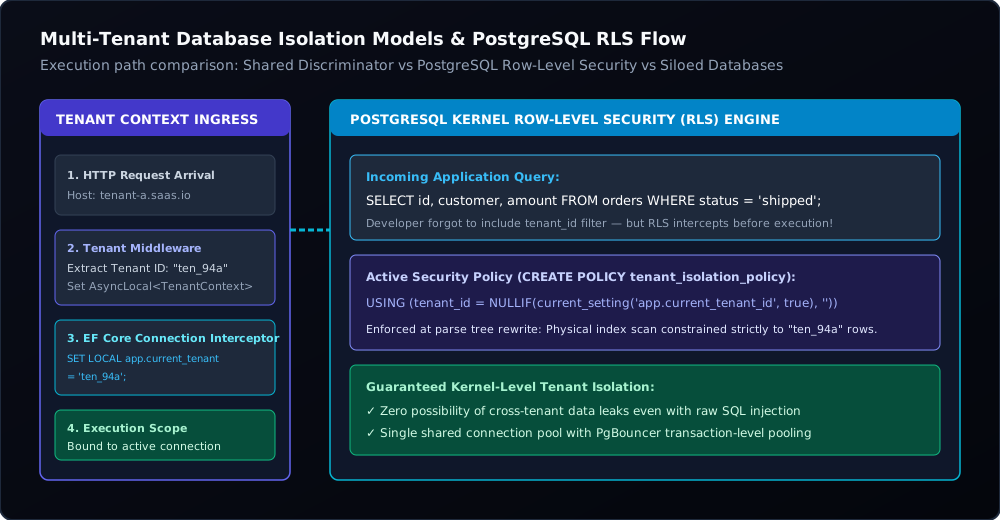
In 2026, the gold standard for high-density, enterprise-grade multi-tenancy pairs PostgreSQL Row-Level Security (RLS) with ASP.NET Core 9 and Entity Framework Core. By pushing tenant boundaries down into the database kernel itself via session variables, platforms achieve the cost efficiency of shared pooling with the ironclad data boundaries of physical silo databases.
In this masterclass, we dissect the three fundamental tenancy patterns, build a production-ready PostgreSQL RLS engine with transaction-scoped configuration, implement defense-in-depth connection interceptors in EF Core, resolve connection pooling deadlocks with PgBouncer, and tame noisy neighbors with adaptive concurrency budgets.
---1. The Three Tenancy Models: Architectural Trade-Offs
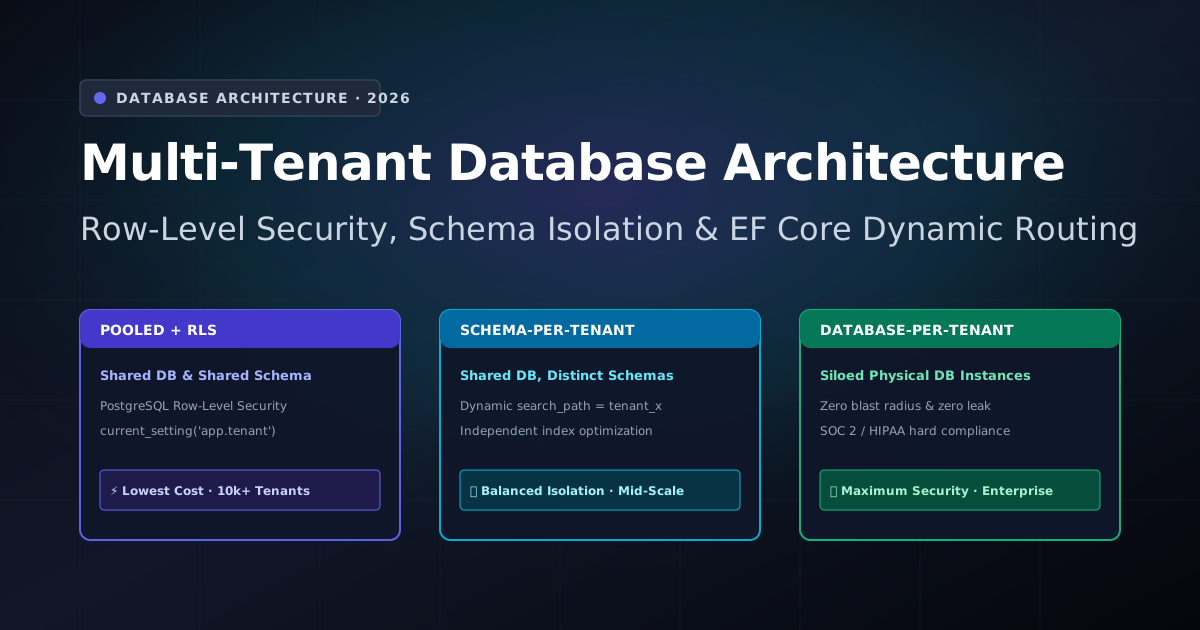
Before writing a single line of SQL or C#, platform architects must evaluate where tenant boundaries should physically live. The industry organizes multi-tenancy into three primary topologies:
| Architectural Model | Data Isolation Boundary | Infrastructure Cost per Tenant | Schema Migration Complexity | Target Scale / Workload |
|---|---|---|---|---|
| 1. Database-per-Tenant (Silo) | Physical OS file & DBMS process isolation | High ($$$) (Requires idle RAM/vCPU per tenant) | High (Must run migrations sequentially on thousands of DBs) | B2B Enterprise, Government, Strict HIPAA/PCI compliance |
| 2. Schema-per-Tenant | Logical schema separation within shared DB (search_path) |
Moderate ($$) (Shared buffer cache, separate table catalogs) | Moderate (Postgres catalog bloat beyond 1,500 schemas) | Mid-market SaaS with customizable tenant extensions |
| 3. Pooled DB with RLS | Kernel-level row security on shared tables | Lowest ($) (Maximum hardware utilization, unified pool) | Lowest (Single global DDL migration deployment) | High-density SaaS, 10,000+ tenants, cost-conscious scale |
2. Deep-Dive: PostgreSQL Kernel Row-Level Security (RLS)
The fundamental flaw of traditional shared databases is that data isolation lives exclusively in the application layer. If an engineer forgets a WHERE tenant_id = @id clause or writes an un-scoped join, the database happily returns records belonging to other companies. PostgreSQL Row-Level Security (RLS) eliminates this failure mode by moving the filter into the query planner rewrite phase inside the database engine.
The Session Setting Pattern
In PostgreSQL, you define an RLS security policy that dynamically inspects a transaction-scoped runtime variable: current_setting('app.current_tenant_id', true). Here is the exact production DDL:
-- 1. Create base business table with tenant discriminator
CREATE TABLE orders (
    id UUID PRIMARY KEY DEFAULT gen_random_uuid(),
    tenant_id VARCHAR(64) NOT NULL,
    customer_name TEXT NOT NULL,
    total_amount NUMERIC(12, 2) NOT NULL,
    created_at TIMESTAMPTZ NOT NULL DEFAULT NOW()
);

-- Critical: Create composite index starting with tenant_id for high-speed index scans
CREATE INDEX idx_orders_tenant_lookup ON orders (tenant_id, created_at DESC);

-- 2. Enable Row-Level Security on the table
ALTER TABLE orders ENABLE ROW LEVEL SECURITY;

-- 3. Force RLS even for table owners (prevents bypasses by app DB users)
ALTER TABLE orders FORCE ROW LEVEL SECURITY;

-- 4. Define declarative security policy for all DML operations
CREATE POLICY tenant_isolation_policy ON orders
    AS RESTRICTIVE
    FOR ALL
    TO application_role
    USING (tenant_id = NULLIF(current_setting('app.current_tenant_id', true), ''))
    WITH CHECK (tenant_id = NULLIF(current_setting('app.current_tenant_id', true), ''));
Notice the SET LOCAL mechanic. When your backend application acquires a connection from the pool, it runs:
SET LOCAL app.current_tenant_id = 'tenant_9984';Because the setting is flagged LOCAL, it is strictly bound to the current database transaction. When the transaction commits or rolls back, PostgreSQL automatically purges the variable. Even if a malicious actor injects SELECT * FROM orders;, the PostgreSQL query engine rewrites the query tree into SELECT * FROM orders WHERE tenant_id = 'tenant_9984' before reading a single block from disk.
3. ASP.NET Core 9 & EF Core Implementation
To integrate this pattern cleanly without polluting application code, we construct a Tenant Context Middleware paired with an EF Core DbConnectionInterceptor.
1. Tenant Resolution Middleware
public sealed class TenantContext
{
    public string TenantId { get; set; } = string.Empty;
}

public static class TenantContextAccessor
{
    private static readonly AsyncLocal<TenantContext?> _current = new();
    public static TenantContext? Current => _current.Value;
    public static void Set(TenantContext context) => _current.Value = context;
}

public sealed class TenantResolutionMiddleware
{
    private readonly RequestDelegate _next;

    public TenantResolutionMiddleware(RequestDelegate next) => _next = next;

    public async Task InvokeAsync(HttpContext context)
    {
        // Extract tenant identifier from Subdomain or JWT claims
        string tenantId = ResolveTenantFromHost(context.Request.Host.Host)
            ?? context.User.FindFirst("tenant_id")?.Value
            ?? throw new UnauthorizedAccessException("Tenant context is missing or invalid.");

        TenantContextAccessor.Set(new TenantContext { TenantId = tenantId });

        await _next(context);
    }

    private static string? ResolveTenantFromHost(string host)
    {
        var parts = host.Split('.');
        return parts.Length >= 3 ? parts[0].ToLowerInvariant() : null;
    }
}
2. EF Core Database Connection Interceptor
Whenever EF Core begins a transaction or executes a command, this interceptor injects the PostgreSQL SET LOCAL statement into the connection:
public sealed class PostgresRlsConnectionInterceptor : DbConnectionInterceptor
{
    public override async ValueTask<InterceptionResult> ConnectionOpenedAsync(
        DbConnection connection,
        ConnectionEndEventData eventData,
        InterceptionResult result,
        CancellationToken cancellationToken = default)
    {
        var tenant = TenantContextAccessor.Current;
        if (tenant != null && !string.IsNullOrWhiteSpace(tenant.TenantId))
        {
            await using var cmd = connection.CreateCommand();
            cmd.CommandText = "SET LOCAL app.current_tenant_id = @tenantId;";
            var param = cmd.CreateParameter();
            param.ParameterName = "@tenantId";
            param.Value = tenant.TenantId;
            cmd.Parameters.Add(param);
            await cmd.ExecuteNonQueryAsync(cancellationToken);
        }

        return await base.ConnectionOpenedAsync(connection, eventData, result, cancellationToken);
    }
}4. Taming the Noisy Neighbor Problem
In a pooled multi-tenant architecture, one hyperactive customer running massive bulk exports can saturate database connection pools and CPU cores, degrading performance for all other tenants. Solving this requires three architectural pillars:
- Tenant Token-Bucket Rate Limiting: Enforce sliding-window request limits at your API gateway using Redis. Tenants attempting more than their allocated tier (e.g., 500 req/sec for Starter, 5,000 req/sec for Enterprise) receive HTTP 429 Too Many Requests.
- Read Replica Segregation: Route analytical reports and heavy background data syncs to a read-only replica via separate EF Core connection strings, protecting the write primary from locking contention.
- PgBouncer Transaction Pooling: Never use session-level pooling with thousands of tenants. Use PgBouncer in Transaction Pooling mode. Because our
SET LOCALvariables reset automatically at transaction commit, tens of thousands of active tenants can safely share 50 physical PostgreSQL connections without data cross-talk.
5. Architectural Checklist for Enterprise Multi-Tenancy
- Always pair RLS with EF Core Global Query Filters: Implement
HasQueryFilter(e => e.TenantId == currentTenant)in EF Core as an application-level defense-in-depth backup to RLS. - Index on (tenant_id, ...): Every composite primary key or lookup index must lead with
tenant_idto allow the B-Tree index to perform fast index seeks rather than full table scans. - Automate Tenant Deprovisioning: For GDPR compliance, implement asynchronous deletion workers that purge tenant records by tenant ID with batch chunking to avoid transaction log exhaustion.
- Audit Tenant Access: Log every query execution with the tenant identifier in structured Serilog metadata for real-time compliance alerting.