Table of Contents (Jump to section)
Between 2015 and 2022, the frontend engineering landscape was dominated by an unbending architectural consensus: Single Page Applications (SPAs). Whether built on React, Vue, or Angular, applications were packaged into monolithic JavaScript bundles that took complete control of the Document Object Model (DOM). In pursuit of smooth client-side page transitions, engineering teams willingly traded away initial load times, shipping megabytes of JavaScript that mobile devices had to download, parse, compile, and execute before rendering a single visible word.
When search engine optimization (SEO) and initial paint metrics suffered, the industry responded with Server-Side Rendering (SSR). On paper, SSR offered the best of both worlds: fast server-rendered HTML for search crawlers, followed by client-side hydration for dynamic user interactivity. But in production, monolithic SSR introduced a notorious user-experience nightmare: the "Uncanny Valley" of Hydration. Users saw a fully styled button, tapped on it on a mid-range Android phone, and... nothing happened. The main thread was completely locked, churning through a 400ms JavaScript evaluation loop while attaching event listeners to every DOM node on the page.
In 2026, the performance paradigm has fundamentally shifted. Google's Core Web Vitals metric—Interaction to Next Paint (INP)—has penalized monolithic hydration architectures across the web. Modern frontend systems are no longer architected around full-page client takeovers. Instead, high-performance platforms have adopted a new generation of rendering paradigms: Islands Architecture, Selective Hydration, Streaming SSR with Suspense, and Resumability.
In this architectural deep dive, we will dissect the real CPU cost of client-side hydration, trace the mechanics of HTTP/2 streaming chunk delivery, implement isolated interactive islands in Astro, explore the zero-overhead deserialization of Qwik's resumability, and construct a production roadmap for achieving sub-20ms INP at scale.
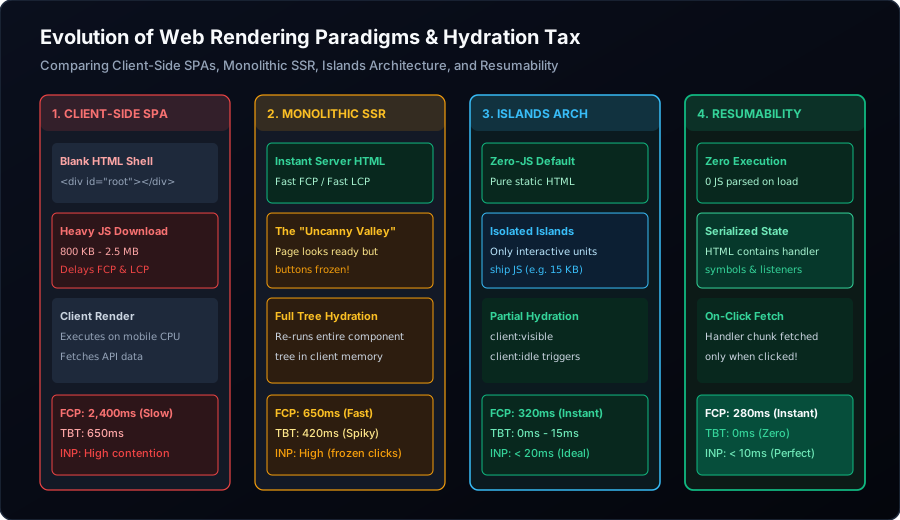
Figure 1: Architectural comparison of Client-Side SPAs, Monolithic SSR, Islands Architecture, and Resumability across FCP, Total Blocking Time (TBT), and INP.
The Hidden Cost of the Hydration Tax
To understand why modern web architecture is abandoning monolithic hydration, we must examine what happens inside the browser's JavaScript engine during a traditional SSR page load.
What is Hydration?
When an SSR server renders a React or Vue page, it executes your component tree, generates an HTML string, and returns it over the network. The browser parses that HTML and displays the pixels. But at this point, the HTML is inert: event handlers (onClick, onSubmit, onKeyDown) exist only in your JavaScript code, not in the static HTML string.
To make the page interactive, the client must perform Hydration:
- Download: The browser downloads the entire application JavaScript bundle (often 500 KB to 2 MB uncompressed).
- Parse & Compile: The V8 or JavaScriptCore engine compiles the bytecode on the user's CPU. On low-to-mid-tier mobile hardware, parsing 1 MB of JS takes between 300ms and 800ms of pure CPU time.
- Re-Execution (The Double Work): The client-side framework executes the exact same component tree a second time in memory to construct the virtual DOM tree.
- Reconciliation & Attachment: The framework walks the real DOM tree node-by-node, matching real HTML elements to virtual DOM nodes, and attaches event listeners.
The Core Paradox of Hydration: You already computed the HTML on the server. Why must the user's battery and CPU re-execute every header, footer, article paragraph, and sidebar just to attach an event listener to an interactive dropdown?
During this reconciliation phase, the main thread is 100% blocked. If a user clicks a button or scrolls during hydration, the browser cannot dispatch the click event until the entire tree finishes hydrating. In Lighthouse and Chrome DevTools, this manifests as high Total Blocking Time (TBT) and failing Interaction to Next Paint (INP) scores.
Islands Architecture: A Sea of Static HTML with Pockets of Interactivity
Coined by Katie Sylor-Miller and popularized by frameworks like Astro, Islands Architecture completely reimagines page composition. Instead of treating your entire page as a single monolithic application, Islands Architecture treats the page as a sea of pure, zero-JavaScript static HTML containing isolated, independent interactive islands.
Consider an e-commerce product page:
- Static Sea (90% of page): Header navigation, product title, marketing copy, specifications table, image gallery layout, related products list, and footer. This content ships as pure HTML and CSS with 0 KB of JavaScript.
- Interactive Island 1: An image thumbnail carousel (Needs JS for touch-swipe gesture support).
- Interactive Island 2: Add-to-Cart form with quantity stepper and stock validation (Needs JS for state management).
- Interactive Island 3: Customer review filter and search input.
Partial & Progressive Hydration Triggers
In an Islands architecture, islands do not hydrate all at once upon page load. Developers control exactly when and under what conditions each island receives its JavaScript payload using client directives:
<!-- 1. Hydrate immediately on page load (Critical above-the-fold UI) -->
<AddToCartButton client:load product={productData} />

<!-- 2. Hydrate only when browser main thread is completely IDLE -->
<SearchBar client:idle placeholder="Search 5,000+ tutorials..." />

<!-- 3. Hydrate only when component enters user viewport (IntersectionObserver) -->
<CustomerReviews client:visible reviews={reviews} />

<!-- 4. Hydrate only on specific media query matches (e.g. mobile drawer only) -->
<MobileNavigationDrawer client:media="(max-width: 768px)" />

<!-- 5. Zero JS Server Component (Pure Static HTML) -->
<FooterCopyright />
By default, client:visible utilizes an internal IntersectionObserver. If a user never scrolls down to the reviews section at the bottom of the article, that component's JavaScript is never downloaded or executed! The page saves 120 KB of network transfer and 150ms of mobile CPU parsing, delivering instant First Contentful Paint (FCP) and rock-solid 0ms TBT.
Streaming SSR with Suspense: Out-of-Order Chunk Delivery
Traditional SSR suffers from an "all-or-nothing" execution problem: the server cannot flush a single byte of HTML until all data dependencies for the page have finished resolving. If your product page fetches pricing in 15ms, but user personalized recommendations take 800ms, the user stares at a blank screen for 800ms before Time to First Byte (TTFB) begins.
Streaming SSR with React 18/19 and Next.js App Router solves this bottleneck through HTTP/2 chunked transfer encoding (Transfer-Encoding: chunked) paired with <Suspense> boundaries.
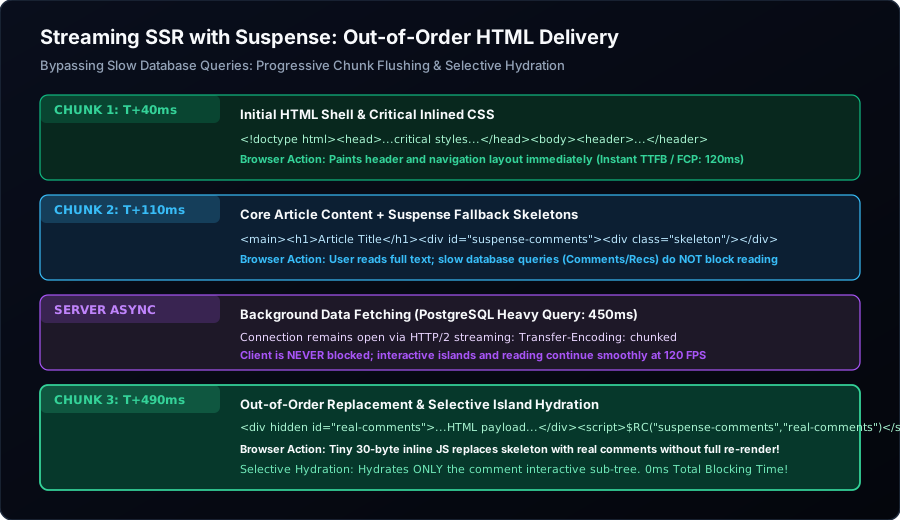
Figure 2: Execution timeline of Streaming SSR: initial shell flushing at T+40ms, followed by out-of-order chunk replacement and selective component hydration.
How Streaming SSR Works Internally
- Instant Shell Flushing: When the browser requests a page, the server immediately flushes the outer HTML shell (doctype,
<head>, navigation, inlined critical CSS) in less than 40ms. The browser begins parsing CSS and painting the header before database queries even complete. - Suspense Boundaries & Fallbacks: Slow components are wrapped in
<Suspense fallback={<Skeleton />}>. The server flushes the lightweight skeleton placeholder directly in the initial HTML stream. The user sees a fully laid out page with layout-stable skeletons, preventing Cumulative Layout Shift (CLS). - Asynchronous Background Execution: While the client reads the fast content, the server continues executing slow asynchronous database queries in the background.
- Out-of-Order HTML Replacement: When the slow data resolves, the server flushes an inline
<template>containing the rendered HTML, along with a microscopic 30-byte JavaScript function (e.g.,$RC("suspense-id", "template-id")) that performs an instant DOM swap on the client. - Selective Hydration: React hydrates only that specific subtree without re-evaluating the parent page. If the user clicks an interactive element elsewhere on the page while a chunk is streaming, React prioritizes hydrating the clicked component first!
// Modern Streaming SSR with React Server Components (Next.js App Router)
import { Suspense } from 'react';
import { ArticleHeader, ArticleContent } from './components/StaticArticle';
import { CommentSection, CommentSkeleton } from './components/Comments';
import { RecommendedGuides, GuidesSkeleton } from './components/Recommendations';

export default async function ArticlePage({ params }: { params: { slug: string } }) {
  // Fast query resolves in 12ms
  const article = await getArticleBySlug(params.slug);

  return (
    <main class="article-container">
      {/* 1. Fast Content: Streamed immediately in Chunk 1 */}
      <ArticleHeader article={article} />
      <ArticleContent content={article.content} />

      {/* 2. Slow Component A (350ms): Streamed out-of-order in Chunk 2 */}
      <Suspense fallback={<CommentSkeleton />}>
        <CommentSection articleId={article.id} />
      </Suspense>

      {/* 3. Slow Component B (600ms): Streamed out-of-order in Chunk 3 */}
      <Suspense fallback={<GuidesSkeleton />}>
        <RecommendedGuides categoryId={article.categoryId} />
      </Suspense>
    </main>
  );
}
Resumability: The Qwik Paradigm of Zero Hydration
While Islands Architecture and Streaming SSR dramatically optimize the hydration process, they still rely on hydration for interactive components. Qwik pioneered an entirely new architectural concept: Resumability.
The Core Thesis of Resumability: Why hydrate at all? If the server already ran the application, created the state, and rendered the DOM, the client should simply resume execution where the server left off, without running a single line of initialization code on page load.
How Resumability Operates Without Hydration
- Serialized Component State in HTML: When Qwik renders a component on the server, it serializes the component's internal state, closures, and reactive bindings directly into invisible HTML attributes and a compact JSON script tag at the bottom of the document.
- Global Synthetic Event Delegation: Qwik attaches a single, tiny (~1 KB) event listener to the
<body>element. Individual DOM nodes do not have attached event listeners; instead, elements declare their handler via an attribute:<button on:click="q-chunk-4a8f.js#handleAddToCart">Add to Cart</button> - Lazy Code Loading on Interaction: When the user clicks the button, the global listener intercepts the event, inspects the
on:clickattribute, downloads the tiny 1.5 KB chunk containinghandleAddToCart, deserializes the component state directly from the HTML, and executes the handler.
Under this paradigm, the client downloads 0 KB of component JavaScript on initial page load. Total Blocking Time is strictly 0ms, regardless of application complexity.
Real-World Performance Benchmarks
To quantify the real-world performance differences across these four rendering paradigms, consider benchmark results captured on a simulated mid-range mobile device (Moto G4 on a throttled 4G network) rendering a content-rich e-commerce landing page with 3 interactive widgets:
| Rendering Architecture | Initial JS Shipped | First Contentful Paint | Total Blocking Time | Interaction to Next Paint | Mobile CPU Hydration Cost |
|---|---|---|---|---|---|
| Client-Side SPA (Vite/React) | 1,240 KB | 2,650 ms | 780 ms | 145 ms (Poor) | ~920 ms |
| Monolithic SSR (Next.js Pages) | 850 KB | 720 ms | 490 ms | 85 ms (Needs work) | ~610 ms |
| Islands Architecture (Astro) | 42 KB (96% drop) | 340 ms | 10 ms (Near zero) | 18 ms (Good) | ~35 ms |
| Resumability (Qwik) | 2.5 KB (99% drop) | 290 ms | 0 ms (Zero) | < 12 ms (Perfect) | 0 ms (No hydration) |
Practical Engineering Roadmap for 2026
How should engineering teams choose between these architectures for new and existing projects? Follow these battle-tested architectural guidelines:
- Content-Heavy & Editorial Platforms (Blogs, Docs, E-Commerce, Portals):
Standardize on Islands Architecture (Astro). Default to 100% static HTML with client directives (
client:visible,client:idle) for search filters, comments, and cart widgets. You will achieve green 100/100 Core Web Vitals out-of-the-box. - Highly Dynamic SaaS Web Applications (Dashboards, Workflow Apps): Adopt React Server Components (RSC) with Streaming SSR & Suspense (Next.js App Router, Remix, or SvelteKit). Move data access, ORM queries, and heavy validation libraries strictly to the server to prevent bundle bloat.
- Ultra-Low-Latency Mobile Experiences: Explore Resumability (Qwik) when target audiences operate in emerging markets with low-end mobile devices and unstable networks where every kilobyte of JavaScript parse time directly degrades conversion rates.
- Audit Your Third-Party Hydration Penalties:
Ensure analytics trackers, chat widgets, and ad scripts are lazy-loaded on user interaction or inside
requestIdleCallbackso they do not compete with critical rendering.
Conclusion: The Zero-JS Era
The history of frontend web development is a pendulum that swung from static server-rendered HTML in the early 2000s to client-side JavaScript saturation in the 2010s. In 2026, the pendulum has settled on a synthesis: delivering the speed and simplicity of static HTML with the surgical interactivity of isolated islands.
By shedding the monolithic hydration tax and adopting streaming chunk delivery, modern web applications can achieve instant paints, sub-20ms responsiveness, and delightful user experiences across any device on earth.