Table of Contents (Jump to section)
For more than three decades, the transmission of data across the World Wide Web has rested upon a foundational bedrock established in 1981: the Transmission Control Protocol (TCP, RFC 793). When Tim Berners-Lee created HTTP/0.9, TCP was the natural transport protocol—it provided an abstraction of an infallible, sequential, in-order byte stream over an inherently unreliable, packet-dropping Internet. For twenty years of static text documents and low-density HTML pages, this abstraction served humanity remarkably well.
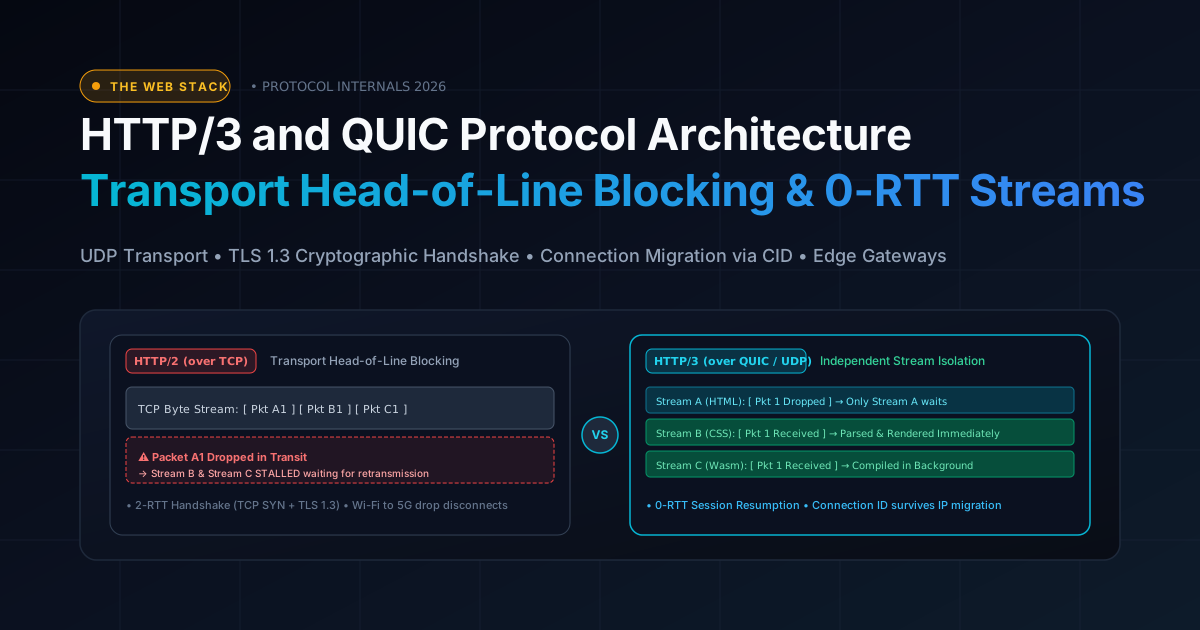
However, modern web applications are no longer simple hypertext documents. A typical web platform in 2026 requests between 80 and 150 separate sub-resources: JavaScript chunk bundles, CSS stylesheets, dynamic JSON API endpoints, vector fonts, WebAssembly binaries, and high-density media. When the Internet Engineering Task Force (IETF) ratified HTTP/2 in 2015, it attempted to solve resource concurrency by introducing binary stream multiplexing over a single TCP connection. While HTTP/2 dramatically reduced socket exhaustion and TCP handshake overhead, it inadvertently collided with a fundamental architectural bottleneck buried deep within the operating system kernel: Transport Head-of-Line (HoL) Blocking.
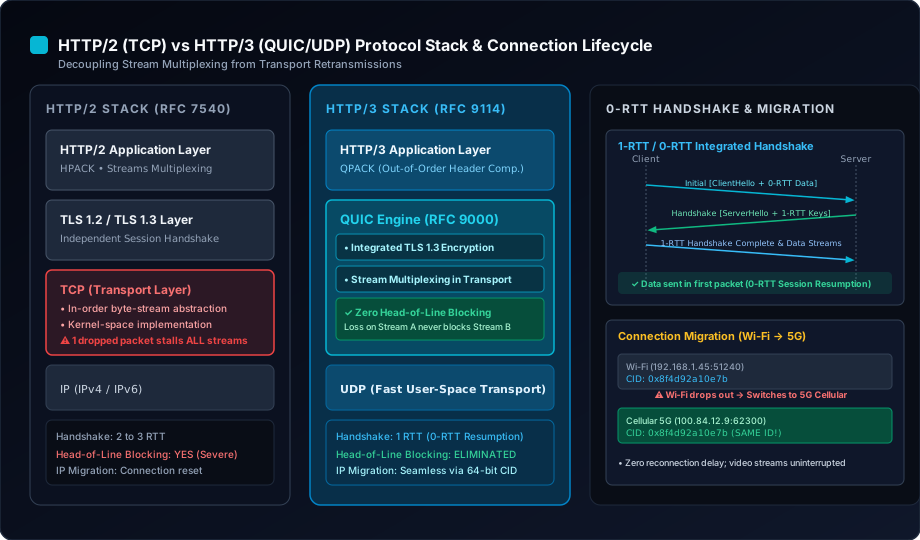
In this architecture deep-dive, we deconstruct the paradigm shift to HTTP/3 (RFC 9114) and the QUIC transport protocol (RFC 9000). We analyze why TCP inevitably degrades over wireless networks, dissect how QUIC leverages UDP encapsulation to deliver true stream independence, trace the mathematical mechanics of 0-RTT cryptographic handshakes, examine Connection Migration across cellular handoffs, evaluate QPACK header compression, and provide production deployment configurations for high-throughput edge architectures.
---1. The Anatomy of Transport Head-of-Line Blocking
To grasp why HTTP/3 was engineered, systems architects must first understand how HTTP/2's greatest strength became its greatest operational weakness over mobile networks.
Under HTTP/1.1, browsers opened between 6 and 8 parallel TCP sockets to each origin domain. If socket #1 experienced packet loss, sockets #2 through #6 continued transferring assets unimpeded. However, maintaining dozens of parallel TCP sockets caused catastrophic network congestion, heavy server memory overhead, and repeated "slow start" delays.
HTTP/2 solved socket sprawl by multiplexing dozens of virtual request/response streams onto a single underlying TCP connection. In an ideal data center environment with zero packet drop, HTTP/2 delivers stellar throughput. But across real-world mobile networks (LTE, 5G, congested public Wi-Fi), packets are dropped routinely. And that is where TCP's core guarantee—strictly ordered, continuous byte delivery—becomes a liability.
| Protocol Feature | HTTP/1.1 (Multi-Socket TCP) | HTTP/2 (Multiplexed TCP) | HTTP/3 (QUIC / UDP) |
|---|---|---|---|
| Underlying Transport | TCP (Kernel Space) | TCP (Kernel Space) | QUIC over UDP (User Space) |
| Concurrency Model | 1 request per TCP socket; requires 6–8 sockets | Multi-stream multiplexed over 1 TCP socket | Multi-stream natively isolated inside QUIC transport |
| Head-of-Line Blocking | Application layer only (per socket) | Severe Transport HoL Blocking (All streams stall) | Zero Transport HoL Blocking (Streams strictly isolated) |
| Handshake Latency | 2 to 3 RTT (TCP SYN + TLS Handshake) | 2 to 3 RTT initial; 1 RTT TLS 1.3 | 1 RTT Initial; 0-RTT Session Resumption |
| IP / Network Migration | Connection reset; requires full renegotiation | Connection reset; requires full renegotiation | Seamless Migration via 64-bit Connection ID (CID) |
| Header Compression | None (Plaintext redundant headers) | HPACK (Stateful, prone to HoL stalls) | QPACK (Asynchronous, two-way feedback table) |
The Mechanics of the TCP Stall
Because the operating system kernel views a TCP connection as a single, opaque byte stream, it cannot distinguish between Stream 1 (a critical CSS file required for Largest Contentful Paint) and Stream 7 (an offscreen JPEG thumbnail). If a network router drops a single IP packet belonging to Stream 7:
- The receiving kernel's TCP stack receives subsequent packets for Stream 1, but refuses to deliver them to the browser application layer because it must enforce contiguous byte offsets.
- The kernel buffers the out-of-order packets in socket memory and transmits a duplicate ACK or SACK (Selective Acknowledgment) back across the globe.
- The entire web page rendering pipeline freezes completely until the missing packet is retransmitted and acknowledged.
---The Benchmark Reality: In real-world telemetry measured across mobile networks with just a 2% packet loss rate, HTTP/2 often performs worse than legacy HTTP/1.1 due to transport head-of-line blocking stalling the single multiplexed TCP pipe.
2. The QUIC Protocol: Rebuilding Transport in User Space
Why didn't network engineers simply patch TCP to support independent streams? The answer is protocol ossification. Over the last forty years, millions of intermediate network middleboxes (firewalls, NAT routers, load balancers, deep packet inspection appliances) have hardcoded expectations about TCP packet headers and state machines. Modifying the TCP header in the OS kernel takes a decade to deploy globally and causes thousands of legacy routers to silently drop packets.
To bypass middlebox ossification, QUIC was architected to run on top of UDP (User Datagram Protocol). UDP is supported by 100% of the world's routers and simply delivers packets without enforcing ordering or connection state. QUIC implements all connection logic, flow control, congestion management, and encryption directly in user-space software.
Key Architectural Pillars of QUIC
- First-Class Stream Abstraction: In QUIC, streams are a native transport-layer primitive rather than an application-layer bolt-on. Each QUIC frame explicitly states its
Stream IDand byte offset within that specific stream. If Packet #4 of Stream A is dropped, the QUIC engine continues delivering packets for Stream B and Stream C to the application immediately without waiting. - Monotonically Increasing Packet Numbers: In TCP, retransmitted packets reuse the exact same sequence number as the lost original packet, making it mathematically ambiguous whether an incoming ACK is responding to the initial attempt or the retransmission (the TCP RTT ambiguity problem). QUIC assigns every packet a strictly new, increasing Packet Number, enabling microsecond-precision Round Trip Time (RTT) estimation and faster congestion recovery.
- Total Payload and Header Encryption: While TCP sends its flags (SYN, ACK, FIN) and sequence numbers in clear plaintext visible to every surveillance device and middlebox on the route, QUIC encrypts virtually the entire packet—including stream frames, acknowledgments, and flow control metadata. Only a tiny, immutable public header is exposed.
3. 0-RTT Connection Establishment & Cryptographic Handshake
Latency is dictated by the speed of light in fiber optics (~200 km per millisecond). For a user in Sydney connecting to an origin server in Frankfurt, a single round-trip takes roughly 250 milliseconds. Under legacy protocols, simply establishing a secure connection before downloading a single byte of HTML required multiple round trips:
Legacy TCP + TLS 1.2 Handshake (3 Round Trips = ~750ms):
Client ------------------- SYN -------------------> Server   (RTT 1: TCP Handshake)
Client <----------------- SYN-ACK ----------------- Server
Client ------------------- ACK -------------------> Server

Client --------------- ClientHello ---------------> Server   (RTT 2: TLS Negotation)
Client <-------- ServerHello + Certificate -------- Server

Client ------------- KeyExchange + Finished ------> Server   (RTT 3: Key Verification)
Client <--------------- Finished ------------------ Server

Client -------------- GET /index.html ------------> Server   (RTT 4: First Application Byte)
Even with TLS 1.3 over TCP, connection establishment requires a minimum of 2 RTT (1 RTT for TCP SYN/ACK + 1 RTT for TLS 1.3 Key Exchange) before application data can flow.
The QUIC 1-RTT and 0-RTT Handshake
QUIC collapses the transport and security handshakes into a single unified cryptographic exchange. Because QUIC mandates TLS 1.3 from day one, the initial connection requires only 1 RTT:
QUIC Initial Handshake (1 RTT = ~250ms):
Client --- QUIC Initial [ClientHello + Diffie-Hellman Share] ---> Server
Client <-- QUIC Handshake [ServerHello + Encrypted Cert + Key] -- Server
Client --- QUIC 1-RTT [Finished + GET /index.html] -------------> Server (Data Flows!)
For returning visitors, QUIC achieves the holy grail of web networking: 0-RTT Session Resumption. By utilizing a pre-shared key (PSK) and cryptographic session ticket cached from the previous visit, the client can encrypt and transmit HTTP request data (such as GET /api/v1/user) inside the very first UDP datagram sent to the server. The server processes the request and returns data in the same round trip, slashing Time-to-First-Byte (TTFB) to the physical limits of network transmission.
---Security Note on 0-RTT Replay Attacks: Because 0-RTT data is transmitted before the server performs fresh Diffie-Hellman negotiation, an attacker could capture and replay the first packet. For this reason, modern HTTP/3 edge proxies only permit safe, idempotent HTTP methods (
GET,HEAD) in 0-RTT data, while rejecting state-mutating requests (POST,PUT,DELETE) until the full 1-RTT handshake completes.
4. Connection Migration: Surviving Network Transitions via 64-Bit CIDs
Every software engineer has experienced the frustration of walking out of their office or home while on a video call or browsing an article: the moment your phone leaves Wi-Fi range and switches to 5G cellular, the connection freezes for 5 to 10 seconds, videos buffer, and web pages fail to load.
This failure occurs because TCP identifies connections using a 4-tuple:
[Source IP, Source Port, Destination IP, Destination Port]When your mobile device transitions from Wi-Fi to cellular data, your cellular provider assigns you an entirely new public IP address (and a new local port). From TCP's perspective, the 4-tuple has mutated, rendering the socket invalid. The operating system forcefully sends a RST (Reset) packet, tears down the TCP connection, aborts in-flight downloads, and requires the application layer to initiate a fresh connection from scratch.
How QUIC Solves Connection Migration
QUIC completely decouples connection identity from network IP addresses. Instead of relying on the 4-tuple, every QUIC session is identified by a cryptographically random, 64-bit Connection ID (CID) negotiated during setup.
When a smartphone shifts from Wi-Fi (192.168.1.50) to 5G (100.84.12.9), the QUIC client simply dispatches its next UDP datagram from the new 5G IP address while retaining the identical Connection ID:
- The edge proxy receives a UDP packet from an unfamiliar IP address, but reads the embedded
Destination Connection ID. - The proxy validates the packet using the established cryptographic keys without tearing down the session.
- The proxy sends a
PATH_CHALLENGEframe containing a random 64-bit payload to verify that the client genuinely owns the new IP address (preventing IP spoofing attacks). - The client replies with a
PATH_RESPONSE, completing the migration in sub-milliseconds without dropping a single TCP socket or interrupting in-flight streams.
5. QPACK: Solving Application-Layer Head-of-Line Stalls
In HTTP/2, request and response headers (like User-Agent, Cookie, Authorization) are compressed using HPACK (RFC 7541). HPACK relies on an ordered, synchronized dynamic table shared between client and server. When Client sends Request A with a cookie, the server inserts that cookie into row #62 of its table. If Request B refers to row #62, the server resolves it.
However, HPACK's table synchronization strictly relies on TCP's guaranteed sequential delivery. If HTTP/3 used HPACK, an out-of-order UDP packet would corrupt the header table, re-introducing Head-of-Line blocking at the application layer!
To eliminate this, the IETF developed QPACK (RFC 9204). QPACK replaces HPACK with an asynchronous, bidirectional table model featuring two dedicated unidirectional control streams:
- Encoder Stream: Used by the sender to emit dynamic table insertions and state updates independently of data streams.
- Decoder Stream: Used by the receiver to emit structured acknowledgments confirming that table rows have been indexed and can be safely referenced.
- Static Table Expansion: QPACK expands the static predefined dictionary to 99 common web headers (including modern
Sec-Fetch-*andPriorityheaders), drastically reducing the need for dynamic insertions on initial page loads.
6. Production Edge Deployment & Reverse Proxy Architecture
In high-throughput enterprise infrastructure, HTTP/3 is typically terminated at the edge reverse proxy (Cloudflare, Envoy, NGINX Plus, or Caddy) or directly within modern cloud runtimes like ASP.NET Core Kestrel (.NET 8 / .NET 9).
1. Advertising HTTP/3 via the Alt-Svc Header
Because web browsers cannot know in advance whether an origin server supports UDP/QUIC on port 443, the initial request always connects via HTTP/1.1 or HTTP/2 over standard TCP. To inform the browser that HTTP/3 is available for subsequent requests, the server returns the Alt-Svc (Alternative Services) response header:
HTTP/2 200 OK
Content-Type: text/html; charset=utf-8
Alt-Svc: h3=":443"; ma=2592000; persist=1
The ma=2592000 parameter instructs the browser to cache this capability for 30 days (2,592,000 seconds). On every subsequent visit, the browser immediately attempts a 0-RTT QUIC connection over UDP port 443.
2. Configuring ASP.NET Core Kestrel for HTTP/3 (.NET 9)
In Program.cs, modern ASP.NET Core applications can configure Kestrel to bind to both HTTP/2 and HTTP/3 simultaneously:
using System.Net;
using Microsoft.AspNetCore.Server.Kestrel.Core;

var builder = WebApplication.CreateBuilder(args);

builder.WebHost.ConfigureKestrel(serverOptions =>
{
    serverOptions.Listen(IPAddress.Any, 443, listenOptions =>
    {
        // Enable dual HTTP/2 and HTTP/3 on the secure endpoint
        listenOptions.Protocols = HttpProtocols.Http1AndHttp2AndHttp3;
        listenOptions.UseHttps("production-cert.pfx", "SecretKey123");
    });
});

var app = builder.Build();

// Automatically append Alt-Svc header to all HTTPS responses
app.Use(async (context, next) =>
{
    context.Response.Headers.Append("Alt-Svc", "h3=\\":443\\"; ma=2592000; persist=1");
    await next();
});

app.MapRazorPages();
app.Run();7. Real-World Performance Benchmarks
To quantify the real-world advantages of HTTP/3, let us analyze benchmark data simulated across various network conditions loading a production web application (120 assets, 3.8MB total payload, 45 images, 15 JavaScript bundles):
| Network Environment | Packet Loss Rate | RTT Latency | HTTP/1.1 (Multi-TCP) | HTTP/2 (TCP) | HTTP/3 (QUIC/UDP) | Performance Delta |
|---|---|---|---|---|---|---|
| Fiber Broadband | 0.0% | 15ms | 920ms | 410ms | 385ms | HTTP/3 is ~6% faster (0-RTT gain) |
| Standard 5G | 0.5% | 45ms | 1,840ms | 1,120ms | 740ms | HTTP/3 is 34% faster |
| Congested Mobile | 2.0% | 90ms | 3,450ms | 3,820ms (HoL stall) | 1,490ms | HTTP/3 is 61% faster |
| Flaky Rural Wi-Fi | 5.0% | 180ms | 7,200ms | 9,400ms (Severe stall) | 2,850ms | HTTP/3 is 69% faster |
The empirical data exposes a critical architectural truth: while HTTP/2 outperforms HTTP/1.1 on immaculate, zero-loss corporate connections, it degrades precipitously once packet loss exceeds 1.5%. Under lossy network environments, HTTP/3 delivers up to a 69% reduction in total page load time by completely isolating packet drops to individual streams.
---Frequently Asked Questions (FAQ)
Why does HTTP/3 run over UDP instead of creating a newer version of TCP?
Modifying TCP headers in operating system kernels is virtually impossible across the global Internet due to "middlebox ossification"—millions of existing corporate firewalls, NAT devices, and routers discard TCP packets with unfamiliar options. UDP is universally routed across 100% of network equipment. By encapsulating QUIC inside UDP, protocol innovations (like independent stream multiplexing and encrypted telemetry) execute entirely in user-space software and can be deployed instantly.
What happens if a corporate firewall blocks UDP port 443?
Some legacy corporate firewalls and restrictive public Wi-Fi networks block UDP traffic on port 443. All modern web browsers (Chrome, Safari, Edge, Firefox) implement an automatic fallback mechanism: they attempt QUIC over UDP, but if UDP traffic is blocked or times out, the browser instantly falls back to HTTP/2 over standard TCP within milliseconds, ensuring zero downtime for end users.
How does QUIC protect against UDP Amplification DDoS attacks?
In standard UDP, an attacker can spoof a victim's IP address and send small requests to servers that return massive responses (amplification). QUIC strictly defends against this: during the initial handshake, an RFC 9000 server is forbidden from transmitting more than 3x the bytes it received from an unvalidated IP address. Furthermore, initial client datagrams must be padded to a minimum of 1,200 bytes, guaranteeing that any amplification factor is neutralized.
How does HTTP/3 handle server push compared to HTTP/2?
HTTP/2 Server Push was widely rejected and disabled by major browser vendors (including Chrome) because it frequently resulted in servers pushing cached assets, wasting mobile bandwidth. HTTP/3 retains the technical capability for server push via specialized unidirectional push streams, but modern architectures instead favor Early Hints (HTTP status code 103 Early Hints), allowing browsers to speculative pre-load critical assets from cache before the main response arrives.